
Spianada Square and Liston
In the heart of Corfu Town, approximately 15 kilometers from Villa Kapella, lie two of the island’s most renowned landmarks: Spianada Square and the Liston. Spianada Square, the largest in Greece and the Balkans, serves as the central square of Corfu Town and ranks as the 27th largest in Europe, covering an area exceeding 40,000 square meters. Situated in front of the Old Fortress, it offers a vast open space that has become a focal point for both locals and visitors.
The creation of Spianada is closely linked to the Venetians’ efforts to bolster the island’s defenses. In 1576, they began demolishing buildings in front of the Old Fortress to improve visibility and strengthen their defensive position. This initiative resulted in a vast open area, which was later landscaped by the French, giving the square much of its present form. The name “Spianada” derives from the Italian verb “spianare,” meaning “to flatten,” reflecting its transformation into a leveled open space.
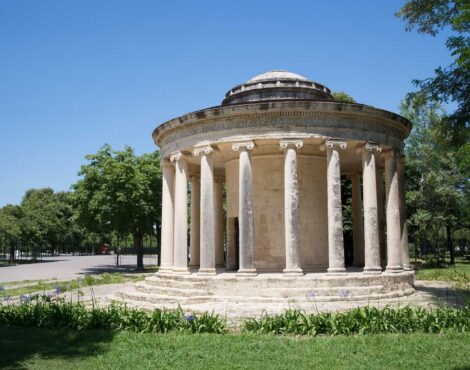
The square is divided into two sections: the Upper Square (Pano Plateia) and the Lower Square (Kato Plateia). The Lower Square lies opposite the imposing Liston and the beautiful Palace of Saints Michael and George. This area hosts cricket matches, a sport introduced during the British rule, and on weekdays, it’s common to see children playing and families strolling on the grass. The Upper Square is the more bustling part of Spianada, lush with numerous trees and plants, and serves as the venue for some of the island’s most significant events. At its center stands the Music Pavilion, known locally as the “Palko,” where the island’s philharmonic orchestras perform concerts, and the grand Resurrection ceremony takes place on Holy Saturday night. Nearby is the Maitland Monument, a peristyle of 20 Ionic columns designed by British General George Whitmore in 1817, originally functioning as a cistern collecting rainwater and now standing as a testament to the island’s rich past.
Adjacent to Spianada is the Liston, one of the most iconic and recognizable spots in Corfu Town, blending rich history, unique architecture, and vibrant social life. The construction of the Liston began during the French occupation of Corfu under Napoleon’s leadership in the early 19th century, specifically in 1807, and continued for several decades. The initiative aimed to beautify the town and create a space for promenades and social gatherings. The design of the Liston is attributed to the French diplomat Mathieu de Lesseps, with supervision by the Corfiot engineer Ioannis Parmezan. Its architecture is inspired by Paris’s famous Rue de Rivoli, reflecting the French influence on Corfu during that era.
The Liston comprises a series of multi-story buildings featuring characteristic arcades on the ground floor, which impart an elegant and harmonious rhythm to the structure. These arches, known locally as “volta,” are adorned with intricate Venetian lanterns, creating an atmosphere that combines French finesse with Venetian tradition. The term “Liston” is believed to derive from the Venetian word “lista” or “liston,” referring to straight and wide streets or squares, such as St. Mark’s Square in Venice. According to one interpretation, the name is associated with the list of nobles (Libro d’Oro) who had the exclusive right to walk in these areas, leading to the term “liston.”
Since its completion, the Liston has played a central role in Corfu’s social life. Its spaces house some of the town’s most renowned cafes and restaurants, making it a popular meeting point for locals and tourists alike. Here, visitors can enjoy their coffee or meal while observing daily life unfold before them and admiring the architecture and historical ambiance of the area. The Liston is also closely linked to Corfu’s cultural events. During Easter, the town’s philharmonic bands parade along the Liston, adding a festive and solemn tone to the area. Additionally, its proximity to Spianada makes it an ideal spot for watching various events, such as concerts, parades, and festivals, that take place in the square.
Both the Liston and Spianada are not merely two locations; they are symbols of the island’s identity and cultural heritage. Through their existence, history, and vibrant social activity, they manage to be among Corfu’s most beloved destinations. Whether you are a visitor discovering the island for the first time or have had the fortune to visit it again, the Liston and Spianada remain timeless landmarks, full of memories, beauty, and unparalleled charm.