Music in the Air
One of the most distinctive sounds of Corfu is not the waves against the shore or the rustling of olive trees, but the triumphant echo of brass instruments filling the streets. The island’s philharmonic bands are more than ensembles of musicians they are cultural institutions, guardians of tradition, and symbols of community pride. For visitors, hearing a Corfiot band march through a square is to witness a living heritage that connects the island to both its Venetian past and its modern identity.
Origins of the Philharmonic Tradition
The tradition of philharmonic bands in Corfu dates back to the 19th century during the period of the British Protectorate (1815–1864). Influenced by Western European musical models, the first organized bands were established as civic institutions, offering musical education and uplifting the community.
The Philharmonic Society of Corfu, founded in 1840, was the island’s first and became the cornerstone of this tradition. From there, dozens of bands were born in towns and villages across Corfu, each proudly carrying its own history, uniforms, and repertoire.
Music for the People
Unlike elite orchestras of major European capitals, Corfu’s bands were always meant for the people. They provided free education in music, especially to children from families who otherwise could not afford lessons. Generations of Corfiots learned to play instruments in these bands, turning music into a shared language across the island.
Key Values of the Bands:
- Accessibility to all social classes.
- Preservation of European classical music.
- Nurturing of local talent and creativity.
Role in Religious and Public Life
The philharmonic bands are inseparable from Corfu’s festive and spiritual rhythms:
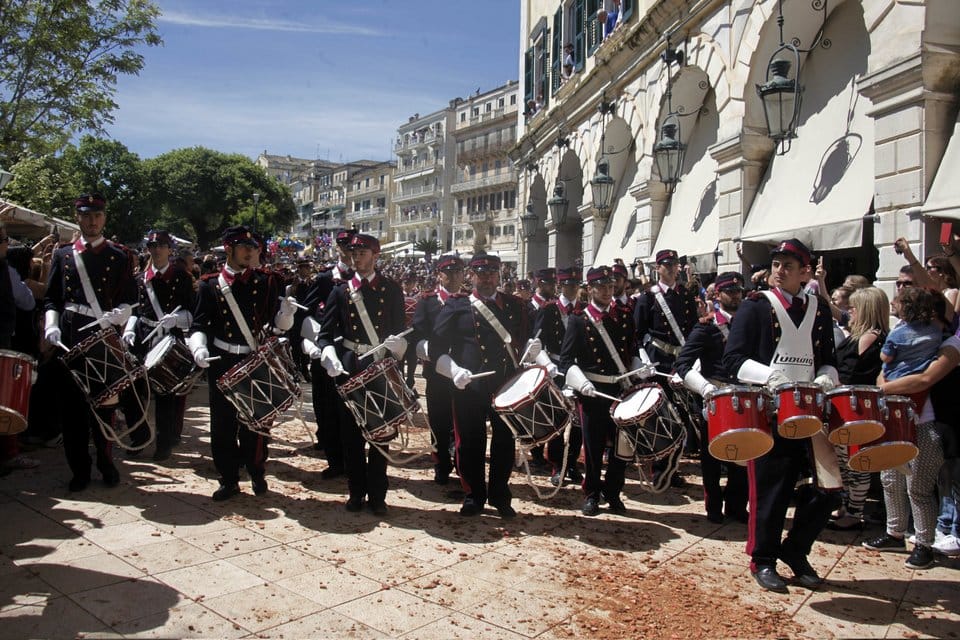
- Easter: The most famous celebration, where the bands accompany the litany of Saint Spyridon and the dramatic pot-smashing ritual on Holy Saturday. Their powerful renditions of Albinoni’s Adagio and Chopin’s funeral marches move both locals and visitors alike.
- Saint Spyridon Processions: Four times a year, the patron saint is honored, and the bands lead the solemn litanies through Corfu Town’s streets.
- National Holidays: Parades on March 25th and October 28th showcase the bands’ patriotic spirit.
- Village Feasts (Panigyria): Bands often play in local festivals, blending sacred and secular sounds.
Uniforms and Identity
The visual aspect is as important as the sound. Each philharmonic society has its own uniforms, often inspired by 19th-century European military attire. Red, blue, and green dominate, with shining brass buttons and feathered hats. The sight of a band marching in full regalia through Spianada Square is unforgettable, a blend of pageantry and pride.
Repertoire: From Classics to Cantades
Corfu’s bands perform an eclectic range of music:
- Classical pieces by Verdi, Mozart, and Beethoven.
- Funeral marches during Holy Week, especially Albinoni and Chopin.
- Folk songs and cantades, the romantic serenades unique to Corfu.
- Modern adaptations, including film music and contemporary compositions.
This variety reflects the adaptability and creativity of Corfu’s musical culture.
Educational Role
Most philharmonic societies maintain music schools, teaching theory and practice to young musicians. These schools are often the first step for those who later pursue careers in music, either in Greece or abroad. Beyond training, they instill discipline, teamwork, and community spirit.
A Living Network
Today, Corfu boasts more than 15 philharmonic societies spread across towns and villages. The most famous are:
- Philharmonic Society of Corfu (1840).
- Mantzaros Philharmonic Society (1890).
- Kapodistrias Philharmonic Society (1980).
Each has its own traditions, rivalries, and loyal supporters, creating a vibrant network of musical life.
For Visitors: Experiencing the Bands
Travelers can experience this tradition in several ways:
- Attend the Easter Holy Week processions, the pinnacle of Corfiot music and ritual.
- Visit local feasts where village bands perform in open squares.
- Explore the Philharmonic Museum in Corfu Town, which exhibits instruments, uniforms, and archives.
- Simply stroll through Corfu Town on a festival day, and let the music guide you.
Why They Matter
Corfu’s philharmonic bands are more than music groups. They are cultural custodians, binding communities together across generations. They carry the island’s European connections, while remaining deeply Corfiot in soul. For the traveler, hearing their brass notes rise into the Ionian sky is to understand the heartbeat of Corfu itself.
The Soundtrack of an Island
The sound of brass is Corfu’s soundtrack bold, solemn, festive, and proud. From narrow village streets to the grandeur of Spianada Square, the philharmonic bands bring life to ceremonies and traditions, making music the island’s universal language. To witness them is not just to hear music but to feel the pulse of Corfu’s history and identity, alive in every note.