
The old town of Corfu is a dense maze of houses and public buildings, within which secrets and unique stories are hidden, waiting to be discovered. One such story is that of the famous bell tower of the Annunziata, a unique attraction on the island that emerges from between the narrow alleys (kantounia) and enchants visitors with its surrounding mystery and remarkable history.
The Church of the Annunciation (Annunziata) was originally built at the end of the 14th century at the very spot where the historic bell tower still stands today. The church was initially constructed as a monastic site, dedicated to the Annunciation of the Virgin Mary, and intended to house the religious order of Saint Augustine’s monks. Over time, however, the monastery ceased to exist. Archbishop Augustus Antonius Zacco officially dissolved the monastic institution known at the time as the Monastery of the Augustinians of Palestine leaving only the church to remain.
It is worth noting, as inscribed on a marble plaque recently installed on the site, that the remains of soldiers who died during the famous naval Battle of Lepanto in 1571 were buried within this church. Local legend even claims that Miguel de Cervantes the great Spanish literary figure who took part in the battle lived briefly in the Annunziata. It is speculated that, after being wounded on the battlefield, he was transported to Corfu to recover. Though this has not been historically confirmed, the association adds a layer of romanticism and international importance to the church’s history.
For several centuries, the Annunziata church continued to play a prominent role in the Catholic faith, not only for Corfu but also for the broader Western European community. Its significance made it a central spiritual and historical site that connected Corfu to greater religious currents across the continent.
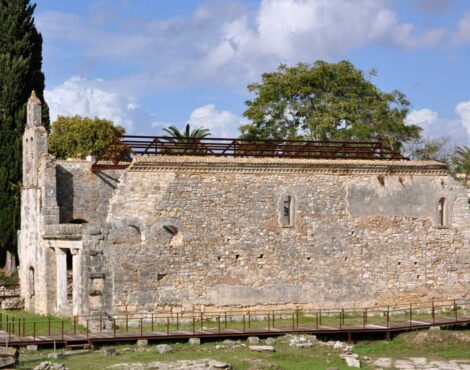
Tragically, the long and storied life of the church came to an end during World War II. In the early hours of September 14, 1943, Corfu was bombarded by German Stuka dive bombers. Although the main structure of the monument survived, its roof was completely destroyed. A decade later, in 1953, a controversial decision was made to demolish the church entirely, stripping Corfu of one of its most important historical landmarks.
In the decades that followed, the memory of the Annunziata remained alive in the hearts of the Corfiot people. The bell tower, the only part of the structure that still stood, became a symbol an enduring monument of the island’s spiritual and architectural heritage. With its tower-like shape and decorative engravings of Corfu’s landscape adorning its facade, it remained a quiet witness to time and history. However, it gradually faded into obscurity and disrepair, with the passage of time clearly etched into its weathered stones.
It wasn’t until the late 2000s that attention returned to the bell tower. A significant renovation was recently completed, restoring the tower to its former glory. Now renewed and imposing once again, the bell tower of the historic Annunziata church stands proudly in the heart of the city, a remnant of a grand past brought back to life.
Like many of Corfu’s historical monuments, the Annunziata has played a vital role in the cultural and historical identity of the island. Though the church building itself no longer exists, the “orphaned” bell tower remains an unmistakable landmark in Corfiot daily life. More than just an elegant piece of architecture, it serves as a meeting point and reference location in the city center. It also draws tourists and visitors interested in the island’s history, standing as a bridge between Corfu’s present and its layered past.