
Corfu, known in antiquity as Korkyra, is one of Greece’s most significant archaeological and historical sites. Its strategic position in the Ionian Sea made it a center of trade, culture, and conflicts between major powers of the time. The history of ancient Corfu begins in the prehistoric era and unfolds through mythological narratives, colonization, and wars that shaped the identity of the island.
According to mythology, Corfu got its name from the nymph Korkyra, daughter of the river god Asopus, whom Poseidon abducted and brought to the island. From their union, Phaeax was born, considered the progenitor of the Phaeacians, the mythical people who hosted Odysseus on his journey back to Ithaca. The first inhabitants of the island were likely Illyrians and Cretans, while archaeological findings indicate the existence of organized settlements as early as the Mycenaean period (1600–1100 BC).
Corfu was one of the earliest Greek colonies. In 734 BC, settlers from Corinth, led by Archias, founded a significant city on the island, which quickly developed into a commercial and naval hub. Despite its close ties with Corinth, Corfu sought independence, leading to conflicts and one of the first recorded naval battles in antiquity (665 BC). The city of Corfu was one of the most powerful naval forces of the ancient world and had a strong fleet. The Corfiots played an important role in the Persian Wars, providing ships for the Greek defense. At the same time, the island was a focal point during the Peloponnesian War (431–404 BC), as the conflict between Athens and Sparta greatly influenced the political landscape of the entire Greek world. Corfu initially allied with Athens, angering Corinth and leading to hostilities. In 427 BC, a civil war broke out in Corfu between the democrats, who supported Athens, and the oligarchs, who were backed by Sparta. The conflict was particularly bloody and caused great turmoil in the city.
After the Peloponnesian War, Corfu experienced periods of relative stability but also conquests by various powers. The island came under Macedonian rule during the campaign of Philip II and later Alexander the Great. During the Hellenistic period, Corfu was influenced by the Illyrians, the Epirotes, and the Romans, who captured it in 229 BC, making it one of the first Greek territories to be incorporated into the Roman Empire.
Under Roman rule, Corfu maintained its significance as a naval station and commercial center. The Romans used it as a base for their campaigns in the East, while new cities and infrastructures were developed. Despite this growth, Corfu’s importance gradually declined, especially as trade shifted toward Rome and Constantinople.
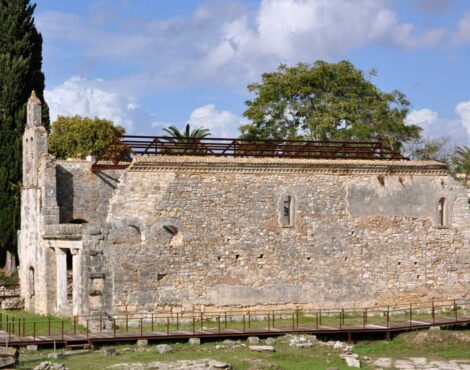
Ancient Corfu has left behind a wealth of archaeological monuments that attest to its greatness. Among these, the most notable are: The Temple of Artemis (600 BC), considered one of the earliest Doric temples in Greece. The Kardaki Temple, dedicated to Poseidon, which exhibits architectural influences from Ionia. The ruins of ancient fortifications, highlighting the island’s strategic importance. The Monument of Menekrates, a cenotaph that once featured a carved lion, which can be found in Corfu’s archaeological museum.
Ancient Corfu was one of the most important cultural and strategic hubs of the Mediterranean. From the age of myths and early settlers to its peak as a naval power and its incorporation into the Roman Empire, its history is filled with conflicts, achievements, and cultural prominence. The monuments and archaeological sites that have been preserved testify to Corfu’s significance in ancient Greek history, providing valuable insights into the island’s life and development in antiquity.