Printing in Corfu has a rich and fascinating history, deeply connected to the cultural and social development of the island. From the establishment of the first printing press by the French in 1798, to the founding of the Aspioti Printing Press in 1873 and the construction of the famous Villa Rossa, printing in Corfu played a key role in the development of local craftsmanship, education, and culture.
The first significant moment in the history of printing in Corfu occurred in 1798 when the French installed the first known printing press in Greece. This installation coincided with the French occupation of the Ionian Islands and the establishment of the French Republic in the region. Besides setting up the printing press, the French implemented important reforms, such as the abolition of the feudal system, the foundation of the Ionian Academy, and the introduction of the Greek language as the official language of the state.
The establishment of the printing press had significant consequences for education and culture in Corfu. The first editions of books and newspapers in the Greek language were created, which contributed to the dissemination of knowledge and the strengthening of national consciousness among the inhabitants of the island. The press enabled the spread of Enlightenment ideas and the modernization of society, laying the groundwork for the intellectual awakening of the Greek people.
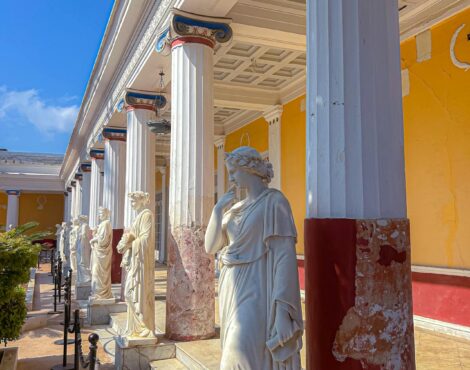
After the French left and political circumstances in Corfu changed, the Aspioti family took a leading role in the development of printing on the island. Nikolaos Aspioti, a painter and entrepreneur, founded the famous Villa Rossa in 1864, a grand residence that became a center of cultural and social life in Corfu. The villa hosted prominent figures from the arts and society, contributing to the cultural flourishing of the island.
In 1873, Nikolaos Aspioti’s son, Gerasimos Aspioti, founded the Aspioti Printing Press, which became the first major printing press in Greece. The press was highly productive, publishing books, newspapers, cards, and other printed materials. Its high-quality publications were recognized as among the best in the country. The Aspioti Printing Press earned a reputation for excellence, producing fine works that were admired for their craftsmanship.
The Aspioti family also had a significant influence on the social and cultural life of Corfu. Villa Rossa hosted important social events, receptions, and cultural activities, attended by prominent figures of the time. The family’s influence extended beyond the business world, playing a role in shaping the intellectual and cultural landscape of the island. Their commitment to the arts and culture made them key figures in the development of printing, education, and cultural activities in Corfu.
The legacy of printing in Corfu is still evident today. The tradition of printing continues with the operation of modern printing houses and publishing houses on the island. Exhibitions, museums, and cultural centers preserve and promote the history of printing in Corfu, while the people of the island maintain a living memory of their ancestors’ efforts to develop printing and culture. Corfu remains proud of its printing history, which continues to be an integral part of its cultural heritage.
Printing in Corfu is not merely a technical activity, but a crucial factor in the development of education, culture, and society on the island. The history of printing in Corfu is intertwined with the history of the island itself and is an inseparable part of its cultural identity. From the establishment of the first printing press to the Aspioti family’s contributions, printing has been a driving force in Corfu’s intellectual and artistic evolution. Today, the island’s printing legacy continues to be a testament to its cultural richness and historical significance.