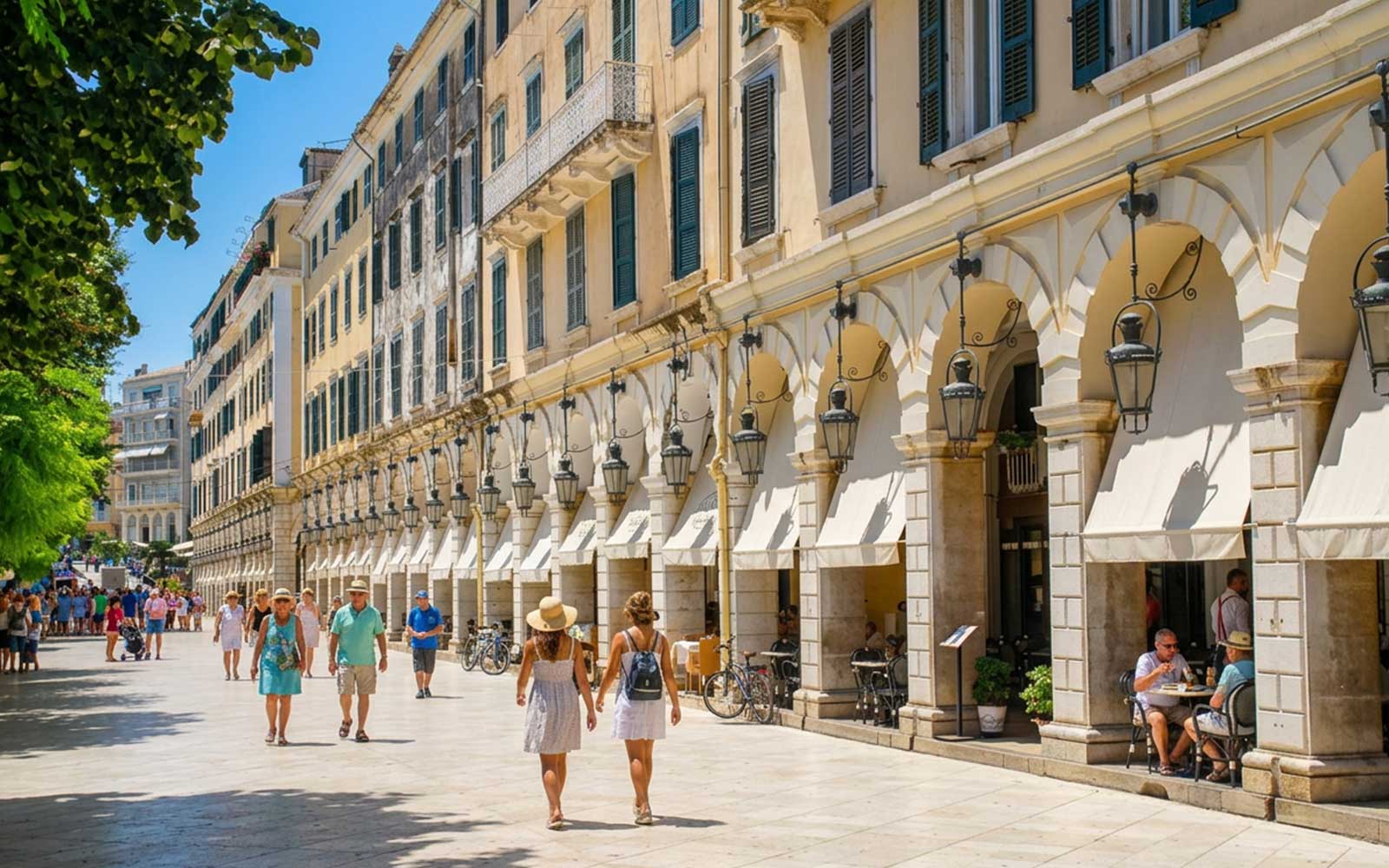
The Liston Promenade: Corfu Town’s Most Elegant Gathering Place
In the centre of Corfu Town, facing the great green expanse of the Spianada and the distant stone walls of the Old Fortress, there is a row of arched buildings that stops most visitors in their tracks the first time they see it. The Liston is not what people expect to find on a Greek island. Its elegant arcades, its symmetrical facades, its rows of cafe tables arranged beneath the arches in the manner of a Parisian boulevard, all speak of a different cultural inheritance than the whitewashed walls and blue domes that dominate the popular image of Greek architecture.
The Liston is Corfu. And understanding it is to understand something essential about an island that has never been quite like anywhere else in Greece.
A Parisian Idea on a Greek Island
The Liston was built between 1807 and 1814, during the period of French administration that followed the fall of the Venetian Republic. Napoleon’s brief governance of the Ionian Islands left several marks on Corfu, but none more visible or more lasting than this arcaded promenade, designed by the French engineer Mathieu de Lesseps and modelled explicitly on the Rue de Rivoli in Paris.
The intent was clear. The French administrators wanted to bring the forms and habits of Parisian public life to the principal town of their new possession. A covered promenade where the educated classes could walk, converse, and be seen was a fundamental element of the civilised urban life that French culture sought to project. The result, constructed in the warm golden limestone of the island, achieved something the designers perhaps did not entirely anticipate. It became not merely a copy of a Parisian original but something distinctly and permanently Corfiot.
The name itself carries history. Liston derives from the libro d’oro, the book of noble families maintained during the Venetian period. In the early years of the promenade, only those whose names appeared in this register of Corfiot aristocracy were permitted to walk beneath the arches. The restriction is long gone, but the name endures, a small reminder that beneath the surface elegance of the place lies a social history considerably more complicated than the pleasant present suggests.
The Spianada: The Stage Before the Promenade
The Liston cannot be fully understood without the Spianada, the vast open esplanade that it faces. The Spianada is the largest square in the Balkans and one of the largest in all of Europe, a great flat expanse of grass and paths that was created during the Venetian period by demolishing the buildings that once stood between the town and the Old Fortress.
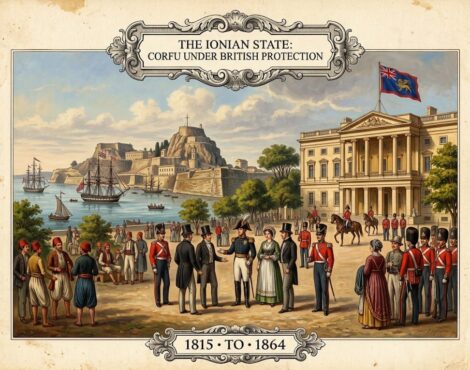
Today the Spianada serves as Corfu Town’s communal living room. On Sunday mornings, families walk its paths. On summer evenings, children play football on the grass while their parents occupy the surrounding benches. Cricket is played on the northern section, a legacy of the British administration that followed the French and that introduced the game to Corfu with sufficient success that it has been played here ever since. From any point on the Spianada, the Liston provides the defining visual boundary, its arches framing the view and giving the entire space an architectural coherence that transforms an open field into something that functions like a proper urban square.
Life Beneath the Arches
The cafes of the Liston are among the most atmospheric places to sit in all of Greece. This is not a modest claim, and it is made with full awareness of the competition. But the particular combination of the setting, the history visible in every direction, the movement of people across the Spianada, the sound of the city at its most relaxed, and the physical pleasure of sitting beneath the cool arches on a warm afternoon produces an experience that is genuinely difficult to replicate.
The coffee is Greek, strong and served with a glass of cold water. The pastries in the display cases reflect Corfu’s Venetian inheritance, with recipes that have more in common with the pasticcerie of Venice than the zaharoplasteia of Athens. The prices are higher than in the neighbourhood cafes and kafeneia of the surrounding streets, a fact that every guidebook feels obliged to mention and that every visitor promptly dismisses as irrelevant once they are sitting in the right chair at the right hour with the right view.
The evening is the finest time. As the heat of the afternoon lifts and the light begins its long Mediterranean transition toward sunset, Corfu Town performs the volta, the evening promenade that is one of the most enduring social rituals of Greek island life. Families, couples, groups of teenagers, elderly men in their best jackets, all move slowly along the Liston and across the Spianada in the particular combination of purposeless walking and intense social observation that the volta requires. The cafe tables fill. The noise level rises gently. And the Liston does what it has been doing for more than two centuries: it provides the most elegant possible setting for the entirely ordinary and completely irreplaceable pleasure of being among people in a beautiful place.
What Surrounds the Liston
The Liston sits at the intersection of Corfu Town’s most significant layers of history. To the east, across the Spianada, the Old Fortress rises on its rocky promontory, its Venetian walls and Byzantine church visible from the cafe tables. To the north of the Liston, the Palace of St Michael and St George, built during the British administration and now housing the Museum of Asian Art, presents its neoclassical facade with the confidence of an institution that has been important for a long time and knows it.
Behind the Liston, the lanes of Corfu Town’s old quarters begin almost immediately. The Campiello, the medieval heart of the town, is a labyrinth of narrow streets, washing lines stretched between shuttered windows, small Orthodox churches tucked into unexpected corners, and the particular domestic architecture that centuries of Venetian influence produced on Corfiot stone. An hour of unhurried walking through the Campiello after a coffee at the Liston is one of the most rewarding ways to spend a morning in Corfu Town.
The Liston as Introduction
For visitors to Corfu Town, the Liston functions well as an introduction to everything that makes the island distinctive. Its French architecture on a Greek island, its Venetian name, its British-era cricket pitch visible across the Spianada, the Orthodox church bells audible from the surrounding streets, all of these things are present simultaneously. Corfu is layered in a way that few places in the Mediterranean can match, and the Liston, with its improbable elegance and its thoroughly Corfiot daily life, is as good a starting point as any for beginning to understand those layers.
Sit beneath the arches. Order a coffee. Watch the Spianada in the morning light or the evening gold. The island will begin to make itself clear.