Kardaki and Corfu’s Royal Connections: A Hidden Corner of the Island
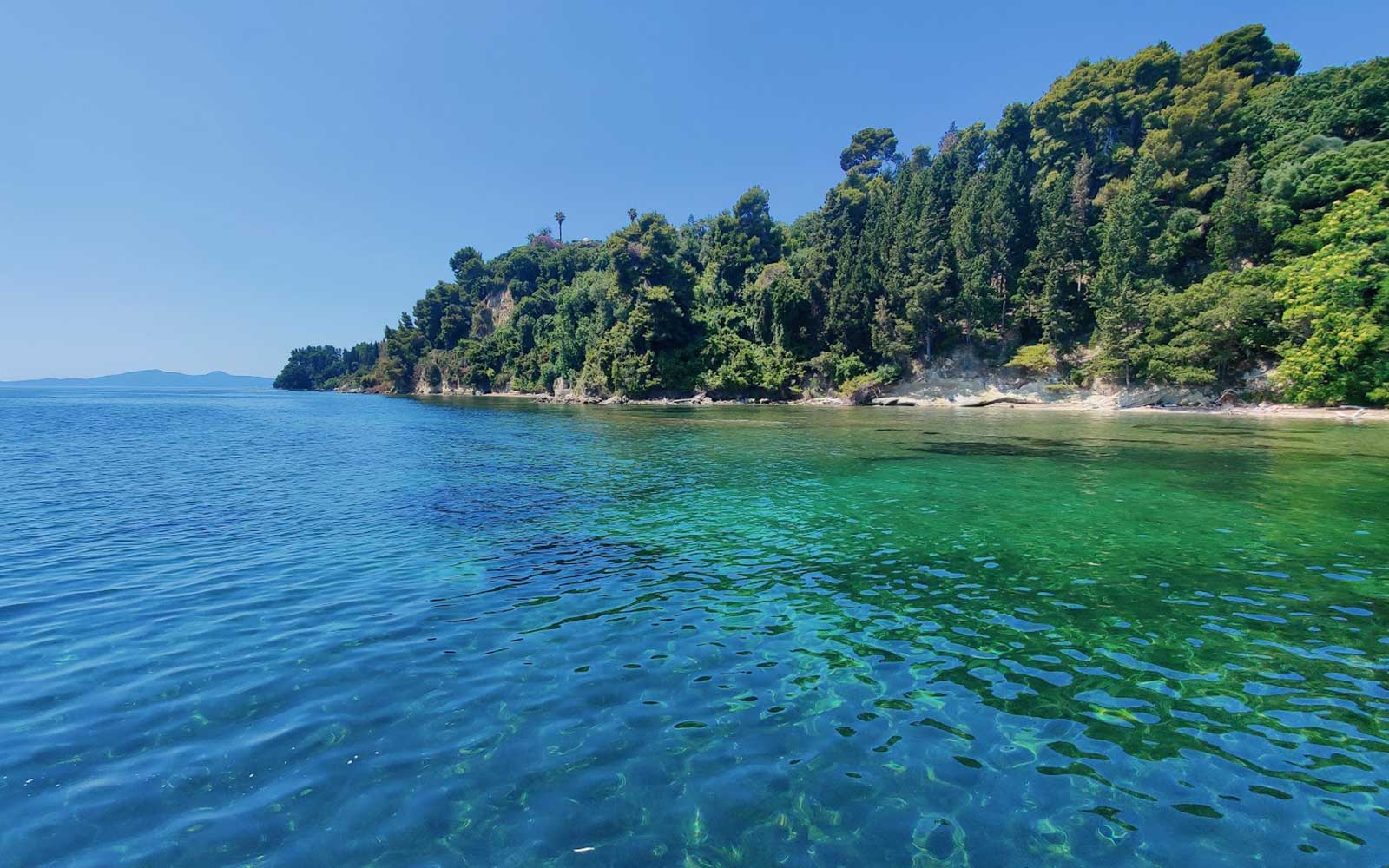
The Kanoni peninsula, with its famous view of Vlacherna and Pontikonisi, draws visitors from across the world to its celebrated promontory. Most of them look out across the bay, take their photographs, perhaps descend to the causeway and take the boat to Mouse Island, and then return the way they came. Very few turn west, into the wooded hillside that falls away from the Kanoni road toward the quieter, more enclosed landscape of Kardaki. Those who do make that turn discover one of the most atmospheric and historically layered corners of Corfu Town, a place where ancient sanctity, aristocratic history, and natural beauty combine in a setting that the island’s more celebrated destinations, for all their magnificence, cannot quite replicate.
The Wooded Hillside
The Kardaki area occupies the western slope of the Kanoni peninsula, a hillside of dense Mediterranean woodland that descends toward the shore of the Halikiopoulos lagoon. The trees here, a mixture of cypress, olive, and the various broadleaved species that colonise undisturbed ground in the Corfiot climate, have been growing without significant disturbance for long enough that the woodland has the character of genuine antiquity: deep shade, a floor of accumulated leaf mould, the sound of birds rather than traffic, and the particular quality of silence that only old trees produce.
The paths through the Kardaki woodland are informal and in places overgrown, requiring some attentiveness to follow but rewarding that attentiveness with the sensation of genuine discovery. This is not a managed tourist site with signposted routes and interpretive panels. It is a place that asks something of the visitor in exchange for what it offers, and what it offers, to those who engage with it properly, is considerable.
The Ancient Temple
Within the Kardaki woodland, the remains of an archaic Greek temple stand in a clearing that the trees have partially reclaimed over the centuries since the building fell out of use. The temple dates from the sixth century BC, contemporary with the great period of Corcyraean artistic and architectural achievement that produced the Gorgon pediment now housed in the Archaeological Museum, and it represents one of the earliest examples of the Doric order discovered on Corfu.
The identification of the deity to whom the temple was dedicated remains a matter of scholarly debate. Apollo and Artemis have both been proposed on the basis of the archaeological evidence and the broader religious geography of ancient Corcyra, and the question has not been definitively resolved. What is certain is that the site was considered sacred long before the temple was built, the presence of the Kardaki spring marking it as a place of divine significance in the pre-temple religious landscape of the island.
The temple remains are fragmentary, as the remains of most ancient Greek temples inevitably are after twenty-six centuries of spoliation, earthquake damage, and the slow reclamation of the natural world. But the setting in the woodland, the quality of the surviving stonework, and the knowledge of what stood here in the archaic period combine to make the Kardaki temple one of the most evocative archaeological sites on the island, precisely because it asks the visitor to do the imaginative work of reconstruction rather than presenting the completed picture.
The Sacred Spring
At the base of the Kardaki hillside, feeding a small stream that runs through the woodland toward the lagoon, the Kardaki spring emerges from the rock with the quiet persistence that freshwater springs in the Mediterranean maintain regardless of the season. The spring has been flowing here since before the temple was built above it, and the association between the water source and the sacred precinct is typical of the Greek religious imagination, which consistently identified springs, groves, and other features of the natural landscape as places where the divine was particularly present and accessible.
The ancient inscription associated with the Kardaki spring carried a warning that has survived in various forms through the scholarly literature on Corfiot antiquities: that any traveller who drank from the spring would be prevented from returning to their homeland. The precise wording and the exact location of the original inscription are matters of debate, but the tradition itself is consistent with the Greek understanding of certain sacred springs as possessing powers that could bind the traveller to the place, making departure impossible or at least inadvisable.
Whether the warning was intended to be taken literally or understood as a poetic expression of the spring’s beauty and the power of the place to hold the visitor’s attention and affection, it has a resonance that the Kardaki spring itself supports. The combination of the woodland, the ancient stones, the sound of running water, and the sense of considerable distance from the ordinary world of the town just over the hill creates the conditions in which such beliefs feel less like superstition and more like accurate observation.
Royal Connections
The broader Kardaki and Kanoni area carries associations with the aristocratic and royal visitors who were drawn to Corfu during the nineteenth and early twentieth centuries, when the island’s combination of natural beauty, mild climate, and cultural richness made it one of the preferred destinations of European high society.
The most celebrated of these connections is the Achilleion palace, built further along the peninsula by Empress Elisabeth of Austria, known as Sisi, in the 1890s. But the estates and villas of the Kanoni and Kardaki area attracted other distinguished residents and visitors whose presence shaped the social and physical landscape of the neighbourhood during its period of greatest aristocratic prestige.
The Greek royal family, whose connections with Corfu were longstanding and deep, maintained associations with the island that extended to the Kanoni peninsula and its surroundings. The villas of the area, several of which survive in varying states of preservation behind their garden walls, were among the most prestigious addresses on the island during the period when Corfu functioned as a destination of choice for the crowned heads and aristocratic families of Europe.
This royal and aristocratic heritage gives the Kardaki area a social history that complements its ancient and natural significance. The wooded paths that lead past the ancient temple and the sacred spring also pass through a landscape that was, within living memory, one of the most socially distinguished addresses in the Ionian islands, a fact that adds a further layer of interest to what is already a remarkably dense accumulation of historical significance within a relatively small area of woodland and hillside.
Exploring Kardaki in May
May is the finest month to explore Kardaki. The woodland is at its most beautiful, the spring running strongly from the winter rains, the wildflowers of the hillside still in bloom among the ancient stones, and the birds active and vocal in the trees overhead. The relative coolness of the shaded paths makes walking comfortable even in the middle of the day, and the absence of significant visitor numbers means that the woodland atmosphere is undisturbed.
A walk through Kardaki in May, beginning at the Kanoni viewpoint and descending through the woodland to the temple remains and the spring before returning along the lagoon shore, takes between one and two hours at a leisurely pace and delivers an experience of the Corfu landscape and its history that is entirely different from, and in many ways more intimate than, the more celebrated attractions of the Old Town.
For guests at Villa Kapella spending a day in the southern Corfu Town area, Kardaki provides the ideal conclusion to an itinerary that might begin with the Archaeological Museum, continue along the Garitsa promenade through Anemomilos, take in the Kanoni viewpoint and the boat to Pontikonisi, and end in the wooded quiet of the Kardaki hillside as the afternoon light filters through the trees and the spring runs on as it has been running, through every civilisation and every season, for longer than any of the histories that surround it.