Music in Corfu is not background. It is not the ambient sound of a restaurant or the incidental accompaniment to a street festival. It is a serious, deliberate, culturally central activity that the island has been practising with conviction and skill for several centuries and that distinguishes Corfu from every other place in Greece as completely as its architecture and its cuisine.
The visitor who encounters a Corfiot philharmonic orchestra for the first time, whether in the formal setting of a concert or in the street processions of the Easter celebrations, is encountering something that has no real equivalent elsewhere in the Greek world. The sound is European in the specific sense that the word carries when applied to the musical tradition that developed in Italy and spread through Venice’s maritime empire: harmonically organised, formally structured, played from written scores by musicians trained in a tradition of musical literacy that the rest of Greece did not share.
Understanding why Corfu sounds the way it does requires understanding something about the centuries of Venetian administration that made the island what it is.
Venice and the Musical Education of Corfu
The Venetian Republic was not simply a military and commercial power. It was one of the great cultural powers of early modern Europe, and its capital was among the most musically sophisticated cities in the world during the sixteenth, seventeenth, and eighteenth centuries. The music of Venice, the elaborate sacred polyphony of the Basilica di San Marco, the secular madrigals and instrumental music that the Republic’s cultural life generated in abundance, and the opera that emerged in Venice in the early seventeenth century and spread from there across the continent, was among the most advanced and most influential musical production of its era.
This musical culture did not stop at the borders of the lagoon. It travelled with the Republic’s administrators, merchants, and clerics throughout the Venetian maritime empire, and in Corfu, where the Venetian presence was both longer and more intense than in most of its other island territories, it took particularly deep root. Music schools were established in Corfu Town during the Venetian period, teaching the Western system of notation and the instrumental and vocal techniques that the Italian musical tradition had developed. The Catholic religious institutions of the island, closely connected to the Venetian administration, maintained musical establishments that performed the sacred repertoire of the Roman rite with the same formal apparatus as their counterparts in Venice itself.
The San Giacomo Theatre and the Opera Tradition
The most direct expression of Corfu’s Venetian musical inheritance was the San Giacomo Theatre, built in Corfu Town during the Venetian period and active as a venue for Italian opera throughout the seventeenth, eighteenth, and nineteenth centuries. The San Giacomo was the first permanent opera house in Greece, a fact that reflects the completeness of Corfu’s integration into the cultural world of Venice and the degree to which the island’s educated classes had absorbed the musical tastes of the Republic.
Italian opera was performed regularly at the San Giacomo by touring companies from the Italian peninsula, and the audience for these performances, the Venetian administrators and the Corfiot aristocracy and upper classes who had received a musical education consistent with their social position, was sufficiently knowledgeable and sufficiently numerous to sustain a regular operatic season. The experience of attending opera in Corfu Town was, for the educated Corfiot of the eighteenth century, a normal rather than an exceptional cultural event, and this normalisation of formal musical experience shaped the musical culture of the island in ways that lasted well beyond the end of the Venetian period.
The composers and musicians that Corfu produced during and after the Venetian period reflect the operatic and formal musical culture of the island in their training and their output. Nikolaos Mantzaros, born in Corfu in 1795, composed the music for the Greek national anthem, setting Dionysios Solomos’s Hymn to Liberty in the formal European musical language that his Corfiot training had given him. The anthem, now the national anthem of both Greece and Cyprus, is a direct product of the musical culture that Venice implanted in Corfu and that the island maintained and developed through the subsequent centuries.
The Philharmonic Societies
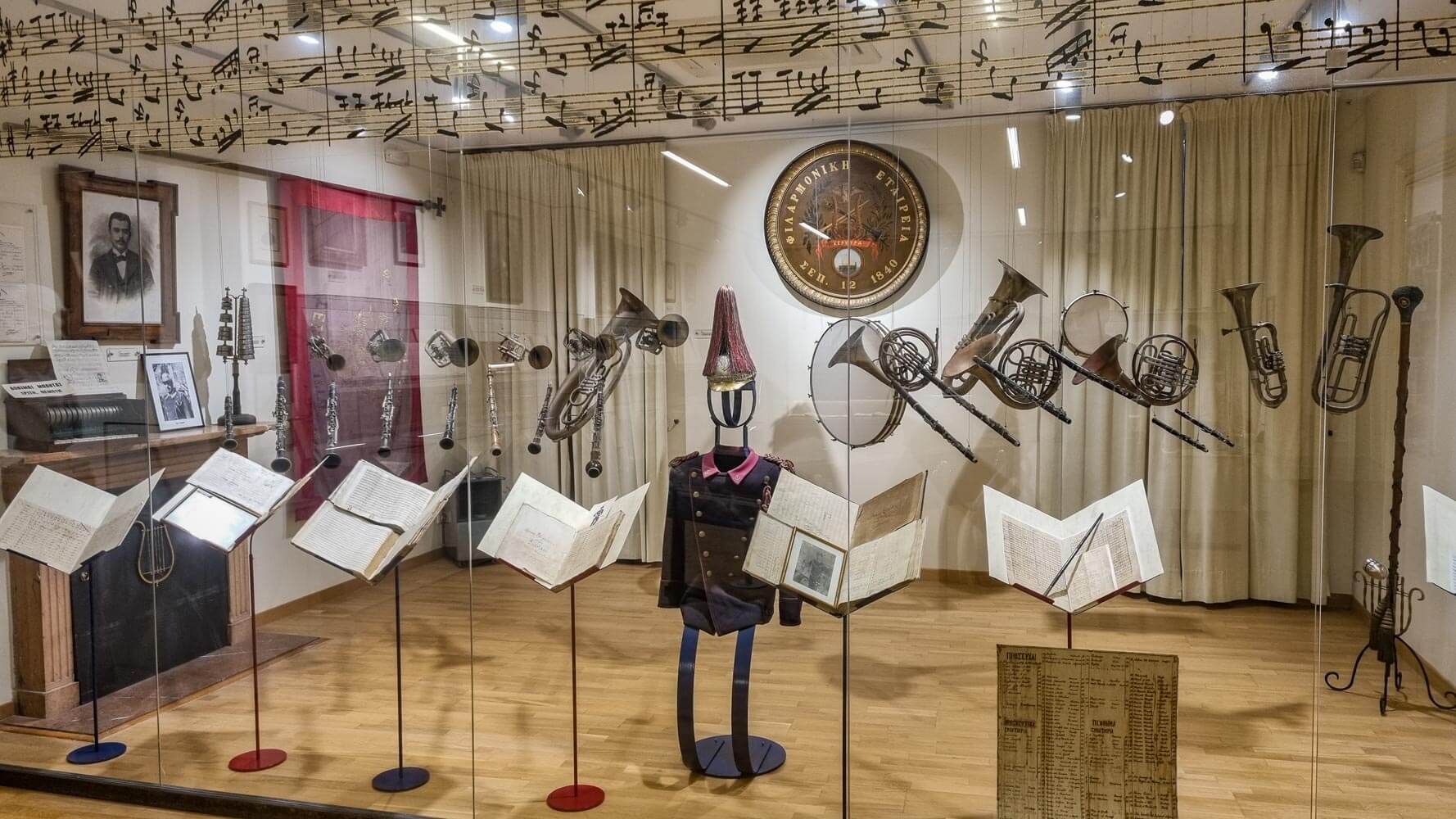
The institutional expression of Corfiot musical culture in the nineteenth century was the philharmonic society, the formal association of musicians dedicated to the performance of orchestral and wind band music in the public life of the town. The Philharmonic Society of Corfu, founded in 1840, is the oldest in Greece and one of the oldest in the Balkans, its establishment reflecting the continuation of the formal musical tradition through the transition from Venetian to French to British administration that the island underwent in the early decades of the century.
The philharmonic societies of Corfu perform at the events that structure the island’s public ceremonial life throughout the year. The Easter celebrations, with the Epitafios processions of Good Friday accompanied by the orchestras playing funeral marches through the streets of the Old Town, are the most celebrated expression of this function, but the societies also perform at saints’ day celebrations, national commemorations, summer concerts, and the various civic events that call for formal musical participation.
The sound of a Corfiot philharmonic orchestra performing in the streets of the Old Town is one of the most distinctive auditory experiences available in Greece. The combination of the formal European wind band repertoire, the acoustic properties of the narrow Venetian lanes through which the processions move, and the communal emotional investment of a town that has been listening to this music in these streets for nearly two centuries produces an experience of unusual power and cultural specificity that no recording adequately captures.
The Mandolinata Tradition
Alongside the formal orchestral tradition of the philharmonic societies, Corfu maintains a separate and equally distinctive musical tradition in the mandolinata, the ensemble of mandolins and guitars that performs the cantades, the part songs of Venetian and Italian origin that have been absorbed into the Corfiot musical repertoire and that represent one of the most immediately appealing expressions of the island’s musical inheritance.
The cantades are love songs, typically, with texts in Italian or the Corfiot dialect and melodies of the kind that the Italian popular musical tradition of the nineteenth century produced: melodically accessible, harmonically straightforward, and possessed of the particular emotional directness that distinguishes the popular song from the more elevated forms of the classical tradition. Performed by a mandolinata ensemble in the evening, in a taverna or a village square, the cantades create an atmosphere of nostalgic warmth that is entirely specific to Corfu and that visitors consistently respond to with an immediacy that suggests the music communicates something beyond the barrier of unfamiliar language.
Hearing Music in June
June in Corfu offers several opportunities to hear the island’s musical traditions in their natural settings. The philharmonic societies perform at various points through the early summer season, and enquiring locally about scheduled performances is the most reliable way to attend a concert or outdoor performance during a June visit.
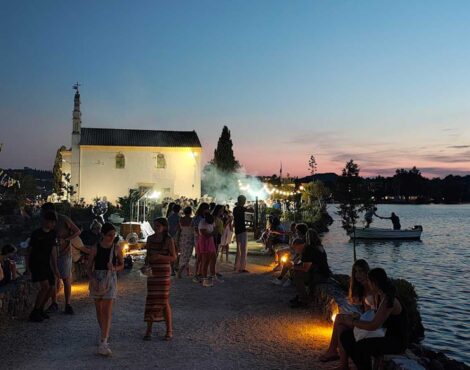
The more informal expression of the cantade tradition, in tavernas and at village festivals, is less predictable but more immediately accessible: a summer evening in the right Corfu Town restaurant or at a village saint’s day celebration may produce an unexpected encounter with the mandolinata that is among the most genuinely memorable experiences of a Corfu holiday.
For guests at Villa Kapella, the musical culture of the island provides a dimension of the Corfu experience that complements the natural beauty and the historical richness that the island offers so abundantly. Music has been part of what Corfu is for four centuries, and encountering it, even briefly and partially, is to touch something essential about an island that has always been, in every sense of the word, in tune with a larger European world.