
Corfu’s September Harvest: Figs, Grapes and the First Autumn Produce
The agricultural calendar of Corfu does not pause for the summer season. While the beaches fill and the tavernas operate at peak capacity and the tourist economy of the island runs at its maximum intensity through July and August, the fields and the orchards and the kitchen gardens of the Corfiot countryside continue the patient, seasonal work of growing food that has structured life on this island for thousands of years and that the tourist economy, however dominant it has become in the summer months, has not displaced from its fundamental role in the island’s annual rhythm.
By September, this parallel agricultural calendar has produced its own peak: the fig season in full swing, the grapes ready for harvest from the island’s small vineyards, the summer vegetables at the fullest expression of their late-season quality, and the first hints of the autumn harvest that will gather momentum through October and November before the olive harvest begins in December. The September market in Corfu Town, and the village shops and the roadside sellers of the island’s interior, reflect this agricultural abundance with a variety and a freshness that the peak season market, supplied for volume and convenience rather than for the finest expression of the seasonal cycle, does not consistently match.
The Fig: September’s Defining Fruit
The fig is the fruit of the Corfiot September, and its presence throughout the island in the early autumn weeks, on the trees that grow along every country road and in every garden and on the terraced hillsides of the agricultural interior, gives the month a specific sensory character that no other season can replicate. The late summer fig, heavier and sweeter than the earlier summer variety, is at its peak ripeness in September, and the trees throughout the island carry fruit in the abundance that a good fig year produces: branches bent by the weight of the ripe fruit, the fallen figs on the ground beneath the trees releasing the particular sweet, slightly fermented fragrance of overripe fig that is one of the most specifically Mediterranean of all seasonal scents.
The figs available in the Corfu Town market and from the roadside sellers who set up their tables along the country roads of the interior in September are figs of a quality that the northern European visitor, accustomed to the imported and under-ripe figs of the supermarket, finds immediately and consistently extraordinary. The flesh of a fully ripe Corfiot fig in September, warm from the sun and soft to the point where the skin barely contains the interior, is sweet with a depth and a complexity that the commercially grown fig picked early for transport can never approach. Eating one at the roadside stand from which it was bought, within minutes of being picked from the tree, is the September food experience of Corfu at its most directly available and its most completely satisfying.
The fig in the Kapella Apartments kitchen in September becomes an ingredient of remarkable versatility. Split and roasted with local honey and a piece of the island’s graviera cheese, the fig delivers a starter of simple perfection that the combination of the sweetness of the fruit, the richness of the honey, and the nuttiness of the cheese makes entirely greater than the sum of its three parts. Eaten fresh with yogurt and the local thyme honey as a breakfast component, it transforms the morning meal into something that the finest hotel breakfast cannot improve upon. Preserved in the simple syrup that the Corfiot kitchen makes from the September abundance, the fig becomes the accompaniment to the local cheeses and the cured meats that the island produces and that the Kapella Apartments outdoor table accommodates most naturally in the warm September evenings.
The Grape Harvest
September brings the grape harvest to the small vineyards that are scattered across the Corfiot interior, their modest scale and their local variety reflecting a wine culture that has existed on the island since antiquity and that the dominance of the olive in the Venetian agricultural transformation never entirely eliminated. The vineyards of Corfu are small by any standard of comparison, their production local and largely consumed locally, and the September harvest that takes place at these sites is the event that connects the island’s contemporary wine culture to its ancient agricultural roots.
The grapes available in the September market, both the eating varieties from the domestic gardens and the wine varieties from the island’s vineyards, have the particular sweetness that the accumulated summer heat and the September ripening produce in combination. The eating grapes, large and flavourful and sold in the covered market by the kilogram rather than by the bunch, are among the finest available in Greece at this point in the autumn and represent a straightforward and entirely rewarding addition to the Kapella Apartments table.
The new wine that the September harvest will eventually produce is not available during a September stay at the property, the fermentation and the minimum aging required to produce a drinkable wine extending the timeline from harvest to bottle well beyond the September season. But the local wines of previous harvests, available in the village shops and the Corfu Town market from the small producers who bottle their own production, provide the context within which the September harvest can be understood and appreciated as part of a continuous tradition rather than an isolated agricultural event.
The Summer Vegetables at Their Peak
The summer vegetables of Corfu’s September market, the tomatoes and the courgettes and the aubergines and the peppers and the various beans and greens that the island’s kitchen gardens have been producing since May, are in September at the point of their maximum quality rather than their maximum quantity. The heat of the summer months has concentrated the sugars and the flavours of the tomatoes to a degree that the earlier summer specimens, however good, do not achieve, and the September tomato of the Corfiot garden, eaten simply with local olive oil and coarse salt or combined in the salad that the island’s tavernas serve as a matter of default rather than a conscious menu decision, is the Mediterranean tomato at its annual finest.
The aubergines and courgettes of September carry the same quality of concentrated summer flavour, the months of growing in the full intensity of the Ionian sun having produced vegetables of a depth and a richness that the northern European equivalent, grown under cooler skies and harvested earlier in the season, does not approach. The Corfiot kitchen’s traditional preparations for these vegetables, the slow-cooked stews and the oven dishes that combine them with the local olive oil and the tomatoes and the herbs of the island’s aromatic landscape, reach their finest expression in September when the ingredients they require are at their absolute seasonal peak.
The Market Visit in September
The covered market in Corfu Town in September has a character that the peak season market, serving the volume demands of the tourist summer, does not maintain with the same consistency. The stallholders in September are serving a market that has returned to its primary function as the food supply for the local population rather than the tourist attraction of the peak months, and the produce they stock reflects this return to the local and the seasonal with a directness that the summer market’s more commercially oriented selection sometimes obscures.
A September morning in the covered market, moving through the vegetable stalls with their September tomatoes and their aubergines and the first autumn squashes beginning to appear, past the fig sellers with their baskets of the heavy late-season fruit, past the cheese section where the graviera and the local feta and the fresh mizithra are available with the unhurried attentiveness of stallholders who have time for the question about which cheese is best with which dish and the answer that the question deserves, and out through the fish section where the September catch has the variety and the freshness of the early autumn sea: this is a market experience of outstanding quality and one that the Kapella Apartments kitchen is ideally positioned to translate into the finest meals of the stay.
The September Kitchen at Kapella Apartments
The Kapella Apartments kitchen in September, supplied from the morning’s market visit with the finest produce of the early autumn harvest, is the villa kitchen at its most naturally and most completely itself. The September ingredients require the simplest treatment: the tomatoes dressed with olive oil and salt, the figs roasted with honey, the aubergines slow-cooked in the traditional Corfiot manner with the local oil and the herbs of the island’s landscape. The cooking that the September produce makes possible is not elaborate. It is the expression of ingredients of exceptional quality in the forms that most directly reveal that quality, prepared in a kitchen whose outdoor setting makes the cooking itself a part of the September Corfu experience rather than a domestic interlude between the island’s other pleasures.
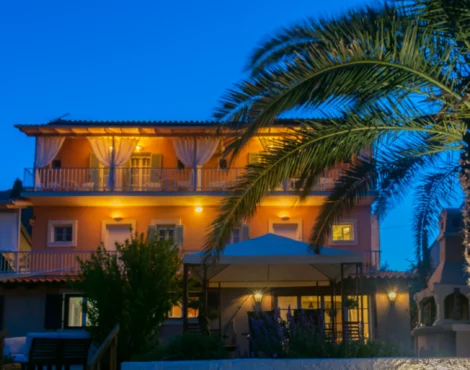
The September dinner at the Kapella Apartments outdoor table, prepared from the morning’s harvest and eaten in the warm early autumn evening with the garden around and the Corfiot sky above, is the meal that the island’s September abundance makes possible and that the property’s garden and terrace make perfect. It is the simplest and the finest expression of what a September stay at Kapella Apartments delivers: the island at its most naturally and most generously itself, offering its finest produce to those who have chosen the season that best knows how to receive it.