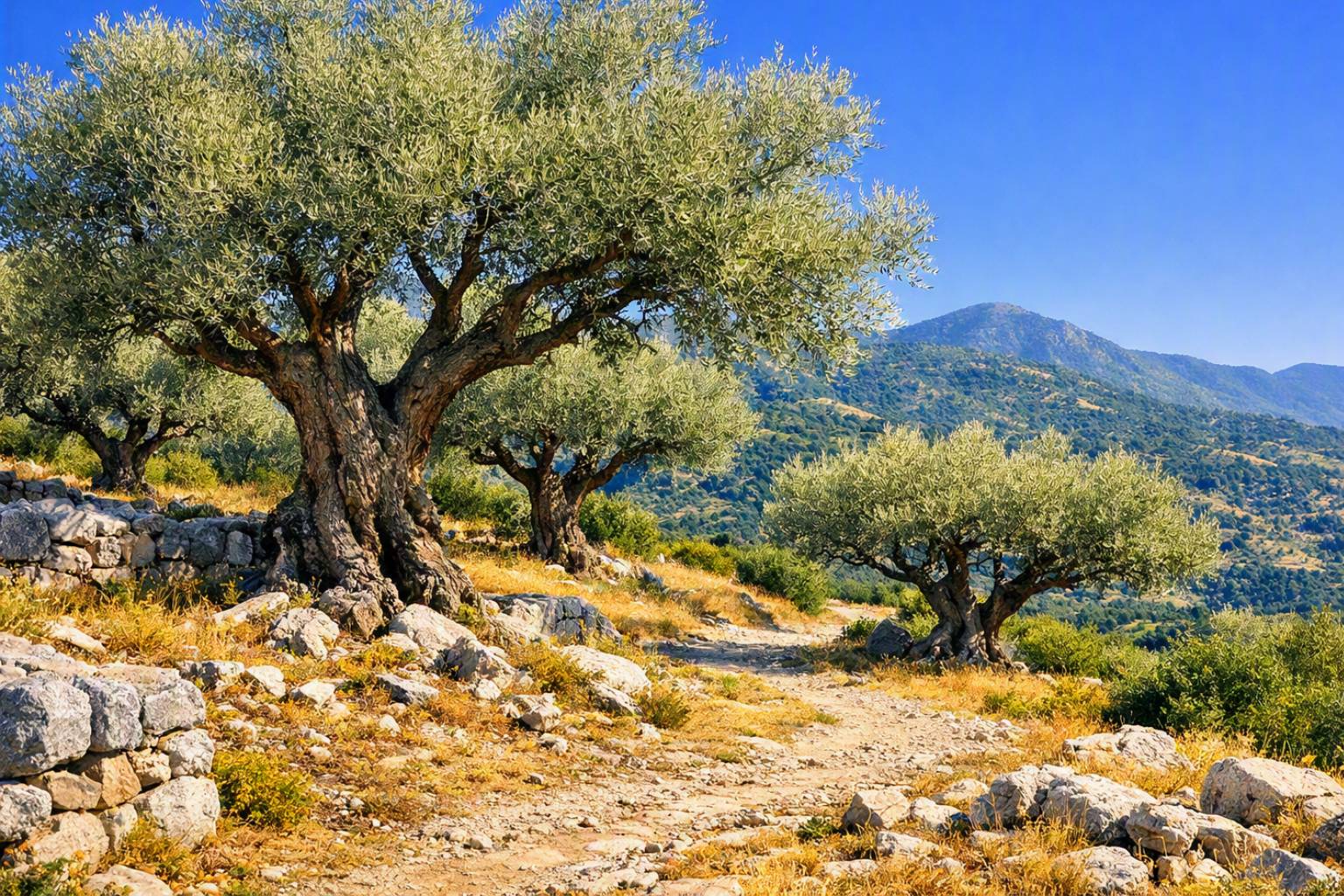
The olive trees that surround Kapella Apartments are in October doing something that the casual observer of the summer months might not immediately distinguish from what they have been doing since May: standing in the Ionian landscape with the silver-green canopy of their leaves catching the light and the ancient texture of their trunks providing the visual character that has defined this landscape for centuries. But the attentive October visitor, who has been watching the groves through the summer months and who knows what to look for in the fruit that the October branches carry, sees something different in October. The olives are changing colour.
The transition from the deep, waxy green of the summer fruit to the first hints of the purple and black that characterise the ripening Lianolia olive is the most visible sign that the Corfiot agricultural calendar has entered its final and most significant phase before the harvest that December will bring. This colour change, beginning in the most exposed and the most sun-warmed sections of each grove and spreading gradually through the canopy over the weeks of October and November, is the agricultural signal that the entire winter economy of the olive-growing communities of Corfu has been building toward since the spring flowering that set the fruit in May.
The Lianolia and Its Late Harvest
The character of the Corfiot olive harvest is defined above all by the variety of olive that the island produces. The Lianolia, the small-fruited variety that is endemic to the Ionian islands and that produces virtually all of Corfu’s olive oil, reaches maturity later than any other significant olive variety in the Greek or Mediterranean world. Where the Koroneiki of the Peloponnese and the Manaki of other Ionian islands are typically harvested in October and November, the Lianolia does not reach the full maturity that the finest Corfiot olive oil requires until December, January, and February.
This late harvest has shaped the agricultural calendar of the Corfiot olive-growing community in ways that extend far beyond the timing of the picking. The entire social and economic structure of the island’s agricultural interior is organised around the fact that the winter months, from December through February, are the months of maximum agricultural activity, and that the summer months, which in most agricultural economies are the period of peak labour demand, are in Corfu the relatively quiet months when the olive fruit is developing on the trees without requiring significant human intervention.
The October visitor to the Corfiot olive groves occupies the transitional moment between these two phases of the agricultural cycle: the summer development is complete, the summer labour of the groves minimal, and the winter harvest is approaching but not yet begun. October is the month of preparation and anticipation in the Corfiot olive economy, and the character of this moment is visible in the groves and audible in the conversations of the agricultural communities that October brings to its most active state of harvest planning.
The Fruit in October
Walking through the olive groves that surround Kapella Apartments in October, with some knowledge of what the changing fruit on the branches above represents in the agricultural cycle of the island, transforms the walk from the aesthetic pleasure of the October light on the silver-green canopy into something more directly connected to the living agricultural reality of the Corfiot landscape.
The Lianolia olives in October are approaching the most visually instructive moment of their annual development. The fruit that has been a uniform deep green since the spring has begun, in the most sun-exposed sections of the grove, its colour transition toward the purple-black of full maturity. This transition, proceeding at different rates in different parts of the same grove depending on the exposure and the position of individual branches within the canopy, gives the October grove a visual complexity that the uniformly green summer fruit does not produce: the canopy now a mixture of the green of the unripe fruit, the reddish-purple of the partially ripened, and the occasional black of the most advanced, the whole creating a chromatic richness in the October grove that the summer months do not provide.
The oil content of the fruit, which is what the harvest is ultimately about, is in October still accumulating toward the peak that December will bring. The grower who picks a Lianolia olive in October and presses it to assess the oil content will find less oil than the same olive pressed in January, and the quality of that oil, while already excellent in the October fruit, will reach its fullest expression in the fully ripe winter olive. The Corfiot olive grower’s patience, the willingness to wait for the full maturity of December and January rather than harvesting in October when other varieties would already be fully ripe, is the agricultural decision that produces the particular quality of Corfiot olive oil and that the October colour change of the Lianolia fruit is the first visible stage of.
The Grove Preparation
The practical activity in the Corfiot olive groves in October is the activity of preparation rather than the activity of harvest. The growers who visit their groves with increasing frequency through October are doing the work that a successful harvest requires before the picking begins: clearing the ground beneath the trees of the vegetation that the summer growth has produced, inspecting and repairing the nets that will be spread beneath the trees to catch the olives as they fall or as they are raked from the branches, and assessing the state of the trees themselves after the summer season.
The nets that are the most distinctive visual element of the Corfiot olive harvest landscape, spread beneath the ancient trees in the enormous sheets of synthetic fabric that have largely replaced the traditional hemp nets of the earlier harvest tradition, are in October either stored from the previous year’s harvest or beginning to be deployed in the groves whose owners have decided to prepare their equipment in advance of the harvest. The sight of the first orange or green nets appearing beneath the trees of the October grove is the signal that the harvest season, if not yet begun, is in its final stage of preparation.
The pruning that shapes the trees for the following year’s production is also partly an October activity in some groves, the growers using the period before the harvest to address the most pressing pruning requirements and to clear the interior of the trees of the deadwood and the crossing branches that the summer growth has produced. The olive tree’s relationship with pruning is complex and ancient: the Corfiot growers’ approach to their trees, shaped by generations of accumulated knowledge of the specific trees in their specific groves, is the approach of people who understand that the health and the productivity of an olive tree that may live for another five hundred years is more important than any single harvest and that the decisions made in October about how to manage the tree are decisions whose consequences will be experienced not only in the coming winter but in the winters of their grandchildren.
The Oil Mill and the Coming Season
The olive mills of Corfu, which will process the harvest from December through February in the continuous operation that the harvest season demands, are in October in their own preparation for the coming activity. The mills, many of them family-owned operations whose equipment ranges from the genuinely modern to the historically significant, are cleaned and serviced and prepared for the season of operation that will make them the most active and most socially significant facilities in the agricultural communities of the island’s interior.
The oil that the Corfiot mills will produce from the December-February harvest is already being anticipated and discussed in the October conversations of the agricultural community. The quality of the fruit, assessed by the growers in their October grove visits, is the subject of the cautious optimism and the careful qualification that the agricultural community characteristically brings to its harvest predictions: the fruit looks good, but the rain has been late in coming, but the trees that were pruned last year are carrying better fruit than those that were left, but the variety of the micro-climate conditions across the island’s diverse grove landscape makes any general prediction unreliable. These conversations, conducted in the kafeneion and across the back fence of the neighbouring grove and at the village square in the October afternoon, are the conversations of a community that has been having them in October for as long as olives have been grown on this island.
The October Grove Walk from Kapella Apartments
For guests at Kapella Apartments, the October olive groves provide the most directly agricultural and most specifically Corfiot dimension of the early autumn stay. The groves that surround the property, accessible on foot from the garden through the lanes that connect the property to the surrounding countryside, are in October in the most visible and the most actively interesting phase of the pre-harvest period, and the walk through them in the October morning or afternoon light delivers the combination of the extraordinary visual quality of the October light on the ancient trees and the direct engagement with the living agricultural cycle of the island that no other month of the open season provides in the same form.
The October grove walk is the walk that connects the Kapella Apartments guest most directly to the island that exists beneath and alongside the tourist season: the agricultural Corfu of the four million olive trees and the winter harvest and the communities whose annual cycle is organised around the production of the oil that has been the island’s most important agricultural product since the Venetians paid a bounty for every tree successfully planted five centuries ago. This is the Corfu that the October visitor encounters in its most active and its most specifically seasonal form, and the morning walk through the developing fruit of the pre-harvest grove is the most direct and most authentic encounter with it that the Kapella Apartments stay makes naturally and completely available.