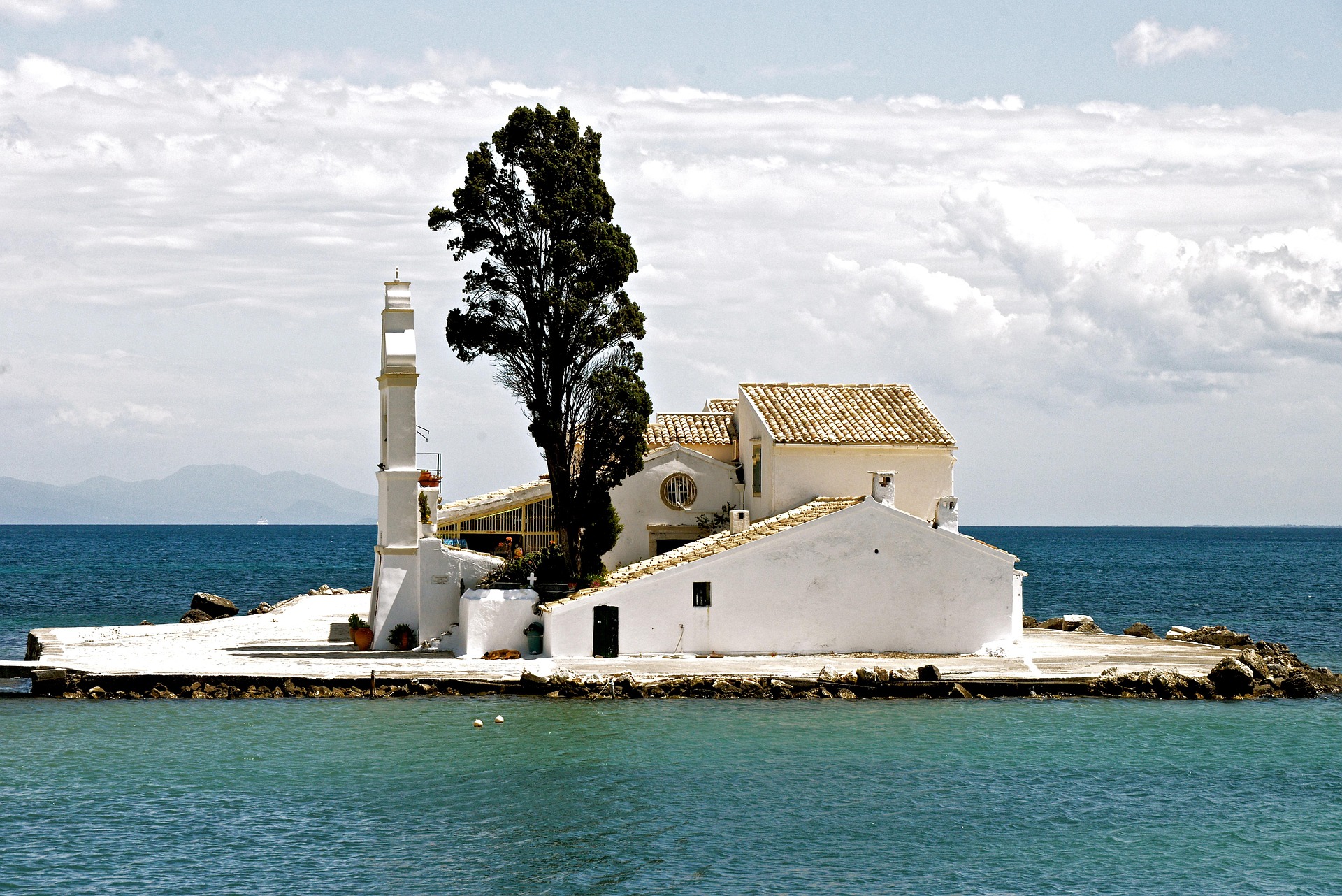
Kanoni and Pontikonisi: Corfu’s Most Iconic Landscape
There are views in Greece that have been photographed so many times, reproduced on so many postcards and travel websites and social media feeds, that the original risks being overwhelmed by its own image. The view from the Kanoni peninsula toward the Vlacherna monastery and Pontikonisi beyond is one of these views. It is, by almost any measure, the single most reproduced image of Corfu, and it has become so familiar that visitors sometimes arrive expecting to feel less than they do.
What they find, almost invariably, is that the image has not lied. The view is genuinely extraordinary. The bay below the Kanoni promontory, enclosed between wooded hills and open to the sea, contains within a single panorama the white church of Vlacherna on its tiny islet, the causeway connecting it to the shore, and beyond it the dark wooded mass of Pontikonisi rising from water of a blue so vivid and so clear that it seems lit from below. No photograph does it justice, not because photographs are inadequate but because the scale and the light and the sound of the place, the lapping water and the distant bells and the aircraft descending toward the runway that crosses the northern end of the bay, are present only when you are there.
The Kanoni Peninsula
The Kanoni peninsula extends southward from Corfu Town as a narrow finger of land separating the bay of Garitsa to the east from the lagoon of Halikiopoulos to the west. The name derives from the cannon, kanoni in Greek, that was positioned at the tip of the peninsula during the French administration to defend the southern approach to the town. The cannon is long gone, but the name has attached itself permanently to the landscape and to the neighbourhood that has grown up along the ridge of the peninsula above the famous viewpoint.
The road from Corfu Town to Kanoni passes through the southern suburbs and climbs gently onto the peninsula through streets of villas and hotels that become progressively less urban as the road narrows toward the tip. The arrival at the Kanoni viewpoint is announced not by signage but by the sudden opening of the view below, the bay appearing all at once in its full extent as the road reaches the promontory edge.
The viewpoint itself is occupied by a terrace with a cafe, the tables positioned to face the panorama with an unselfconscious directness that acknowledges what everyone is here for. Sitting at one of these tables in May, with the morning light on the water and the bay beginning its daily transition from the pale shimmer of early morning to the deep blue of midday, is one of the most uncomplicated pleasures that a visit to Corfu Town can produce.
Vlacherna: The Monastery on the Water
Below the Kanoni viewpoint, reached by a steep path or road, the causeway to the Vlacherna monastery extends from the shore across a narrow channel of water to the tiny islet on which the monastery church stands. The building is small, its scale appropriate to the islet that barely contains it, and its whitewashed walls and terracotta roofed bell tower have been photographed from the Kanoni viewpoint above so many times that they function as a kind of emblem for the entire island.
The monastery of Vlacherna is dedicated to the Virgin Mary and dates in its current form from the seventeenth century, though earlier religious structures occupied the site before it. The church interior is simple and well maintained, with the characteristic combination of icons, hanging lamps, and the smell of incense and beeswax candles that defines the interior atmosphere of Greek Orthodox churches regardless of their size or importance.
Walking out along the causeway to Vlacherna in May, with the water on both sides and the view of Pontikonisi directly ahead, is one of those simple physical experiences that a place of genuine beauty reliably produces: the sensation of moving into the landscape rather than merely observing it, of entering the view rather than standing outside it.
Pontikonisi: The Mouse Island
The small boat from the Vlacherna causeway reaches Pontikonisi in a few minutes, crossing the short stretch of water that separates the two islets. The landing is simple, a small wooden jetty and a path that winds upward through the dense vegetation toward the Byzantine chapel at the island’s summit.
Pontikonisi is tiny, barely large enough to contain the trees and undergrowth that cover it entirely, and the chapel that crowns it. The chapel of Pantokrator, dating from the twelfth century and one of the oldest Byzantine religious buildings on Corfu, sits in a small clearing at the top of the island, its stone walls and simple form entirely in keeping with the natural surroundings. The interior is small and dark and cool, the walls bearing icons of considerable age, the atmosphere one of the genuine remoteness that the island’s physical separation from the mainland preserves even when boats are arriving every few minutes.
From the chapel terrace, the view back toward Corfu Town and the surrounding landscape is equally rewarding from the reverse direction. The Kanoni promontory with its cafe terrace, the curve of the Garitsa bay, the Old Fortress on its rocky headland, and the modern town spreading up the hillsides beyond all combine into a panorama that places Pontikonisi at the geographical centre of a landscape that has been continuously settled and continuously significant for nearly three thousand years.
The Aircraft and the Bay
Any honest account of Kanoni must acknowledge the aircraft. The runway of Corfu International Airport crosses the northern end of the Halikiopoulos lagoon on a narrow causeway, and arriving and departing aircraft pass directly over the Kanoni area at low altitude. The effect is startling the first time and becomes, surprisingly quickly, part of the particular character of the place.
Aircraft descending toward the runway pass so close to the Kanoni viewpoint that their details are clearly visible, and the noise, while brief and not continuous, is considerable. Rather than detracting from the view, this oddity of geography has become one of Kanoni’s characteristic pleasures: the juxtaposition of the ancient and the entirely modern, the Byzantine chapel and the commercial jet, the timeless blue of the bay and the very contemporary technology passing above it. Plane spotters gather at Kanoni specifically for this experience, and the popularity of the viewpoint owes something to this element of spectacle alongside the more conventionally scenic pleasures of the panorama.
Visiting in May
The Kanoni and Pontikonisi visit is rewarding at any point in the season, but May offers conditions that the summer months cannot replicate. The water in the bay is at its clearest, the vegetation on Pontikonisi at its most vivid green, and the crowds at the viewpoint cafe a fraction of the numbers that July and August bring. A May morning at Kanoni, followed by the short boat trip to Pontikonisi and a walk around the island before the midday heat builds, is one of the most consistently satisfying excursions available to guests staying at Villa Kapella.
The combination of the Kanoni visit with the Garitsa and Anemomilos walk described in the previous article makes for a complete day in the southern part of Corfu Town, one that moves from the archaeological and architectural to the purely scenic with a natural progression that the geography of the area supports perfectly.