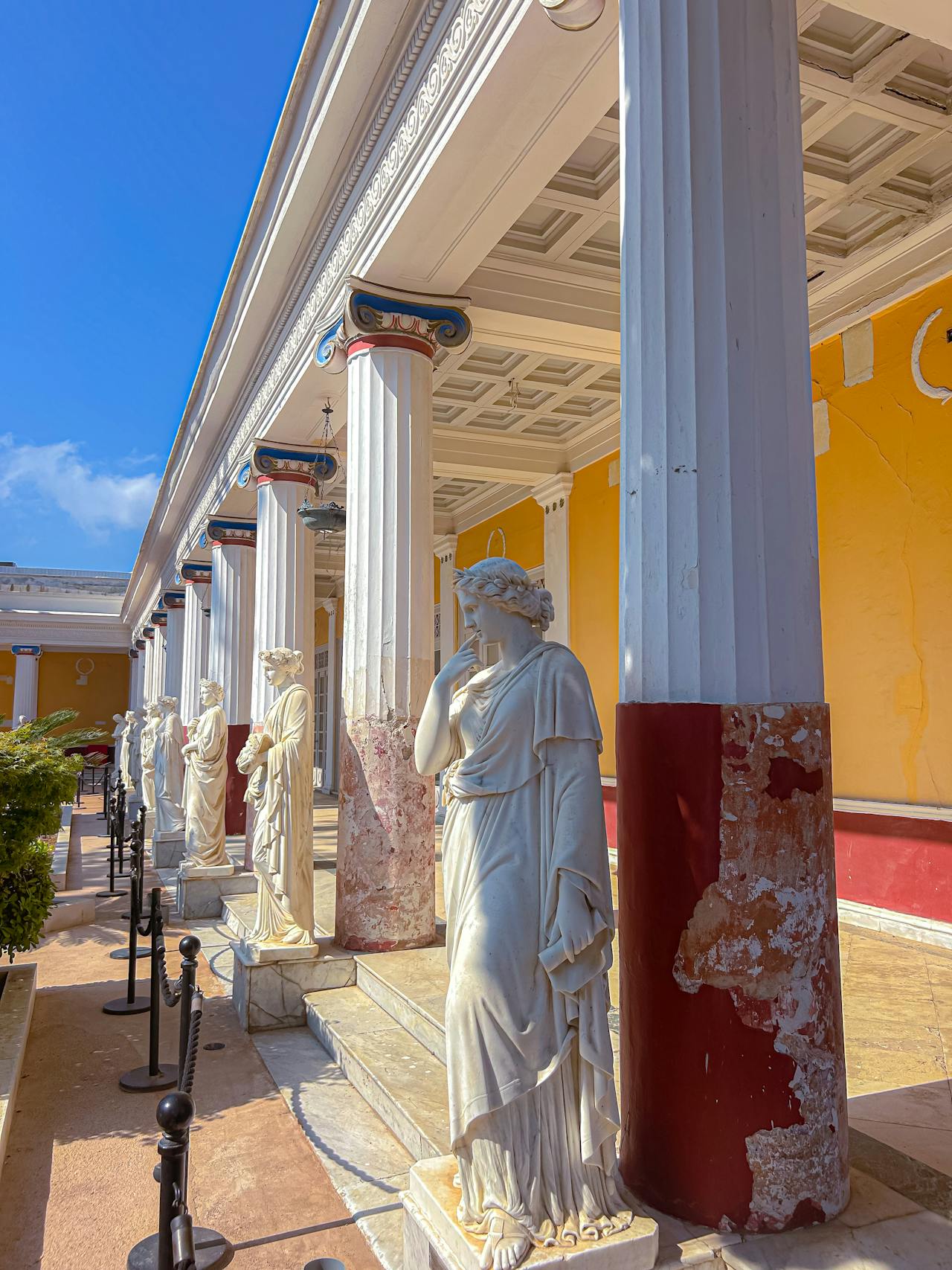
There is a particular kind of place that only a certain combination of wealth, melancholy, and obsessive personality can produce. The Achilleion Palace on the hills above Gastouri, looking south and west across the Corfiot landscape toward the sea, is that kind of place. It was built by one of the most restless and unhappy women of the nineteenth century, decorated according to a personal mythology that she had constructed around the figure of a hero dead for three thousand years, and visited with a regularity and intensity that suggested she found here something she could find nowhere else in the vast empire over which her husband presided.
Empress Elisabeth of Austria, known throughout Europe by the diminutive Sisi, came to Corfu for the first time in 1861 and returned repeatedly over the following decades. She loved the island with the particular devotion of someone who had found, in a place far from the obligations and protocols of her official life, the freedom and the beauty that her temperament required. When she decided to build a permanent retreat on Corfu, she chose a hilltop site above the village of Gastouri, commissioned an Italian architect to realise her vision, and named the result for the hero whose story had become, for her, a mirror of her own.
Elisabeth and Achilles
The identification that Elisabeth made between herself and Achilles was not casual or decorative. It was the expression of a genuine philosophical and emotional alignment that she had developed through years of reading classical literature and that shaped her understanding of her own situation and character.
Achilles, as Elisabeth understood him, was a figure of exceptional gifts and exceptional suffering, a being of such intense physical and spiritual qualities that the ordinary world could not contain him, whose fate was determined by forces beyond his control, and whose greatness was inseparable from his tragedy. The resonance with her own experience, as a woman of unusual intelligence and beauty trapped within the ceremonial constraints of the Habsburg court, was something she felt with a sincerity that the palace she built expresses at every turn.
The sculptures and paintings that she commissioned for the Achilleion reflect this identification. The dying Achilles, a marble sculpture of considerable beauty showing the hero at the moment of his fatal wounding, occupied a prominent position in the original garden arrangement and expressed with sculptural directness the aspect of the Achilles story that Elisabeth found most personally significant. The later bronze of the triumphant Achilles, installed by Kaiser Wilhelm II after he purchased the palace, presents a different and more conventionally heroic interpretation of the same figure, and the contrast between the two statues tells something about the difference between the two personalities that the palace served in succession.
The Palace and Its Architecture
The Achilleion was designed by the Italian architect Raffaele Carito in a style that its creator described as Pompeian neoclassical, combining the formal elements of ancient Greek and Roman architecture with the decorative vocabulary of the nineteenth century historicist tradition. The result is a building that is simultaneously impressive and slightly peculiar, its ambitions larger than its proportions entirely support and its interiors combining genuine quality with the occasional excess that private palaces built to satisfy a specific and intense personal vision tend to produce.
The entrance facade, approached through the formal gardens on the uphill side of the property, presents a colonnaded portico of considerable dignity. The interiors beyond it mix rooms of real architectural quality, the main hall with its painted ceiling and marble floor, with smaller spaces of more personal character where Elisabeth’s particular tastes are more directly visible. The empress’s study, preserved largely as it was during her occupation of the palace, conveys something of the private person behind the public figure with an intimacy that the grander rooms do not quite achieve.
The chapel, small and elaborately decorated, reflects the complex religious sensibility of a woman whose relationship with the official Catholic faith of the Habsburg court was not entirely straightforward. The portraits and personal objects that remain in the palace from the Elisabeth period, her exercise equipment, her writing materials, the evidence of a daily routine conducted with an intensity that bordered on the ascetic, add a biographical dimension to the architectural visit that transforms it from a tour of a historic building into something more like an encounter with a specific and remarkable human life.
The Gardens
The gardens of the Achilleion are, by any measure, among the finest in the Ionian islands and among the most spectacular in Greece. Arranged on a series of terraces that descend the hillside from the palace entrance toward the lower garden, they combine formal design with a natural setting of extraordinary beauty: the hillside dropping away below to the olive-covered plain of the island’s centre, the sea visible in two directions, and on clear days the mountains of the Greek mainland and Albania rising on the eastern and northeastern horizons.
The upper terraces, closest to the palace, are formal in character, with clipped hedges, classical statuary, and the geometric organisation of plants and paths that the neoclassical tradition requires. The bronze Achilles, standing nearly twelve metres tall on his plinth at the edge of the upper terrace, dominates this section of the garden with a presence that is difficult to ignore and that Kaiser Wilhelm II, who commissioned it as a statement of Teutonic martial virtue, intended to be precisely as overwhelming as it is.
The lower terraces are more naturalistic, the planting less rigidly controlled and the atmosphere correspondingly more relaxed. The views from the lower garden, particularly from the terraces that look directly south and west toward the sea, are among the finest that can be had from any fixed point on the island. In June, with the early summer vegetation in full growth and the sea below beginning its summer blue, these views from the Achilleion gardens are worth the visit on their own terms, independent of everything the palace itself offers.
Kaiser Wilhelm and the Second Chapter
The Achilleion’s second significant occupant, Kaiser Wilhelm II of Germany, purchased the palace in 1907 following a period in which it had stood largely empty after Elisabeth’s assassination. His use of it as a summer residence between 1908 and 1914 added a second biographical layer to the building that the visit to the palace makes impossible to ignore.
Wilhelm’s modifications to the palace and gardens, which included the installation of the triumphant Achilles bronze and various additions to the interiors, reflect a personality and a set of values quite different from those of the palace’s founder. Where Elisabeth was essentially private, melancholic, and driven by a personal mythology of loss and beauty, Wilhelm was extrovert, politically engaged, and interested in the palace primarily as a stage for the kind of imperial self-presentation that his temperament demanded.
The contrast between the two occupants and their approaches to the same building is one of the more interesting historical subtexts of a visit to the Achilleion. The palace that Elisabeth built to escape the obligations of empire became, under Wilhelm, a venue for the exercise of imperial display. The hero she chose for his suffering became, in Wilhelm’s interpretation, a symbol of military triumph. The private retreat became a diplomatic and social address. The building survived both these uses and remains, today, most legibly the creation of its first and more interesting owner.
Visiting in June
The Achilleion is open to visitors throughout the season and in June offers the combination of full accessibility and manageable visitor numbers that the peak summer months cannot guarantee. The gardens in June are at the height of their early summer beauty, the palace interiors accessible without the queues that the most popular Corfu attractions accumulate in July and August, and the hilltop setting, with its panoramic views and its cool breeze above the summer heat of the plain below, makes the visit physically as well as culturally rewarding.
For guests at Villa Kapella, the Achilleion represents one of the island’s essential cultural destinations, a place that adds a dimension of European history and personal biography to the natural and architectural pleasures that Corfu offers in such abundance. A morning at the palace and gardens, followed by lunch in the nearby village of Gastouri and an afternoon drive back through the olive country toward the villa, is one of the most satisfying day programmes that the island offers in June.