Garitsa and Anemomilos: Corfu Town’s Most Elegant Seaside Neighbourhoods
Every city of substance has its quieter quarters, the neighbourhoods that the tourist maps mark but that the majority of visitors pass through without stopping, drawn always toward the more loudly celebrated attractions that crowd the centre. In Corfu Town, those quieter quarters are Garitsa and Anemomilos, and the visitors who do stop, who slow their pace along the seafront promenade or turn into the residential streets to look at the neoclassical villas behind their garden walls, consistently find that these two neighbourhoods offer something the Old Town, for all its extraordinary richness, cannot: the experience of a city at rest, going about its daily life in surroundings of considerable elegance.
The Geography of Elegance
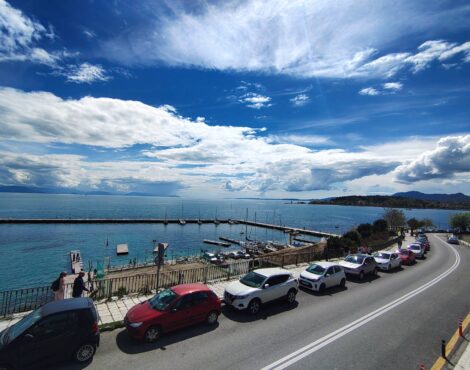
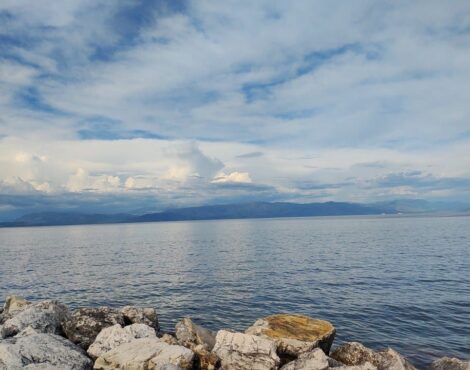
Garitsa and Anemomilos occupy the southern extension of Corfu Town, curving away from the base of the Old Fortress along the shoreline of Garitsa bay toward the narrow neck of land that connects the town to the Kanoni peninsula. The bay itself is one of the finest urban waterfronts in Greece, a broad curve of calm water enclosed between the rocky promontory of the Old Fortress to the north and the wooded hills of Kanoni to the south, with the Albanian mountains visible on the eastern horizon across the channel.
The geography has always favoured settlement. The bay provided shelter for the vessels of ancient Corcyra, whose harbour facilities occupied this stretch of coastline for centuries before the Venetians reorganised the town’s relationship with the sea. The level ground behind the shoreline, protected from the worst winds and blessed with morning sun, attracted the aristocratic and professional classes of nineteenth century Corfu Town, who built the neoclassical villas and walled gardens that give the area its distinctive character today.
The Seafront Promenade
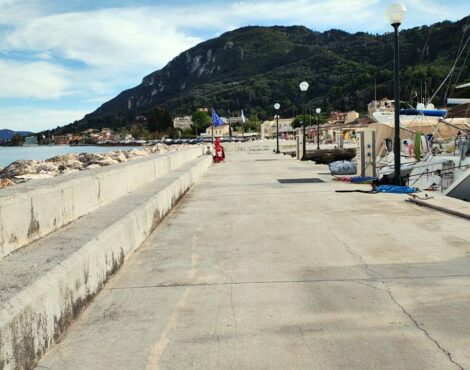
The Garitsa seafront promenade is one of the most pleasant walking routes in Corfu Town, and one of the least celebrated. Running along the curve of the bay from the vicinity of the Old Fortress southward toward the Anemomilos headland, it is lined with mature trees that provide shade and the particular quality of dappled light that only old trees produce. Benches face the water at regular intervals, and the view across the bay toward the Old Fortress, its towers and walls reflected in the calm morning sea, is one of the finest urban prospects the island offers.
The promenade is at its best in the early morning and the evening, when Corfu Town residents use it for the regular walking that is one of the enduring habits of Greek urban life. In May, with the air still carrying the freshness of spring and the sea beginning its slow warming toward summer temperature, a morning walk along the Garitsa promenade has a quality of uncomplicated pleasure that the more celebrated walks of the Old Town, for all their historical richness, do not quite replicate.
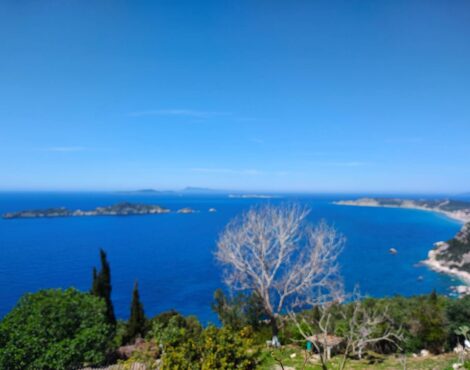
At the southern end of the promenade, where the road curves around the Anemomilos headland, the view opens to the south toward Kanoni and the famous double bay where the islet of Pontikonisi sits surrounded by its circle of extraordinarily blue water. This view, glimpsed first from the Anemomilos promontory, prepares the walker for the more complete panorama that the Kanoni viewpoint delivers, and the walk from the Garitsa promenade to the Anemomilos point and on toward Kanoni is one of the most rewarding half-day routes available in Corfu Town.
The Neoclassical Villas
The streets behind the Garitsa seafront contain the greatest concentration of neoclassical architecture in Corfu Town outside the official public buildings of the Spianada area. The villas that were built here during the nineteenth century, many of them commissioned by members of the Corfiot aristocracy and professional classes who prospered under British administration, represent a distinct chapter in the island’s architectural history and one that receives considerably less attention than the Venetian and French periods that preceded it.
The neoclassical style that these villas employ is not the grand institutional classicism of the Palace of St Michael and St George or the Liston. It is a more domestic, more personal expression of the same classical language, applied to private residences with a freedom and inventiveness that official architecture rarely permits. Pediments above doorways, pilasters framing windows, iron balconies of considerable delicacy, walled gardens with mature trees whose canopies extend above the garden walls into the street, all combine to create a streetscape of genuine architectural quality that rewards slow walking and attentive observation.
Many of the villas are still private residences, their interiors inaccessible but their exteriors available to the attentive walker. Others have been converted to institutional or commercial uses, their original character preserved to varying degrees. The most significant, the Villa Evraiki and the surrounding properties that once formed the heart of Corfu Town’s Jewish aristocratic quarter, carry layers of social history that add depth to the purely architectural pleasure of the neighbourhood.
Anemomilos: The Windmill Point
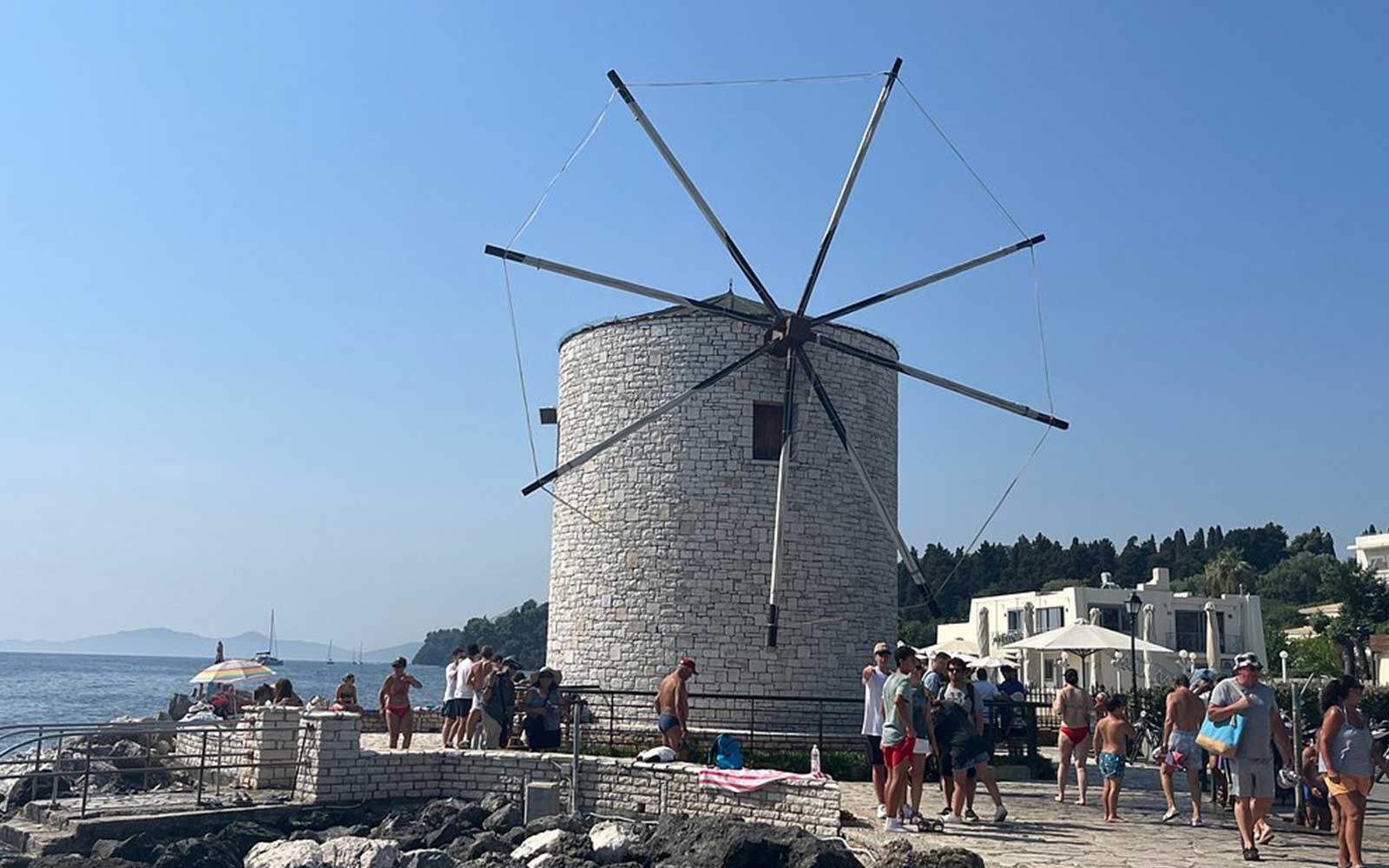
The name Anemomilos means windmill in Greek, and the promontory at the southern end of the Garitsa seafront takes it from the windmills that once stood on this exposed point, harnessing the prevailing winds that move across the bay to grind the grain that fed the city. The windmills are long gone, replaced by the road and the small development that occupies the headland today, but the name persists as a reminder of the working, functional landscape that existed here before the nineteenth century transformation of the area into a residential neighbourhood.
The Anemomilos area today retains several of the finest neoclassical villas in Corfu Town, set on the slightly elevated ground of the promontory with views across the bay that their original owners chose deliberately and that remain among the most enviable residential prospects on the island. The combination of water views, mature garden vegetation, and the architectural quality of the buildings themselves gives Anemomilos a character that is simultaneously urban and remarkably peaceful, a neighbourhood that feels, even in the middle of the day, as if it exists slightly apart from the busier city to the north.
Ancient Garitsa Beneath the Modern Neighbourhood
Walking through Garitsa with knowledge of what lies beneath the modern streets adds a dimension to the neighbourhood that the architectural pleasures of the surface only partially suggest. The area around Garitsa bay was the heart of ancient Corcyra, the Greek colonial city founded by Corinthian settlers in the eighth century BC that grew to become one of the most powerful and prosperous cities in the archaic Greek world.
The tomb of Menekrates, the archaic funerary monument whose lion is one of the treasures of the Archaeological Museum, stands in a small enclosure near the Garitsa seafront, a reminder that the pleasant residential streets above conceal archaeological deposits of considerable significance. The ancient city’s layout, its harbours, its temples, and its residential quarters have been partially traced by excavation over many decades, and the map of ancient Corcyra overlaid on the modern street plan of Garitsa reveals a continuity of urban occupation stretching back nearly three thousand years.
Exploring in May
May brings Garitsa and Anemomilos to a particular form of beauty. The mature trees of the gardens and the promenade are in full leaf, the neoclassical facades are lit by the warm spring light, and the bay is beginning to show the deep blue that will characterise it through the summer months. The neighbourhoods are quiet in May, their residential character preserved by the relative absence of the tourist activity that fills the Old Town to the north.
For guests at Villa Kapella exploring Corfu Town in May, Garitsa and Anemomilos offer a complement to the more concentrated historical experiences of the Old Town. An afternoon that begins with the Archaeological Museum, continues along the Garitsa promenade, and ends at the Anemomilos viewpoint with the bay spread below and the first warmth of the evening settling over the water is one of the small, complete pleasures that a May stay on Corfu consistently delivers.