The Venetian Gates of Corfu Town: Ancient Entrances to a Fortified City
To enter Corfu Town through one of its surviving Venetian gates is to pass through a threshold that separates not merely one part of the city from another but one era from another. The gates that the Venetian administration built and rebuilt over four centuries of occupation were not decorative features. They were instruments of control, the points at which a maritime empire asserted its authority over the movement of people and goods, the last lines of defence between the city and its enemies, and the most immediate expression of Venetian power in stone.
Several of these gates survive. They stand, some restored and prominent, others worn and easily overlooked, as among the most significant physical remnants of the period that shaped Corfu Town more completely than any other in its long history. Understanding them is to understand something essential about how the Venetians conceived of their city, and why Corfu Town looks and feels so unlike any other town in Greece.
Venice and the Fortified City
Corfu came under Venetian control in 1386, when the island’s own administrators, threatened by repeated Ottoman raids and unable to defend themselves adequately, voluntarily submitted to Venetian protection. For Venice, Corfu was not merely another territorial acquisition but a strategic necessity: the gateway to the Adriatic, the first and last port of call for the merchant fleets that sustained the Republic’s commercial empire, and a military position of such importance that its loss would have been catastrophic.
The Venetians understood fortification with a thoroughness that reflected centuries of experience defending island and coastal positions against enemies who were frequently more numerous and sometimes better armed. Their approach to Corfu was systematic and continuous. Over four centuries of occupation, they rebuilt the Old Fortress on its rocky promontory, constructed the New Fortress on the high ground to the northwest of the town, surrounded the inhabited areas with walls and bastions, and controlled every point of entry with gates designed to be both physically strong and administratively functional.
The result was one of the most comprehensively fortified cities in the Mediterranean, a place that the Ottomans besieged repeatedly and never succeeded in taking, and whose survival as a Venetian possession helped determine the broader balance of power in the eastern Mediterranean for three centuries.
The Spilia Gate: The Sea Entrance
The Spilia Gate, cut through the base of the Old Fortress on its western, town-facing side, was the primary entrance between the town and the fortress complex and served also as the main point of arrival for those coming from the sea. The name derives from the Greek word for cave, a reference to the tunnel-like quality of the passage through the massive fortification walls.
Passing through the Spilia Gate today, the visitor moves from the sunlit space of the small harbour into a darkness that is brief but complete, the walls close on either side and the thickness of the Venetian masonry apparent in the length of the passage before the light of the fortress interior opens ahead. This is not an accidental effect. The Venetian engineers who designed the gate understood that a controlled passage through a thick wall is inherently more defensible than a simple opening, and the physical experience of passing through the Spilia Gate communicates something about Venetian military thinking that no description can fully convey.
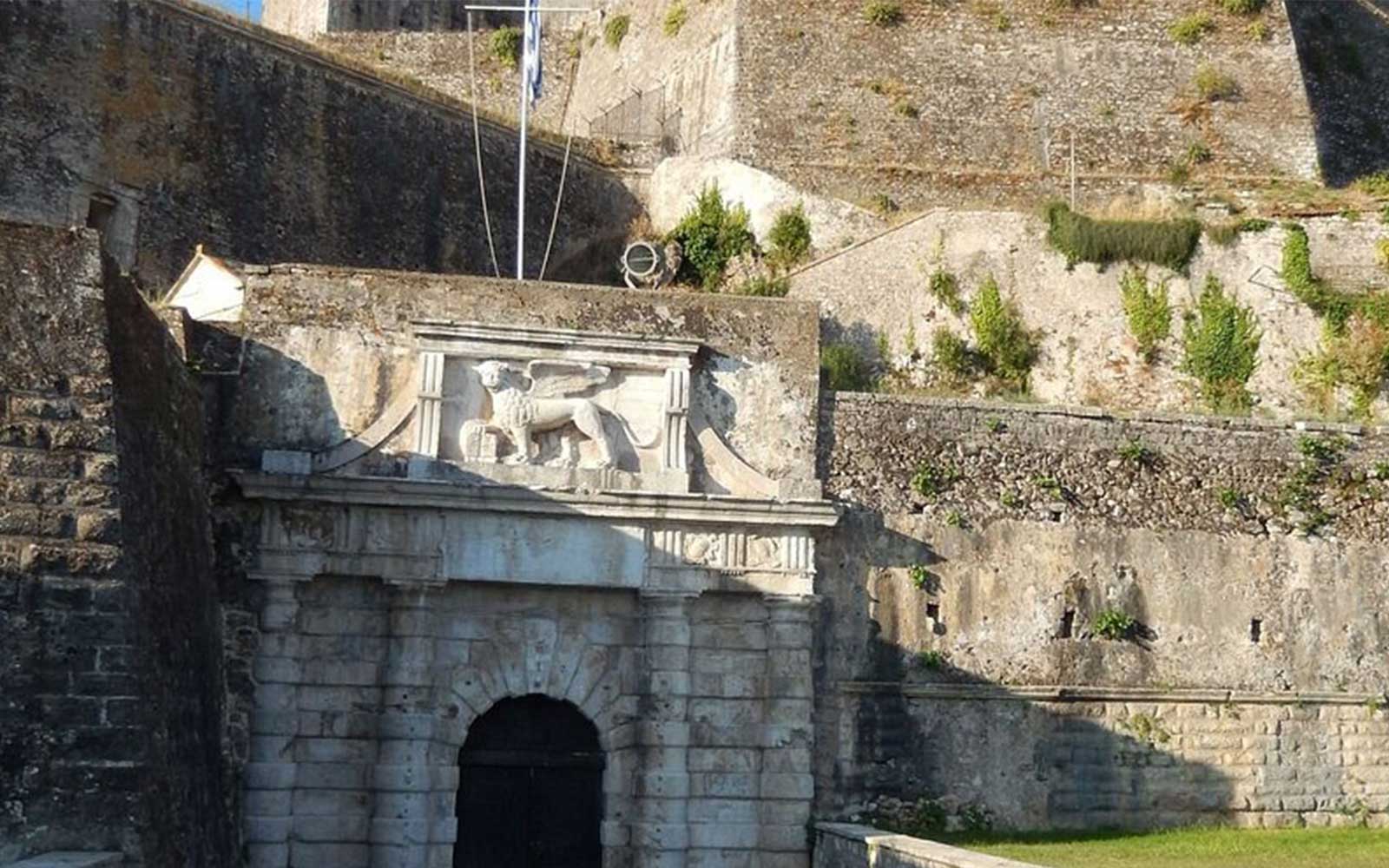
The gate retains its original stonework in large sections, with the marks of Venetian masons still visible on the dressed blocks that frame the entrance. The winged lion of St Mark, the symbol of the Venetian Republic that once appeared above every significant gate and public building in the city, was removed or defaced at various points in the island’s subsequent history, but traces of its presence can still be found by attentive observers at several points along the old fortification walls.
The Gates of the New Fortress
The New Fortress, constructed in the second half of the sixteenth century on the high ground of San Marco hill to the northwest of the old town, incorporated gates that reflected the advances in military engineering that the intervening century had produced. Where the older gates of the Byzantine and early Venetian periods were primarily designed to control a single point of entry, the New Fortress gates were integrated into a more sophisticated system of bastions, outworks, and overlapping fields of fire that represented the state of the art in Renaissance fortification.
The main gate of the New Fortress, facing the town on its eastern side, retains its Venetian stonework and the carved relief that once identified the gate’s importance within the overall defensive system. The approach to the gate through the surviving sections of the outer walls gives a clear impression of how a determined attacker would have faced multiple defensive obstacles before reaching the gate itself, and how the gate’s defenders could bring fire to bear on any force that reached the walls.
The interior of the New Fortress is now partially accessible to visitors, and the view from its upper levels across the town, the harbour, and the sea beyond rewards the walk through the gate with one of the finest panoramas available in Corfu Town.
Reading the Gates: Venetian Symbols and Inscriptions
The Venetian gates of Corfu Town were not merely functional structures. They were also statements of authority, carrying the symbols and inscriptions that the Republic used to mark its territory and assert its legitimacy. The winged lion of St Mark, present above gates and public buildings throughout the Venetian maritime empire from Bergamo to Cyprus, appeared prominently on the major gates of Corfu Town, reminding every person who passed through that they were entering a space governed by the laws and protected by the power of the Serenissima.
Inscriptions recording the dates of construction and the names of the provveditori, the Venetian governors responsible for specific building campaigns, survive on several of the gate structures. These inscriptions are in Latin, the administrative language of the Republic, and their formal phrasing reflects the Venetian habit of recording their works with a combination of practical specificity and rhetorical grandeur that characterises the Republic’s self-presentation throughout its history.
The Gates in May
For visitors exploring Corfu Town in May, the Venetian gates provide some of the most rewarding destinations on a walking tour of the Old Town. The quality of the May light, warm and clear without the harsh overhead intensity of midsummer, is particularly suited to the reading of stonework, bringing out the texture and colour of the Venetian masonry in ways that midday summer light flattens and obscures.
The relative quiet of May, before the full summer season brings its crowds to every corner of the Old Town, allows the gates to be approached and examined at leisure. Standing before the Spilia Gate or the entrance to the New Fortress in May, with time and space to look properly, is to engage with the physical reality of the Venetian city in a way that the busier months make more difficult.
For guests staying at Villa Kapella during the early weeks of the season, a day spent in Corfu Town with the Venetian gates as its focus provides a depth of historical engagement that complements the natural beauty and outdoor pleasures that the island offers in such abundance during May and the months that follow.