Corfu’s Traditional Easter Foods: Lamb, Tsoureki and Holy Week Flavors
Greek Easter is, above all things, a feast. The forty days of Lent that precede it, observed with varying degrees of strictness across different generations and households, are defined in large part by what they exclude from the table. Meat, dairy, eggs, fish, oil on certain days, the accumulated absences of the fasting period build toward a single moment of reversal. When the priest raises the Holy Light at midnight on Holy Saturday and the congregation erupts in the proclamation of the Resurrection, what follows is not merely a religious celebration but the beginning of one of the most food-centred festivals in the European calendar.
In Corfu, the Easter table carries the island’s distinctive culinary fingerprints. The foundations are shared with the rest of Greece, lamb and tsoureki and red eggs and magiritsa. But the details, the particular recipes that Corfiot bakers and cooks have maintained through generations, reflect an island whose kitchen was shaped by Venetians, French administrators, and British colonists as well as by the Greek Orthodox tradition that underlies everything.
The Night Before: Magiritsa
The midnight Resurrection service ends and the fast breaks. In homes and restaurants across Corfu, the first food of Easter is magiritsa, the lamb offal soup that Orthodox Greeks eat in the small hours of Holy Sunday morning, still holding their lit candles, still wearing the good clothes they put on for church.
Magiritsa is an acquired taste that most Greeks acquire in childhood and carry for life. The soup is made from the internal organs of the lamb, chopped finely and combined with spring onions, fresh dill, and a generous finish of avgolemono, the egg and lemon sauce that is one of the foundations of Greek cooking. The result is rich, aromatic, and deeply savoury, a soup that manages to be both delicate and intensely flavoured at once.
In Corfu, the magiritsa recipe carries local variations that distinguish it from the versions found on the mainland. The precise balance of herbs, the treatment of the offal, the consistency of the final soup, all of these details are the subject of strong family opinions and gentle inter-household competition. Every Corfiot family believes, with complete sincerity, that their grandmother’s magiritsa is the definitive version.
Easter Sunday: The Lamb
The lamb begins its journey to the table long before lunch is served. Across Corfu on Easter Sunday morning, the smoke rises from courtyards, gardens, village squares, and hillside clearings where families have gathered to tend the spit from early in the day. The preparation of the spit roasted Easter lamb, kokoretsi alongside it for those who prefer the offal course cooked over fire rather than simmered in soup, is a social ritual as much as a culinary one.
The men tend the spit, rotating it steadily over the charcoal with the particular focused attention that the task demands and that provides a legitimate reason to stand around a fire drinking wine at nine in the morning. The women prepare the salads, the mezedes, the Easter bread, and the various accompaniments that will surround the lamb on the table. The children run between the adults and the fire, stealing small pieces of crackling skin from the edges of the lamb as it reaches readiness.
When the lamb is finally carved and brought to the table, the meal that follows is one of the year’s great pleasures. The meat, having roasted slowly for several hours, is tender and fragrant with herbs. The salads are dressed simply with the island’s own olive oil. The wine is local and served generously. The conversation is loud and simultaneous and entirely unconcerned with its own resolution. Easter Sunday lunch in Corfu is not a meal that ends quickly or quietly.
Tsoureki: The Easter Bread
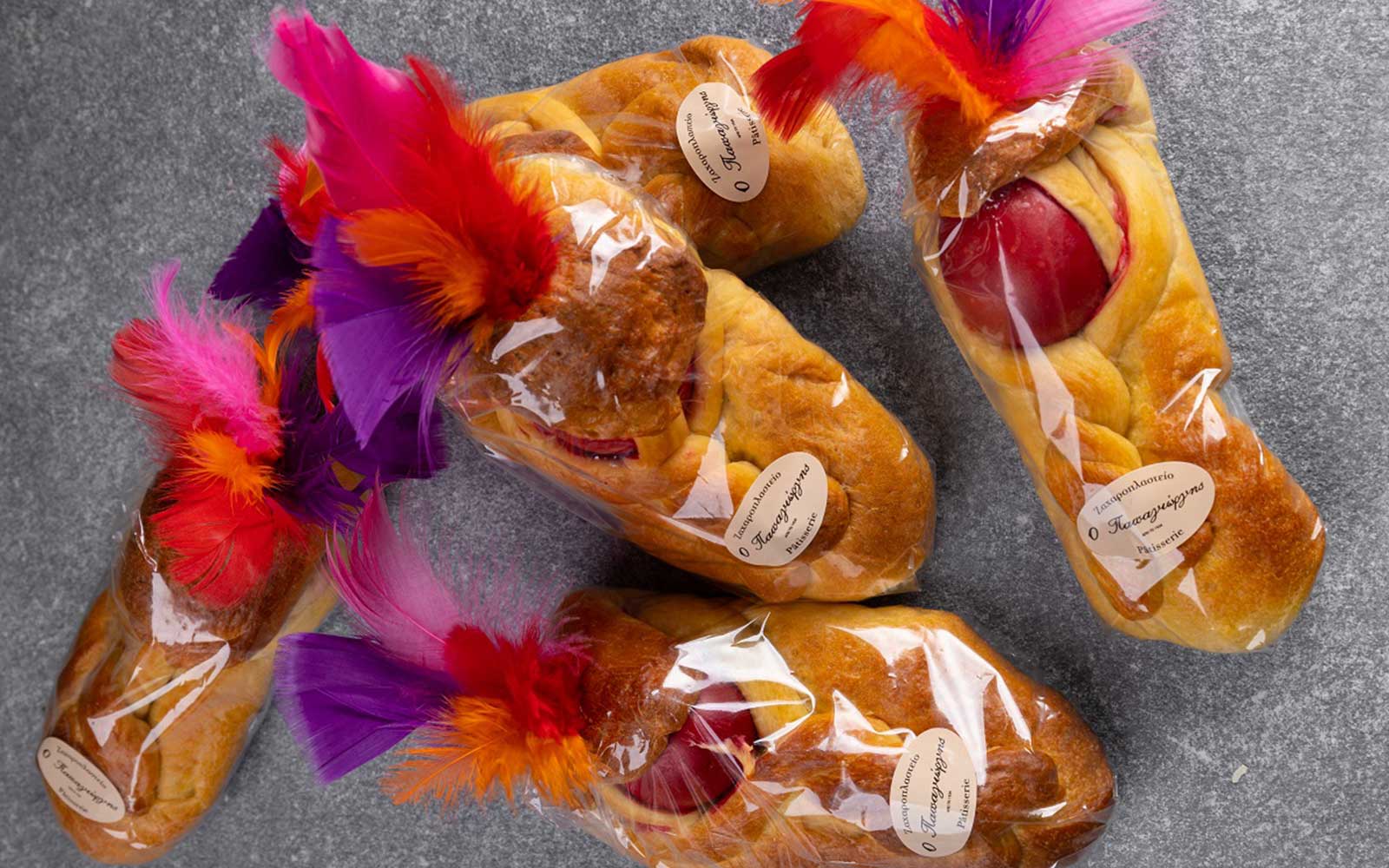
In the days before Easter, Corfu Town’s traditional bakeries fill with the aroma of tsoureki, the sweet enriched bread that is as central to the Greek Easter as the lamb itself. Baked in braided loaves and flavoured with mahlab, the ground cherry kernel spice that gives tsoureki its distinctive slightly bitter, almond-adjacent perfume, and sometimes mastic from the trees of the nearby island of Chios, the bread is simultaneously a pastry and a ritual object.
The red egg pressed into the dough before baking is the bread’s most immediately striking visual element. The egg, dyed the deep crimson that represents the blood of Christ, sits in a nest formed by the braided dough and bakes alongside the bread until the loaf is golden and the egg shell has taken on a slightly matte, baked quality that distinguishes it from an ordinary hard boiled egg.
Corfiot bakeries produce tsoureki throughout Holy Week, and the quality varies considerably between establishments. The finest versions, baked in the traditional family-owned shops of the old town where the recipes have been maintained for generations, achieve a texture that is simultaneously light and rich, tearing apart in long, feathery threads that speak to both skill and patience in the baking.
Red Eggs and the Cracking Game
The red eggs that decorate the tsoureki and appear in bowls on every Easter table are more than ornament. They are the props for one of the most enduring and universally observed Easter rituals in Greek culture. The tsougrisma, the egg cracking game played at the Easter table, pits one egg against another as participants attempt to crack their opponent’s shell while preserving their own.
The rules are simple and the stakes purely ceremonial, but the game is taken seriously. Holders of particularly hard shelled eggs are regarded with a combination of admiration and suspicion. The person whose egg survives all challengers is said to enjoy good luck for the coming year, a claim that every winner accepts with becoming modesty.
The Sweets of Holy Week
The Easter season in Corfu supports a wider world of traditional sweets and pastries that are worth seeking out beyond the tsoureki. The island’s pastry shops produce kourambiedes, the white powdered shortbread biscuits that appear at Easter as well as Christmas, alongside melomakarona, honey dipped spiced cookies, and a range of Venetian-influenced pastries that reflect Corfu’s particular culinary history.
The covered market in Corfu Town and the traditional shops of the Campiello quarter are the best places to find these Easter specialities during Holy Week. Arriving early in the day is advisable, particularly in the days immediately before Easter Sunday, when the most popular items sell quickly and the most accomplished bakers find themselves unable to produce their goods fast enough to meet demand.
Easter in Corfu is a full sensory experience, and the table is as central to that experience as the processions, the music, and the extraordinary pot throwing of Holy Saturday morning. To eat well at Easter in Corfu is to participate in something that the island has been doing, with undiminished conviction and appetite, for a very long time.