Traditional Lacemaking: Corfu’s Disappearing Textile Heritage
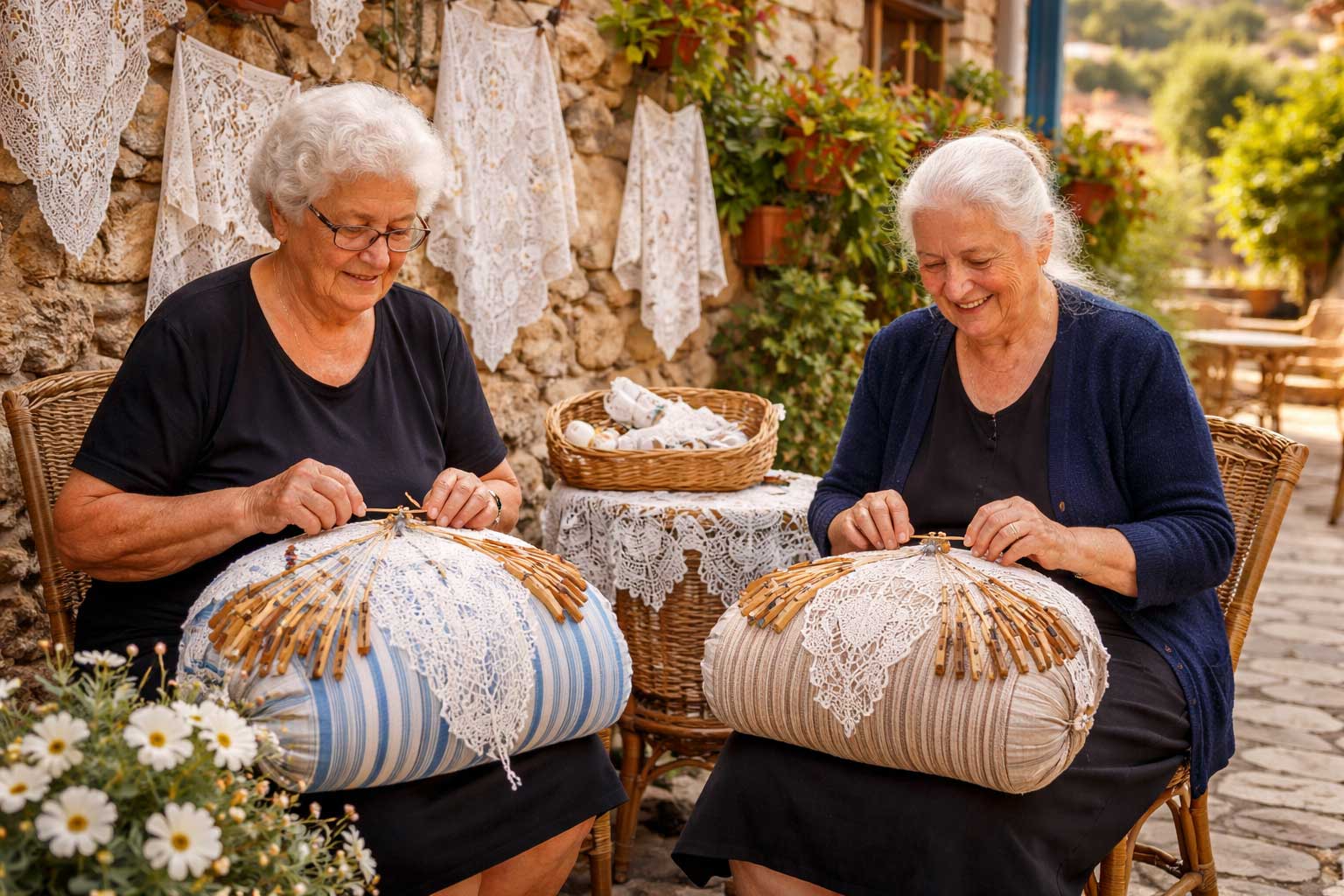
In dim village homes, elderly women’s fingers move with practiced precision creating delicate lace patterns their grandmothers taught them decades ago. These artisans, often in their seventies and eighties, represent final generation maintaining textile traditions spanning centuries. Their knowledge, accumulated through childhood observation and years of practice, disappears incrementally as each practitioner passes without apprentices learning complex techniques requiring patience and dedication incompatible with modern life’s pace and economic realities. Understanding Corfu’s lacemaking heritage reveals cultural dimension facing extinction within years, traditional knowledge vanishing irretrievably unless urgent documentation and preservation efforts succeed against demographic and economic forces rendering traditional handicrafts economically unviable and culturally obsolete to younger generations pursuing education and careers offering futures handwork cannot provide.
Historical Context and Development
Lacemaking arrived in Greece through multiple cultural channels, Venetian influence particularly strong in Ionian islands including Corfu. The four-century Venetian rule introduced Italian lace techniques and aesthetic preferences that merged with existing Greek textile traditions creating distinctive regional styles.
Venetian patrician women brought bobbin lace and needle lace techniques to Corfu during the 15th-18th centuries. Local women, observing and learning from Italian examples while maintaining own traditions, created hybrid styles incorporating Venetian technical sophistication with Greek decorative sensibilities and pattern preferences.
Convents and religious institutions served as lace production and teaching centers. Nuns, maintaining traditional crafts while performing religious duties, preserved techniques and trained young women in skills considered appropriate feminine accomplishments. Ecclesiastical lace for vestments, altar cloths, and religious purposes provided both spiritual and practical motivation.
Dowry traditions incorporated handmade lace extensively. Young women spent years creating trousseau linens decorated with elaborate lace demonstrating skill, patience, and suitability for marriage. The quality and quantity of lace reflected family status and bride’s accomplishments, creating strong motivation for learning and practicing craft.
Social distinction attached to lace quality and complexity. Wealthy families commissioned elaborate pieces while less affluent households produced simpler work within their capabilities. However, even modest homes valued handmade lace representing invested time and skill beyond mere monetary cost.
Regional variations developed as villages created distinct pattern preferences and technical variations. These local styles, passed mother to daughter through generations, created identifiable characteristics allowing experts recognizing village of origin from pattern and technique details.
19th and early 20th century industrialization introduced machine-made lace threatening traditional handwork. However, Corfu’s relative isolation and continued value placed on handmade quality preserved traditions longer than more industrialized regions where machine production dominated completely.
Techniques and Materials
Traditional Corfu lacemaking encompasses multiple techniques, each requiring specific skills, tools, and materials while producing characteristic results.
Needle lace (reticella) creates designs by removing warp or weft threads from woven fabric then using needle and thread creating decorative patterns in open spaces. This technique, among the oldest, produces geometric patterns particularly suited to ecclesiastical and formal applications.
The process begins with linen fabric preparation, marking design areas, carefully removing specific threads creating grid, then working needle through remaining threads and open spaces building pattern. Precision and patience essential as errors difficult correcting without starting over.
Bobbin lace uses multiple thread bobbins manipulated according to patterns creating lace through systematic crossing, twisting, and braiding. This technique, mechanically more complex than needle lace, produces flowing, organic designs impossible with needle techniques.
Bobbin lace requires specialized pillow holding pattern, numerous weighted bobbins maintaining thread tension, and pins securing work in progress. The rhythmic manipulation of many bobbins simultaneously demands coordination and concentration developed through extensive practice.
Crochet lace, though technically distinct from true lacemaking, appears frequently in Corfu textile traditions. Single hook creating chain stitches and variations builds dimensional lace-like fabric. This more accessible technique enabled wider participation than complex bobbin or needle methods.
Thread choice dramatically affects final appearance and durability. Traditional work used linen thread spun fine enough for delicate work. Cotton threads became popular later offering different handling characteristics. Silk appeared in luxury pieces. Thread quality and preparation directly impacted finished lace quality.
Dyeing, when practiced, used natural materials including plant extracts, minerals, and insect-derived colors. However, white and natural linen color dominated traditional Corfu lace, the color’s purity and difficulty maintaining it demonstrating quality and care.
Pattern sources ranged from memorized traditional designs passed orally and through observation, to drawn patterns, to later printed pattern books. The transition from purely memory-based knowledge to documented patterns marked significant change in knowledge transmission.
Cultural Significance and Social Functions
Lacemaking transcended mere craft production, serving multiple social and cultural functions integral to traditional Corfu society.
Feminine identity construction through lacemaking skills marked successful socialization into women’s roles. Girls learning from mothers and grandmothers acquired not just technical skills but feminine virtue concepts including patience, attention to detail, and domestic capability.
Social bonding occurred through communal lacemaking sessions. Women gathered working collectively while conversing, sharing news, and maintaining community relationships. These sessions, serving social functions beyond production, created and maintained female solidarity and information networks.
Economic contribution, though rarely primary household income, supplemented agricultural and other earnings. Selling lace pieces at markets or to wealthier households provided money controlled by women, creating limited economic independence within patriarchal structures.
Status expression through lace quality and quantity displayed in homes demonstrated family position and feminine accomplishment. Elaborate lace curtains, table linens, and decorative pieces signaled prosperity and refined sensibility.
Religious devotion expression through creating ecclesiastical lace represented pious offering. Women donating hours creating altar cloths or priest vestments performed spiritual service while demonstrating devotion through skilled labor.
Life passage marking included lace in baptismal gowns, wedding attire, and burial shrouds. These ritual applications invested lace with symbolic significance beyond decorative function, the handwork representing human care and connection across generations.
Intergenerational knowledge transmission through lacemaking teaching created bonds between generations while preserving cultural knowledge. Grandmothers teaching granddaughters maintained techniques and patterns while building relationships spanning age differences.
Contemporary Decline and Causes
Traditional lacemaking faces near extinction in Corfu, multiple interconnected factors driving the craft’s disappearance despite occasional preservation efforts.
Economic unviability represents primary challenge. Handmade lace requires dozens or hundreds of hours creating single piece. At any remotely fair hourly wage, costs become prohibitive. Machine-made alternatives costing fraction of handmade prices eliminate commercial market.
Younger generation disinterest reflects changed aspirations and opportunities. Girls pursuing education and careers view lacemaking as old-fashioned skill offering neither economic return nor modern relevance. The patient sedentary work appeals little to generation valuing other activities and achievements.
Artisan aging without replacement creates inevitable timeline for extinction. Current practitioners predominantly in their seventies and eighties. Without younger apprentices, the knowledge disappears completely within decade or two as final artisans pass.
Technical complexity requires years of practice achieving competence let alone mastery. This extended learning period, once accepted as normal feminine education, now represents opportunity cost few willing accepting when other options provide faster skill acquisition and better economic returns.
Lifestyle changes eliminate time and motivation for intensive handwork. Modern women balancing employment, family, and other responsibilities lack time traditional women dedicated to handcrafts. Even if interested, finding sustained hours lacemaking requires proves impossible for most.
Cultural devaluation of handmade traditional items reflects modernization privileging novel over traditional. Young people viewing traditional crafts as backwards or irrelevant actively reject them rather than valuing cultural heritage preservation.
Tourism misrepresentation through cheap machine-made “souvenirs” labeled as traditional actually undermines authentic craft. Visitors purchasing imported factory lace believing it local handwork removes even small potential market for genuine articles.
Preservation Efforts and Challenges
Despite grim outlook, some individuals and organizations attempt preserving lacemaking knowledge before complete disappearance, though efforts face significant obstacles.
Documentation projects recording techniques through video, photographs, and written descriptions capture knowledge for posterity even when living practice ends. These archives, though not maintaining living tradition, preserve information enabling potential future revival.
Museum collections preserving antique lace pieces provide material evidence of historical practice. However, objects alone cannot convey tacit knowledge embodied in skilled practitioners’ hands and judgment developed through years of practice.
Occasional workshops teaching basic techniques introduce interested parties to craft. However, brief introductory sessions cannot transmit deep knowledge requiring years of practice. These serve awareness raising more than genuine skill transmission.
Cultural festivals sometimes feature lacemaking demonstrations by remaining artisans. These public displays educate audiences while honoring practitioners. However, demonstration contexts prevent deep engagement or serious learning.
Academic research including anthropological and historical studies documents lacemaking’s cultural context and significance. This scholarly attention legitimizes craft’s importance though doesn’t directly preserve practical knowledge.
Artisan cooperation challenges preservation efforts as elderly women sometimes reluctant teaching or demonstrating, viewing knowledge as personal rather than public heritage. Convincing them sharing knowledge serves valuable purpose requires trust and cultural sensitivity.
Funding limitations restrict comprehensive preservation programs. Properly documenting techniques, supporting remaining artisans, creating teaching programs, and maintaining facilities requires sustained financial commitment lacking in current economic climate.
Language barriers complicate international interest. Artisans typically speak only Greek, often local dialect, limiting communication with outside researchers or interested parties without translation assistance.
Economic and Social Barriers
Understanding why lacemaking cannot simply be revived through good intentions requires confronting harsh economic and social realities.
Labor economics make handmade lace economically absurd in modern context. A doily requiring 40 hours at even minimum wage costs hundreds of euros production cost alone. No market exists supporting such pricing for decorative items.
Skill development timeline means anyone seriously learning must commit years unpaid or minimally paid practice before producing marketable work. This investment rational only for independently wealthy or those viewing lacemaking as hobby rather than livelihood.
Market size for authentic handmade lace infinitesimally small. Few people value or can afford genuine articles. Niche luxury market exists theoretically but finding and accessing it requires marketing sophistication beyond individual artisans’ capabilities.
Competition from machine production and imports makes even excellent handwork nearly impossible selling. Customers cannot distinguish handmade from machine-made in casual observation, removing quality advantage.
Social status of traditional crafts as low-prestige work prevents attracting practitioners. Intelligent, capable young people choosing careers seek modern professions offering income, status, and advancement. Traditional handicrafts offer none of these.
Gender dynamics historically making lacemaking exclusively feminine now work against it as women pursue careers historically male-dominated, viewing traditional feminine crafts as limiting rather than liberating.
Geographic isolation of remaining artisans in rural villages limits access for interested learners. Serious study requires relocating or extended rural stays incompatible with most modern lifestyles.
What Can Be Saved
Realistic assessment acknowledges living lacemaking tradition probably cannot be preserved in Corfu. However, certain elements remain salvageable deserving preservation effort despite ultimate practice extinction.
Complete technical documentation including detailed video of experienced artisans demonstrating all techniques preserves knowledge enabling theoretical future revival even after living tradition ends. This documentation, though incomplete substitute for living transmission, represents achievable preservation goal.
Pattern archives collecting and cataloging traditional designs ensures these distinctive expressions preserved. Photographing, drawing, and describing patterns from antique pieces and artisan knowledge creates reference maintaining design heritage.
Oral histories recording artisans’ narratives about learning, practicing, and living with lacemaking captures social and cultural context. These stories, valuable beyond technical content, preserve lived experience and meaning.
Physical collections in museums and cultural institutions ensure future generations can see and study actual pieces. Proper conservation maintaining these artifacts long-term serves educational and inspirational purposes.
Academic studies producing scholarly understanding of lacemaking’s historical, cultural, and technical dimensions creates knowledge base supporting heritage appreciation even absent living practice.
Digital humanities projects creating accessible online archives democratize access to preserved knowledge. Virtual exhibitions, technique videos, and interactive resources enable worldwide engagement impossible with physical-only preservation.
Corfu’s lacemaking tradition, like countless traditional crafts worldwide, faces inevitable extinction within years as final practitioners age without replacement. This loss, though sad, reflects social evolution privileging economic efficiency, educational advancement, and lifestyle choices incompatible with intensive handwork requiring years mastering for economically unviable purposes. Preservation efforts, though ultimately unable maintaining living tradition, can capture knowledge, honor practitioners, and ensure future understanding of what existed before modernity rendered it obsolete. Those witnessing final years of traditional lacemaking, whether through rare demonstrations, museum collections, or elderly artisan encounters, observe not quaint folk art but dying knowledge system accumulated across generations now ending because changed world simply doesn’t value it enough for anyone rationally choosing dedicating life to maintaining it, a loss perhaps inevitable yet loss nonetheless of human knowledge, cultural diversity, and connection to past that once gone can never be fully recovered regardless of documentation efforts preserving shadows of what living tradition once was and soon will cease being entirely when final artisan’s hands still forever.