Exploring Corfu’s Old Town on Foot: A UNESCO Walking Tour
There are cities whose history is best understood through books, and cities whose history is best understood by walking. Corfu Town belongs firmly in the second category. The UNESCO World Heritage designation that the Old Town received in 2007 was not awarded for a collection of isolated monuments that can be ticked off a list and photographed in sequence. It was awarded for an entire urban fabric, a living town whose streets and buildings and public spaces carry, simultaneously and inseparably, the traces of every civilisation that has held and shaped and inhabited this place over the past thousand years.
To walk through Corfu’s Old Town with some knowledge of what you are seeing is to experience something that no museum can replicate: history not as a curated selection of notable objects but as an environment, a place where the past is not displayed but simply present, embedded in stone and paint and the proportions of streets that were laid out when Venice ruled the Adriatic.
Starting Point: The Spianada and the Liston
Every walking tour of Corfu Town begins, naturally and inevitably, at the Spianada. The great open esplanade at the heart of the town is the place where the various historical layers of the city are most immediately legible. Standing at its centre, you can see in a single glance the Old Fortress to the east, the Liston to the west, the Palace of St Michael and St George to the north, and the green expanse of the square itself, where cricket is played on the northern section in a tradition that has survived the departure of the British administration that introduced it by well over a century.
The Liston, the arcaded promenade built by the French in the early nineteenth century and modelled on the Rue de Rivoli in Paris, provides the ideal first stop for a coffee and an orientation. From a table beneath the arches, the logic of the town begins to become clear. The Spianada was created by the Venetians to provide a clear field of fire in front of the Old Fortress, and the entire western edge of the square was subsequently filled with the buildings of successive administrations, each leaving its architectural signature on the same continuous facade.
The Old Fortress
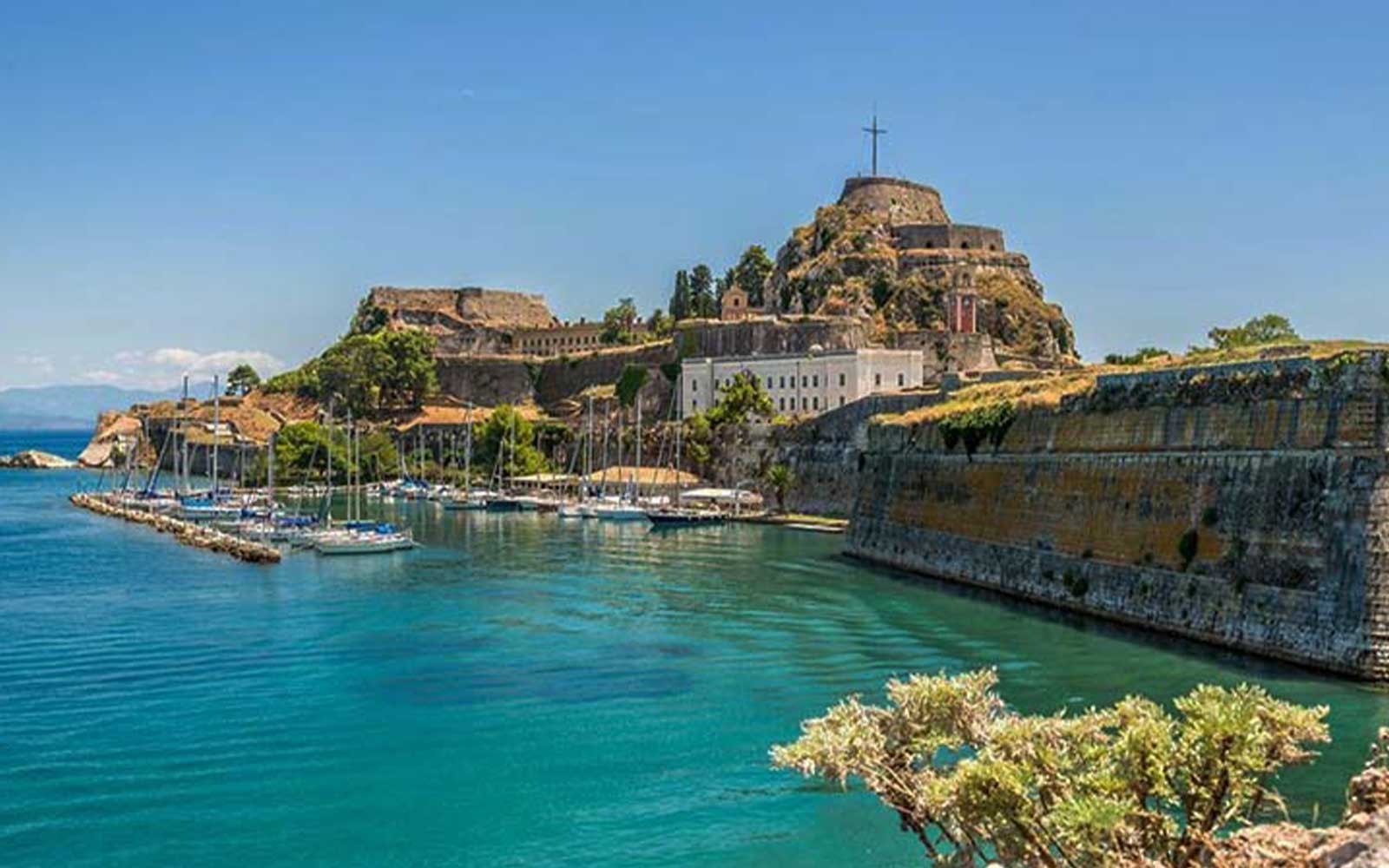
From the Liston, the walk east across the Spianada leads to the bridge that connects the town to the rocky promontory of the Old Fortress. The fortress is not a single building but an entire fortified precinct, its Venetian walls enclosing Byzantine foundations and a British-era church of St George that stands incongruously among the older structures in the neoclassical style that British colonial architecture favoured regardless of local context.
The views from the upper levels of the Old Fortress are among the finest available in Corfu Town. The harbour, the Ionian Sea, the Albanian mountains on the northeastern horizon, and the rooftops and campaniles of the old town below combine into a panorama that rewards the climb. The lighthouse at the fortress tip, operational and functional, marks the point where the Adriatic and Ionian seas meet, a geographical fact that has defined Corfu’s strategic importance for every power that has sought to control this corner of the Mediterranean.
The Campiello: The Medieval Heart
Returning from the Old Fortress and entering the lanes that run behind the Liston, the walker crosses a threshold that the architecture makes immediately apparent. The broad French-era streets give way to something altogether older and narrower. The Campiello, the medieval quarter of Corfu Town, is a labyrinth of lanes and staircases that has been continuously inhabited for centuries and that retains, more completely than any other part of the town, the character of the Venetian city.
The streets of the Campiello are too narrow for vehicles and sometimes too narrow for two people to pass comfortably. They rise and fall with the topography of the hill on which the old town is built, connecting small squares and unexpected courtyards through passages that turn without warning and deliver the walker into spaces that seem to belong to entirely different parts of the city. Washing lines connect opposing windows. Cats occupy every sunny step and doorway. The sound of the broader town fades quickly, replaced by the intimate sounds of a neighbourhood that is still, genuinely and unmistakably, lived in.
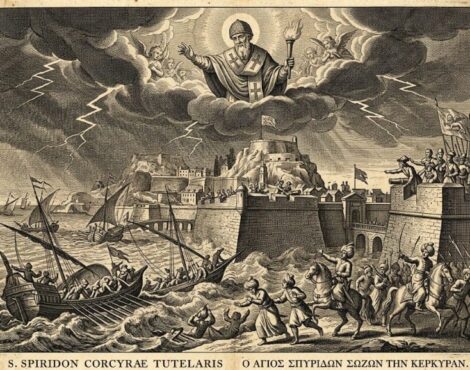
The churches of the Campiello are its most significant architectural features. Orthodox churches of Byzantine origin sit next to Catholic churches built by the Venetian community, and the occasional synagogue remnant marks the presence of a Jewish community that was once substantial and central to the life of the town. The Church of St Spyridon, whose distinctive red dome is visible from across the Old Town, houses the remains of Corfu’s patron saint and is the spiritual heart of the island. On the feast days of St Spyridon, the saint’s silver reliquary is carried in procession through the Campiello and beyond, a ritual that the town has performed four times annually for centuries.
The Palace of St Michael and St George
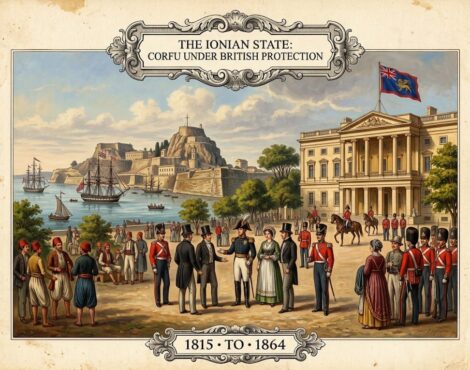
At the northern end of the Spianada, the Palace of St Michael and St George presents its imposing neoclassical facade with the authority of an institution that was designed to project British imperial power and has spent the subsequent two centuries accumulating a more nuanced significance. Built between 1819 and 1824 as the residence of the British Lord High Commissioner, it is now home to the Museum of Asian Art, one of the finest collections of its kind in Greece, and to the permanent exhibition on the history of Corfu’s diplomatic relations.
The palace is worth entering for the museum alone, but the building itself, with its colonnaded facade and the formal gardens that run between it and the Spianada, is one of the finest pieces of British colonial architecture in the Mediterranean and a reminder that the British period on Corfu, though relatively brief and sometimes contentious, left a physical legacy as significant as those of the Venetians who preceded it.
The New Fortress and the Market Quarter
The western side of the Old Town is dominated by the New Fortress, the massive Venetian fortification built in the late sixteenth century to defend the town from the land side. Less visited than the Old Fortress and less immediately picturesque, the New Fortress is architecturally more sophisticated, its design incorporating the latest developments in military engineering of its period. The views from its upper levels look west and north across the new town and the harbour.
Between the New Fortress and the covered market lies one of the most rewarding sections of the Old Town for the walker interested in the everyday life of the city rather than its monuments. The covered market, the surrounding streets of small shops and workshops, and the neighbourhood churches and squares of this part of the old town preserve a character that is less touristic and more authentically Corfiot than the areas immediately around the Spianada.
Walking in April
April walking in Corfu’s Old Town has a quality that the summer months cannot provide. The streets are quiet enough that the architecture can be properly seen and the atmosphere properly felt. The morning light on the Venetian facades, without the crowds that fill every lane in July and August, reveals the town in something close to its natural state. The cafes have space. The museums have no queues. The Campiello has the particular silence of a place not yet aware that it is supposed to be a destination.
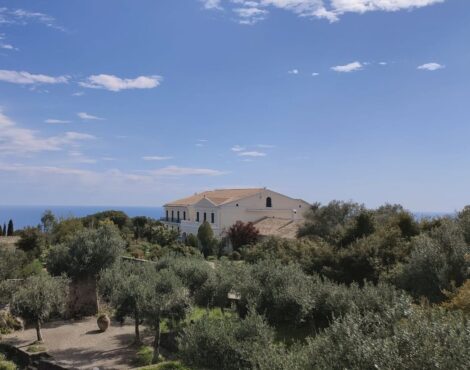
For guests planning a summer stay at Villa Kapella, a day in Corfu Town is among the most consistently rewarding excursions the island offers at any point in the season. The town is accessible from the villa and delivers, every time and in every weather, the specific pleasure of a place that has been genuinely important for a very long time and has not yet forgotten it.