The Archaeological Museum of Corfu: Treasures of the Ancient Ionian World
Before the Venetians built their walls and gates, before the Byzantines constructed their churches, before the Romans administered their province and the Greeks founded their colony, Corfu was already old. The island that classical sources called Corcyra and that mythology identified as the home of the Phaeacians who received the shipwrecked Odysseus was inhabited, traded with, fought over, and artistically productive for centuries before the historical period that most visitors to the island’s monuments encounter. The Archaeological Museum of Corfu exists to tell this deeper story, and it tells it with objects of such quality and significance that the museum deserves to be counted among the finest in Greece.
The Museum and Its Setting
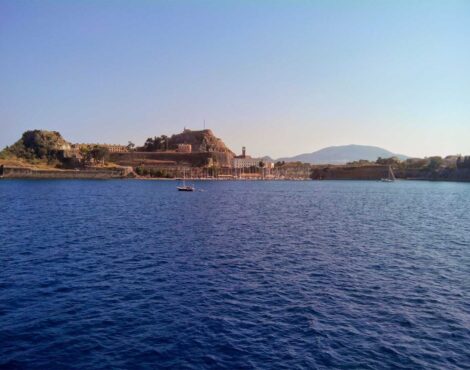
The Archaeological Museum occupies a building in the Garitsa district of Corfu Town, set back slightly from the seafront promenade that runs south from the Old Fortress along the curve of Garitsa bay. The location is significant. The area around Garitsa contains some of the most important archaeological remains on the island, including the site of ancient Corcyra itself, and the museum sits within the landscape it interprets in a way that allows visitors to connect the objects inside with the terrain outside.
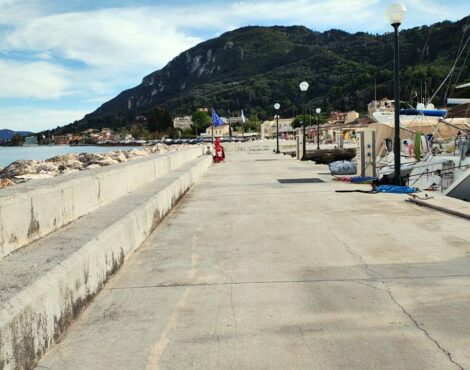
The approach to the museum in May, along the Garitsa seafront with the bay on one side and the tree-lined streets of the neighbourhood on the other, is a pleasant introduction to a part of Corfu Town that many visitors overlook in favour of the Old Town’s more immediately dramatic attractions. Garitsa has a quiet, residential quality that contrasts pleasantly with the Campiello’s intensity, and the walk to the museum is itself a small discovery of a less visited corner of the city.
The Gorgon Pediment: The Great Archaic Marvel
Every museum has a work that justifies the visit on its own terms. At the Archaeological Museum of Corfu, that work is the Gorgon pediment, and it justifies the visit with a force and completeness that few museum pieces anywhere in the world can match.
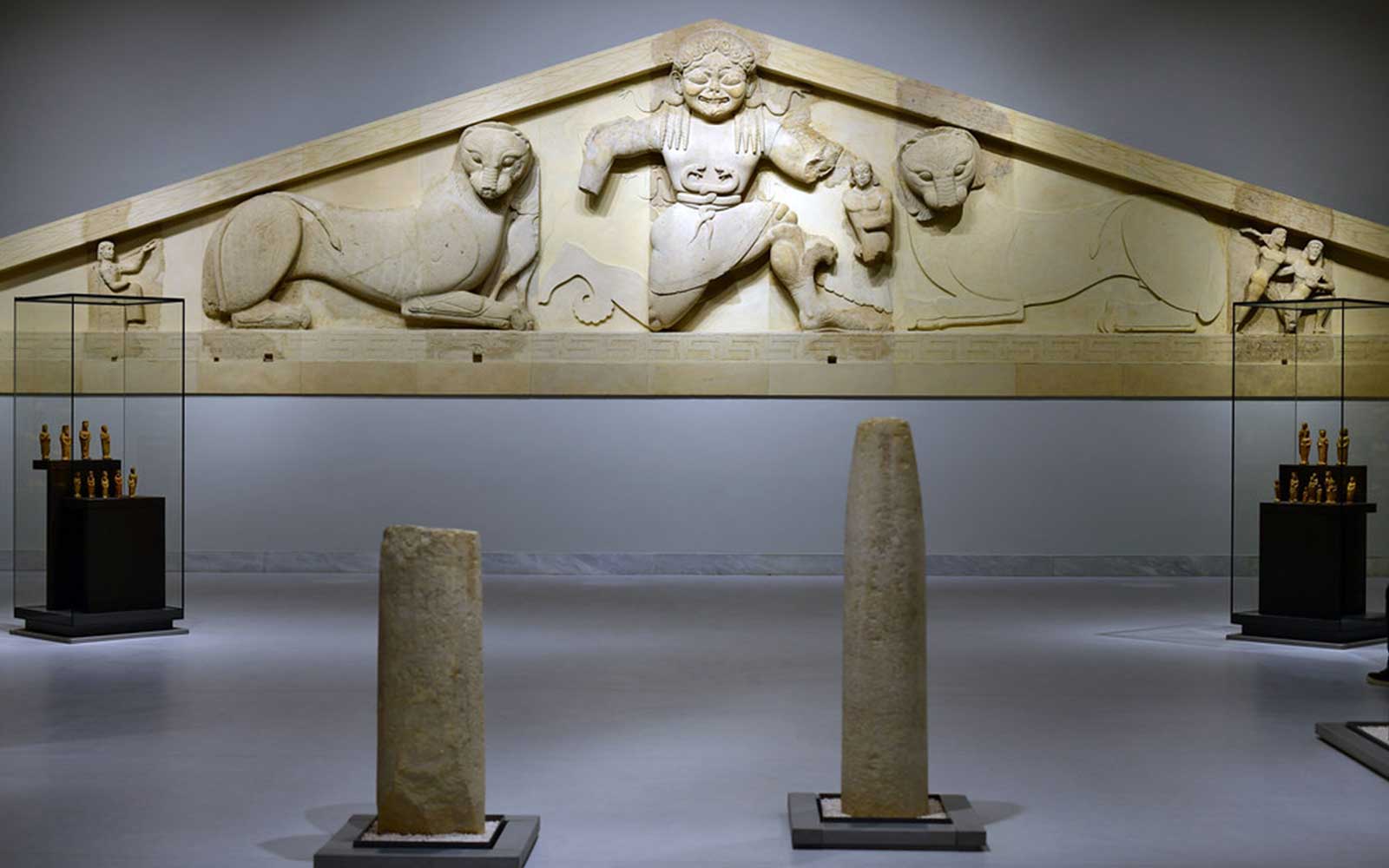
The pediment was carved around 580 BC to decorate the western facade of the Temple of Artemis at ancient Corcyra, one of the earliest monumental Doric temples built in the Greek world. When it was created, it was among the largest architectural sculptures yet attempted in Greece, and the ambition of the undertaking is still apparent in the scale of the finished work. The central figure is the Gorgon Medusa, rendered in the archaic style with a frontal face of extraordinary power, her eyes wide, her mouth open in the characteristic archaic grin that the sculptors of this period used to represent supernatural energy and force.
Flanking Medusa are her children Pegasus and Chrysaor, born at the moment of her death. To either side of the central group, panthers crouch in a heraldic arrangement that reinforces the compositional symmetry. In the corners of the pediment, mythological scenes fill the triangular space with figures at a smaller scale, their identity debated by scholars but their presence contributing to a composition of remarkable complexity for its period.
Standing before the Gorgon pediment in the museum, the scale is the first thing that registers. The pediment is enormous, occupying most of a dedicated gallery wall, and the central figure of Medusa, nearly three metres tall, has a physical presence that photographs do not adequately convey. The second thing that registers is the quality of the carving, still sharp in most areas despite the centuries, and the compositional intelligence of a work that was solving problems of monumental architectural sculpture for which there were, at the time of its creation, very few precedents.
The Lion of Menekrates
The second great object of the Archaeological Museum of Corfu is the Lion of Menekrates, an archaic funerary sculpture dating from the late seventh or early sixth century BC that was discovered near the ancient tumulus tomb of a man named Menekrates, a proxenos, or official representative, of the city of Corinth who died on Corfu and was buried with a distinction that his monument still communicates across twenty-six centuries.
The lion is carved in the archaic manner, compact and stylised, its mane rendered in a pattern of formal curls that is characteristic of the period. It crouches in the position of a guardian, facing outward from the tomb it was built to protect, and despite the abstraction of its archaic style it conveys a sense of contained power that the sculptor achieved through a command of form remarkable for the period.
The Lion of Menekrates is less immediately overwhelming than the Gorgon pediment but in some ways more moving. It is a private object, made for a specific individual at a specific moment of grief and commemoration, and the survival of both the lion and the inscription that identifies its subject gives it a particularity that the great architectural sculpture cannot quite match.
The Broader Collection
Beyond its two great masterpieces, the Archaeological Museum of Corfu houses a collection that traces the history of the island and the surrounding region from the prehistoric period through the Hellenistic era. Pottery from the archaic and classical periods documents the trading connections that made ancient Corcyra one of the most prosperous colonial cities in the Greek world. Bronze objects, coins, terracotta figurines, and funerary monuments fill the galleries with evidence of daily life, religious practice, and artistic production across many centuries.
The collection of archaic pottery is particularly strong, reflecting Corcyra’s position as a major producer and exporter of decorated ceramics in the seventh and sixth centuries BC. The distinctive Corcyraean style, with its particular approach to animal friezes and geometric ornament, is well represented and provides context for understanding the artistic environment in which the great sculptural commissions of the archaic period were conceived and executed.
Finds from the surrounding region include material from the ancient sanctuary sites that dotted the Corfiot landscape, votive offerings left by worshippers over centuries that accumulate into a picture of religious life and practice that complements the architectural and funerary evidence from the city itself.
Visiting in May
May is an excellent month to visit the Archaeological Museum of Corfu. The summer crowds that fill the galleries later in the season have not yet arrived in their full numbers, and the museum can be explored at the leisurely pace that its collection rewards. The staff are accessible and often knowledgeable beyond their formal roles, and the relative quiet of a May morning in the galleries allows the objects to communicate without competition.
The combination of the museum with a walk along the Garitsa seafront and through the surrounding neighbourhood makes for one of the most satisfying half days available in Corfu Town. For guests staying at Villa Kapella, the museum represents one of the island’s essential cultural experiences, a reminder that the beauty of Corfu’s landscape and the pleasures of its summer season rest on historical foundations of extraordinary depth and richness.