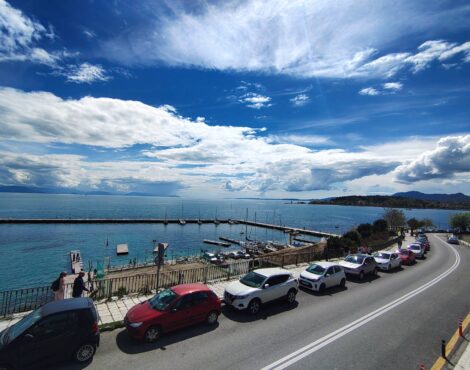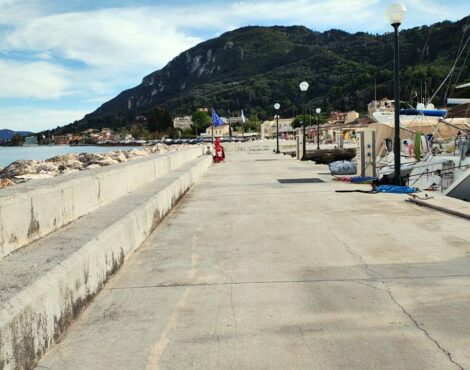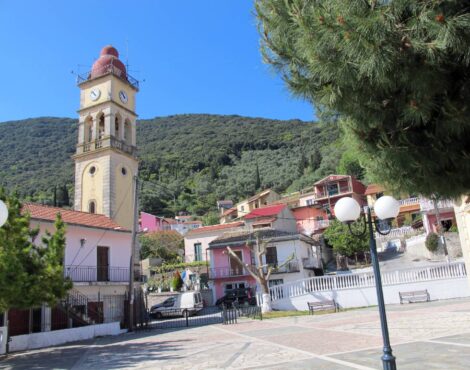
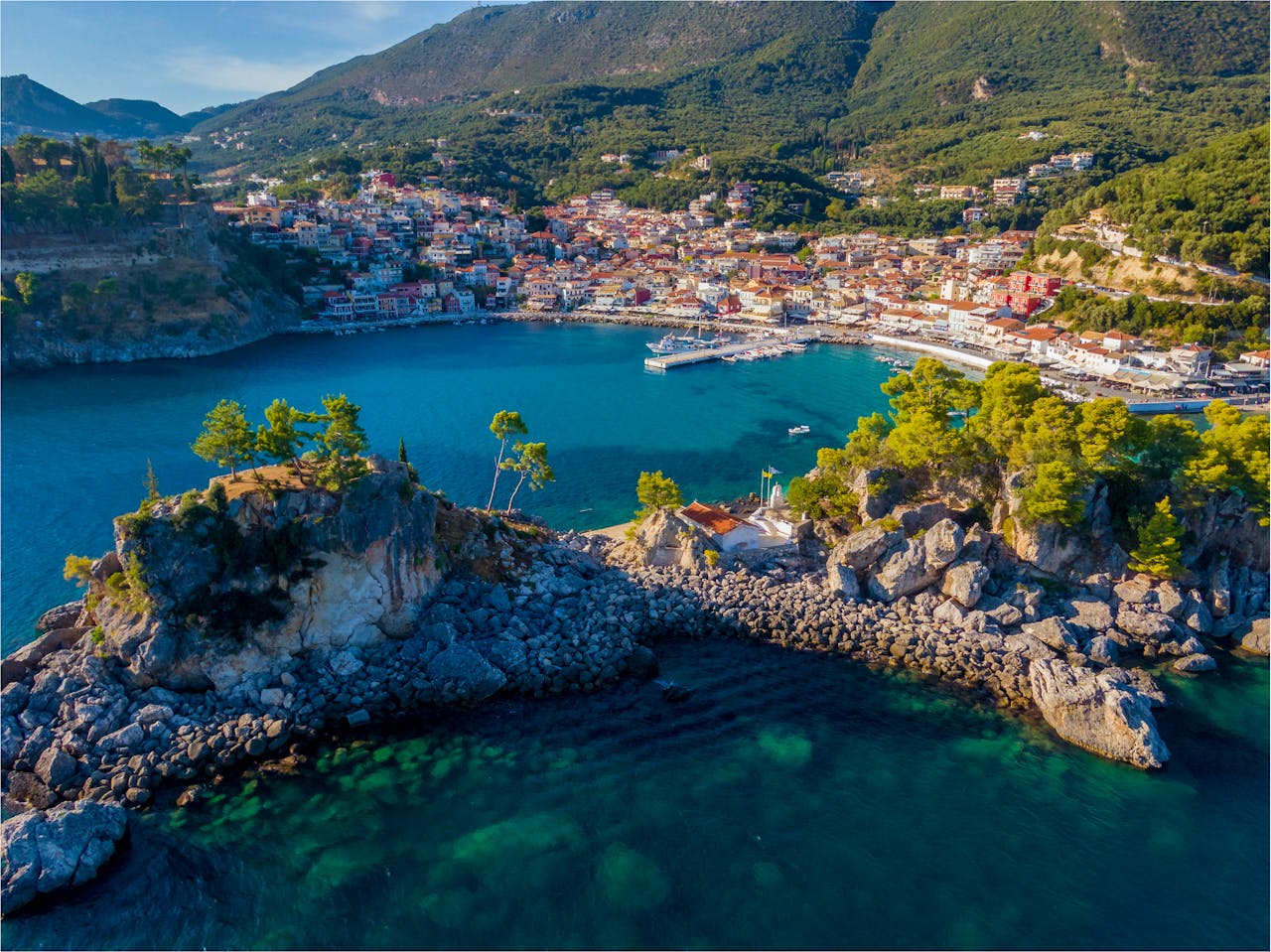
There are places that photographs have made so familiar that the actual experience of arriving at them can feel like revisiting something already known. Paleokastritsa is one of those places. The image of the turquoise bays enclosed by wooded headlands, the white monastery on the highest promontory, the extraordinary colour of the water, has appeared on enough postcards and travel pages and social media feeds that most visitors arrive with a visual pre-knowledge that might reasonably be expected to blunt the impact of the real thing.
It does not. Paleokastritsa, seen for the first time in person, from the road above as it descends toward the bay or from the water as a small hired boat rounds the outermost headland into the inner bay, exceeds the image with a consistency that speaks to something the photograph cannot capture: the scale, the light, the smell of the pine-covered hills above the water, and the particular quality of being inside a landscape of this beauty rather than looking at a representation of it.
June delivers this experience in conditions that are, in nearly every respect, superior to those of the peak summer months.
The Geography of the Bay
Paleokastritsa is not a single bay but a system of interconnected coves and inlets created by a series of rocky headlands that push out from the main body of the northwest coastline into the Ionian Sea. The headlands divide the shoreline into a sequence of separate beaches, each with its own character and orientation, connected by the water that surrounds them and by the paths and roads that wind through the vegetation above.
The main bay, the largest and most accessible, is the arrival point for most visitors and the base for the boat hire operations that provide access to the less accessible parts of the coastline. The water in the main bay is calm, sheltered from the prevailing westerly winds by the enclosing headlands, and of the extraordinary colour that results from the combination of shallow sandy bottom, clear water, and the angle of the Mediterranean sun at this latitude.
The secondary bays, accessible by boat or by the footpaths that descend from the road through the vegetation to small landings at the water’s edge, offer conditions that are in some respects superior to the main beach. The Alipa bay to the south, the smaller coves to the north of the main headland, and the various inlets accessible only from the water each have a character of their own, and the exploration of these secondary spaces is where the finest Paleokastritsa experience is found.
The Water: Clarity and Colour
The water at Paleokastritsa in June is among the finest swimming water in the Mediterranean. The colour, a turquoise of such intensity that it requires genuine adjustment before it settles into the category of natural rather than artificial, is the product of the shallow sandy bottom reflecting the June sunlight through a column of water of exceptional clarity. The combination produces hues that shift from the palest aquamarine in the shallows through a succession of blues and greens to the deep indigo of the open sea beyond the outer headlands.
The clarity is equally extraordinary. On a calm June morning, before any boat traffic has disturbed the surface, the bottom is visible at depths that most water makes opaque long before reaching. Snorkelling in this water, over the rocky sections where sea grass and small fish occupy the terrain between the boulders, is an experience of unusual natural richness: the visibility sufficient to make the underwater world as clearly legible as the surface one, the temperature warm enough in June for extended immersion, and the variety of the underwater terrain sufficient to reward extended attention.
The sea caves in the cliffs of the outer headlands, accessible by small boat, extend the underwater experience into spaces of particular geological beauty. The light entering through the cave openings and reflecting on the water inside creates effects of colour and movement that photographers consistently attempt to capture and consistently find impossible to reproduce adequately.
Boat Hire: The Essential Paleokastritsa Experience
The single best decision available to any visitor to Paleokastritsa is the hiring of a small motorboat from the operators on the main beach. The boats are simple, their operation straightforward, and no licence or previous experience is required for the calm, sheltered waters of the Paleokastritsa coastline. What they provide is access to the full scope of what the bay and its surroundings have to offer, unconstrained by the limitations of shore-based exploration.
With a small boat, the outer coves that are inaccessible from the land become available. The sea caves in the limestone cliffs can be entered and explored at the pace the exploration deserves. The snorkelling grounds away from the main beach, where the water is undisturbed and the underwater terrain more varied, can be reached and used with complete freedom. And the experience of floating in one of the smaller coves, the boat pulled up on the rocks and the surrounding headlands blocking any view of the road or the main beach above, with nothing but the water and the cliffs and the sky, is one of those complete and temporary freedoms that the best coastal landscapes provide.
In June, the boat hire operators are fully established but not yet at the peak season capacity that creates waiting times and limits availability in July and August. Arriving at the beach in the mid-morning and hiring a boat for the full day is straightforwardly possible in June in a way that the height of summer makes less certain.
The Monastery of Theotokos
Above the bays, on the highest point of the central headland, the monastery of Theotokos occupies a position of extraordinary visual drama. The buildings, whitewashed and terracotta-roofed in the characteristic manner of Greek Orthodox monasteries, are visible from every point in the bay below and from the open sea beyond the outer headlands, their white walls standing out against the dark green of the surrounding vegetation with a clarity that makes the monastery one of the defining visual elements of the Paleokastritsa landscape.
The monastery is open to visitors during designated hours, modest dress being required as at all Greek Orthodox religious sites, and the interior contains a small museum with a collection of religious icons, vestments, and objects from the Byzantine and post-Byzantine periods that reflects the long religious history of the site. The olive press and the wine press preserved in the monastery buildings speak to the agricultural dimension of monastic life that the religious character of the institution sometimes obscures.
The views from the monastery terrace are, predictably given the elevation and the position, outstanding. The full extent of the Paleokastritsa bay system is visible from this vantage point, and the perspective from above clarifies the geography of the interconnected coves and headlands in a way that ground-level exploration only partially achieves. In June, with the vegetation at its most vivid and the water below at its clearest, the view from the monastery terrace is one of the finest in all of Corfu.
Lunch Above the Bay
The restaurants and tavernas of Paleokastritsa occupy the hillside above the main bay, their terraces positioned to look directly down onto the water and across to the surrounding headlands. Lunch at one of the better establishments, with fresh fish grilled over charcoal and served at a table from which the turquoise water is directly visible sixty metres below, is one of the most straightforwardly pleasurable meals available on the island.
In June, these restaurants are operating with the focused attention of a season finding its rhythm, the service attentive and the produce reflecting the best of the early summer availability. The grilled fish, sourced from local boats whose catch reached the kitchen the same morning, is prepared simply and served generously in the manner of a restaurant whose confidence in its ingredients is sufficient that elaborate preparation would be an interference rather than an improvement.
Paleokastritsa and Villa Kapella
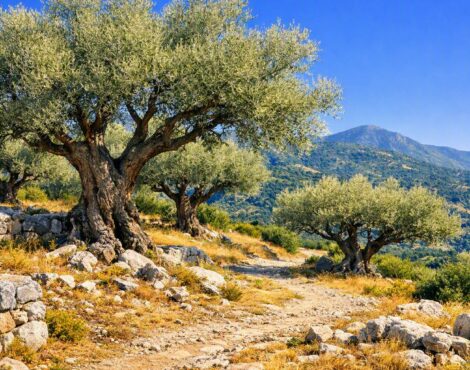
For guests at Villa Kapella, Paleokastritsa is the beach day destination that the island’s northwest coast provides as its finest and most complete offering. The drive from the villa, through the olive country of the island’s interior and over the central ridge that separates the east and west coasts, is itself a pleasure, the road passing through villages and countryside that represent the quieter, less visited face of Corfu before the dramatic reveal of the northwest coast as the road descends toward the sea.
A full day at Paleokastritsa in June, beginning with the boat hire and the exploration of the outer coves, continuing through lunch on the terrace above the bay, and concluding with a visit to the monastery before the drive home through the late afternoon light, is the kind of day that guests at Villa Kapella return from with the particular satisfaction of having been somewhere entirely worth being.