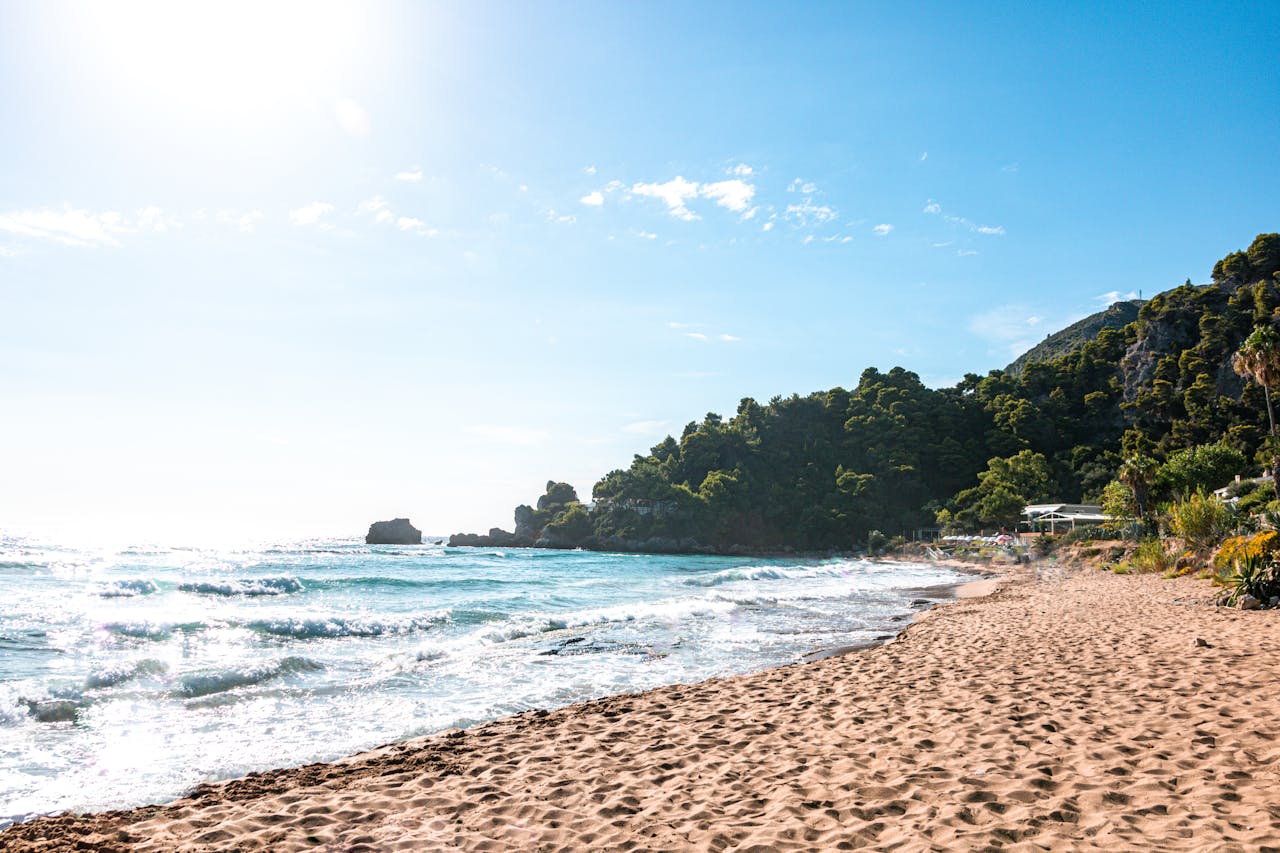
The northwest coast of Corfu is where the island makes its most dramatic argument for the attention of the world. Elsewhere, Corfu is beautiful in the gentle, accumulated way of olive groves and Venetian architecture and the particular quality of light over the Ionian in the late afternoon. On the northwest coast, it is beautiful in the way of something geological and absolute: cliffs dropping into water of improbable colour, wooded headlands enclosing bays that look as if they were designed for a purpose more specific than simple geography, and a coastline that turns every corner with the confidence of a landscape that knows exactly what it is doing.
June is the finest month to discover it.
Paleokastritsa: The Crown of the Northwest
No account of the northwest coast begins anywhere other than Paleokastritsa. The bay, or more accurately the system of interconnected bays enclosed by a series of wooded promontories, is the single most celebrated coastal destination in Corfu and one of the most photographed in the entire Mediterranean. The reputation is entirely deserved, and unlike many places whose fame has outrun their reality, Paleokastritsa in June continues to exceed expectations.
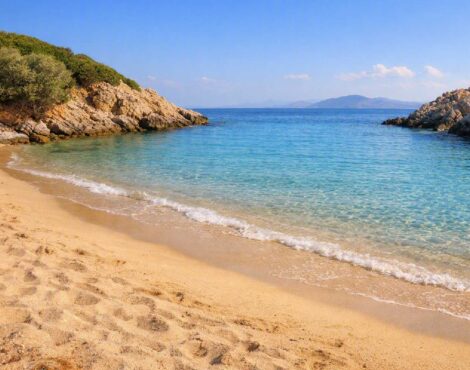
The water is the first thing. The colour, a turquoise of such intensity and clarity that first-time visitors consistently react with something approaching disbelief, is the product of the particular combination of water depth, white sandy bottom, and the angle of the June sun. It is not a trick of photography or of selective timing. It is simply what the water looks like, and it looks like this for most of the daylight hours throughout the summer season.
The main beach at Paleokastritsa is organised with sunbeds and umbrellas and serviced by several restaurants and cafes on the hillside above. In June, the organisation is in place but not yet at summer capacity, meaning that the beach can be enjoyed with a comfort and ease that July and August will later compromise. The water is calm in the main bay, sheltered by the enclosing headlands, and ideal for swimming of any level of competence.
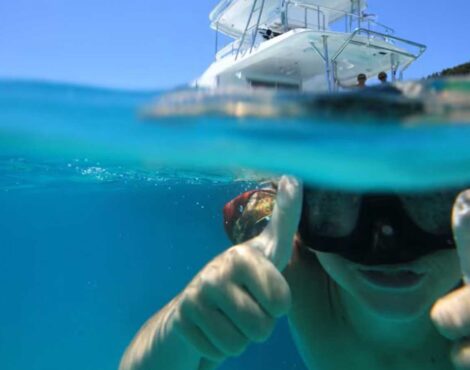
The better approach, for those with any inclination toward exploration, is to hire one of the small boats available from the beach operators and move along the coastline independently. The coves beyond the main bay, accessible only from the water, contain some of the finest swimming and snorkelling on the entire island. The water in these enclosed spaces is even clearer than in the main bay, the underwater terrain of rocks and sand and sea grass supporting a variety of marine life that rewards attentive snorkelling, and the absence of other visitors in June gives each cove a quality of private discovery that the main beach cannot replicate.
Above the bay, the monastery of Theotokos sits on the highest promontory, its white walls and terracotta roofs visible from every point in the bay below. The monastery dates from the thirteenth century in its origins, though the current buildings are largely later, and the views from its terrace across the bays and the open sea to the west are among the finest available on the island.
Myrtiotissa: The Hidden Jewel
South of Paleokastritsa, the coast becomes less accessible and correspondingly more rewarding for those willing to make the effort. Myrtiotissa is reached by a road that descends steeply through pine and olive woodland to a beach of considerable beauty: a long arc of sand enclosed between rocky headlands, with water of exceptional clarity and a natural setting that has remained largely unchanged because the difficulty of access has protected it from the more intensive development that affects the more easily reached beaches.
In June, Myrtiotissa is quiet in the way that only genuinely off-the-beaten-track beaches manage to be. The walk down from the parking area takes fifteen minutes through woodland that is cool and fragrant in the morning and provides welcome shade on the return in the afternoon heat. The beach itself, when it appears at the end of the path, delivers the particular satisfaction of a discovery made by effort rather than by following the crowd.
The water at Myrtiotissa is excellent for swimming, clear and warm in June with the rocky edges of the bay offering good snorkelling. The single small refreshment facility operating in summer provides sufficient sustenance for a beach day without the infrastructure that larger beaches carry and that often works against the natural character of the setting.
Ermones: The Mythological Shore
Further south along the northwest coast, Ermones occupies a bay of considerable charm that carries one of the island’s most appealing mythological associations. It is here, according to the tradition that connects the Odyssey to the Corfiot landscape, that Odysseus was washed ashore after his shipwreck and encountered the princess Nausicaa on the beach where she had come with her companions to wash linen in the river that flows into the bay.
The association lends Ermones a literary dimension that the beach itself, pleasant and well situated without being as dramatically beautiful as Paleokastritsa or Myrtiotissa, does not entirely provide on its own. The river mouth, the wooded hillsides enclosing the bay, and the particular quality of the light on the water in the early morning all contribute to an atmosphere that makes the mythological connection feel less arbitrary than it might at a less evocative location.
The beach is organised and serviced with a hotel operating above it, but the scale in June is manageable and the water quality excellent. The river flowing into the southern end of the bay creates a freshwater mixing zone that some swimmers find particularly refreshing after the salt of the open sea.
Glyfada and Pelekas: The Sunset Beaches
Moving south along the northwest coast, the beaches of Glyfada and Pelekas occupy a section of coastline that faces directly west into the Ionian and that, in consequence, receives the full force of the setting sun in a manner that has made this stretch of coast the preferred destination for those whose beach day is planned around the evening rather than the morning.
Glyfada is the larger and more organised of the two, a wide sandy beach backed by a small resort development that in June is at a human scale appropriate to its setting. The sand is fine and extensive, the water excellent for swimming, and the afternoon west-facing light produces conditions that photographers and sunset seekers find exceptional.
The village of Pelekas, perched on the ridge above its beach, is one of the most beautifully situated villages on the island, its whitewashed houses and the famous Kaiser’s Throne viewpoint offering a panorama that encompasses most of the northwest coastline. The descent from the village to Pelekas beach is steep, the beach itself less organised than Glyfada but correspondingly more natural and, in June, more likely to offer the solitude that the northwest coast in its finest moments provides.
Planning the Northwest Coast Day
A full day on the northwest coast, approached from Villa Kapella in the morning and returning in the evening, follows a natural structure that the geography of the coastline suggests. An early start to reach Paleokastritsa before the midday heat builds, a morning in the main bay with a boat trip to the outer coves, lunch at one of the seafront restaurants, and an afternoon drive south along the coast road to Myrtiotissa or Ermones before returning inland through Pelekas for the sunset views from the Kaiser’s Throne: this is a day that requires nothing added or improved.
The northwest coast in June is Corfu at its most visually commanding. For guests at Villa Kapella, it is one of the essential excursions of any summer stay, and the beach day that most consistently produces the response that all the best travel experiences produce: the immediate and completely sincere wish to return.