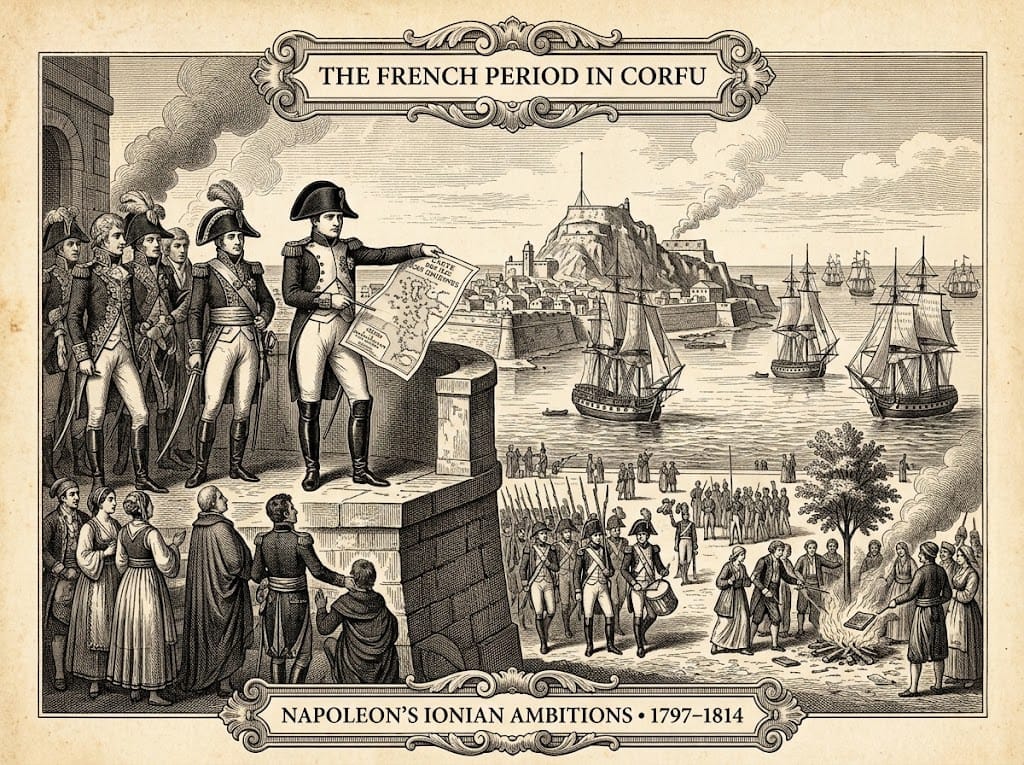
The French period in the history of Corfu, though brief in absolute duration when measured against the four centuries of Venetian rule that preceded it, left an impression on the island’s physical landscape, its political culture, and its intellectual life that is disproportionate to the number of years involved. The decade and a half between the fall of the Venetian Republic in 1797 and the final establishment of British control over the Ionian Islands in 1815 was not a single coherent period of French administration but a more complex sequence of events: two distinct periods of direct French governance separated by the establishment of the Septinsular Republic under Russian and Ottoman joint protection, and the whole embedded within the broader context of the Napoleonic Wars that were reshaping the political map of Europe with a speed and a completeness unprecedented in modern history. Within this compressed and turbulent timeframe, the French presence in Corfu generated changes that contributed lastingly to what the island became.
Napoleon and the Strategic Value of the Ionian Islands
Napoleon Bonaparte’s interest in the Ionian Islands was a combination of strategic calculation and personal intellectual fascination that made the islands, in his assessment, among the most valuable territorial acquisitions available in the broader redistribution of Mediterranean power that his Italian campaigns were making possible. Strategically, the islands at the entrance to the Adriatic represented a potential base for French operations in the eastern Mediterranean, a forward position from which pressure could be applied to the Ottoman Empire, control of Egyptian and Levantine trade routes pursued, and the communications of the British Empire with India via the overland route through the Middle East threatened or disrupted. Napoleon’s understanding of eastern Mediterranean geopolitics was acute, and the islands’ value in this context was one he grasped with the characteristic speed and clarity of his strategic intelligence.
The personal dimension of Napoleon’s interest in the Ionian Islands was equally characteristic of the man: his engagement with the classical tradition, his identification with the great commanders of antiquity, and his romantic conception of Greece as the source of the civilisation he was seeking to reshape made the Ionian Islands, with their ancient Greek history and their proximity to the Greek mainland, an object of genuine personal fascination rather than merely strategic calculation. His famous remark that the islands were worth more than all of Italy, while an exaggeration for rhetorical effect, reflected a real appreciation of their historical significance and their strategic potential that went beyond the conventional military assessment of an island chain at the edge of the Adriatic. French forces took possession of Corfu in June 1797 following the Treaty of Campo Formio, and the first French administration began with the ideological ambitions and the practical limitations that would characterise the entire French engagement with the island.
The First French Administration: Revolution Comes to Corfu
The first French administration of Corfu, lasting from June 1797 until the expulsion of French forces by the Russian and Ottoman naval coalition in 1799, was a period of genuine ideological ambition combined with the practical difficulties of implementing the principles of the French Revolution in a community whose social structures and political traditions had been shaped by four centuries of Venetian patrician governance. The French administrators abolished the Venetian aristocratic institutions, dismantled the Golden Book of noble families that had defined social privilege under Venice, established French-style administrative structures based on the principles of equality before the law, and attempted to introduce the language and the institutional forms of Revolutionary France into the governance of an island community whose primary languages were Greek and the Venetian dialect and whose legal traditions were rooted in the customary law of the Venetian colonial system.
The most enduring and the most beautiful physical legacy of the first French administration in Corfu is the Liston promenade, constructed along the western side of the Spianada on the model of the Rue de Rivoli in Paris. The arcade of neoclassical arches that lines the Spianada on the eastern side and from which the Liston takes its character was designed and built during the French period as a conscious expression of the architectural language of Revolutionary and Napoleonic France transplanted to the Ionian context. The Liston remains today the most prominent and the most socially active public space in Corfu Town, the place where the island’s population gathers for the evening promenade, for the celebration of Easter, and for the collective social life that the Mediterranean city tradition has sustained through the centuries. That its essential form and character are French in origin is a fact that the island’s population has absorbed so thoroughly that the French provenance of the most typically Corfiot of public spaces has become invisible through familiarity.
The Septinsular Republic: The First Greek Self-Governance
The expulsion of French forces from the Ionian Islands in 1799 by the combined Russian and Ottoman naval squadron led by the Russian Admiral Ushakov produced one of the most interesting and most historically significant political experiments of the post-Venetian period: the Septinsular Republic, established in 1800 under the joint protection of Russia and the Ottoman Empire as a nominally independent Greek state governed by the islands’ own population under a constitution drafted by the Corfiot diplomat Ioannis Kapodistrias.
The Septinsular Republic lasted from 1800 to 1807, when the Treaties of Tilsit between Napoleon and Tsar Alexander transferred the Ionian Islands back to French control, but its significance extended far beyond its brief duration. It was the first instance of organised Greek self-governance in the modern period, preceding the Greek state established by the War of Independence by more than two decades, and the constitutional and administrative experience that the Ionian political class gained through its operation contributed significantly to the intellectual and practical preparation for Greek national independence. Kapodistrias himself, the most significant political figure the Ionian islands produced, drew directly on his experience of the Septinsular Republic in the governance philosophy he later brought to the first independent Greek state as its inaugural Governor.
The French Return and the Legacy of the Revolutionary Period
French forces returned to Corfu following the Treaties of Tilsit in 1807 and governed the island until the British occupation of 1815. The second French administration was less ideologically intense than the first but more militarily competent, and the defensive infrastructure that the French improved and extended during this period contributed to the physical security of the island through the turbulent final years of the Napoleonic Wars. The intellectual legacy of both French periods in Corfu, the introduction of Revolutionary ideas of popular sovereignty and national self-determination, the engagement with the Greek nationalist thinking that was developing simultaneously among the Greek communities of the diaspora, and the practical experience of self-governance that the Septinsular Republic had provided, contributed to the intellectual foundations of the enosis movement that would define Corfiot political life throughout the British Protectorate period and culminate in the union with Greece in 1864. The French period in Corfu was brief, complex, and in some respects incomplete, but it planted seeds whose growth would define the island’s political future for the following half century.