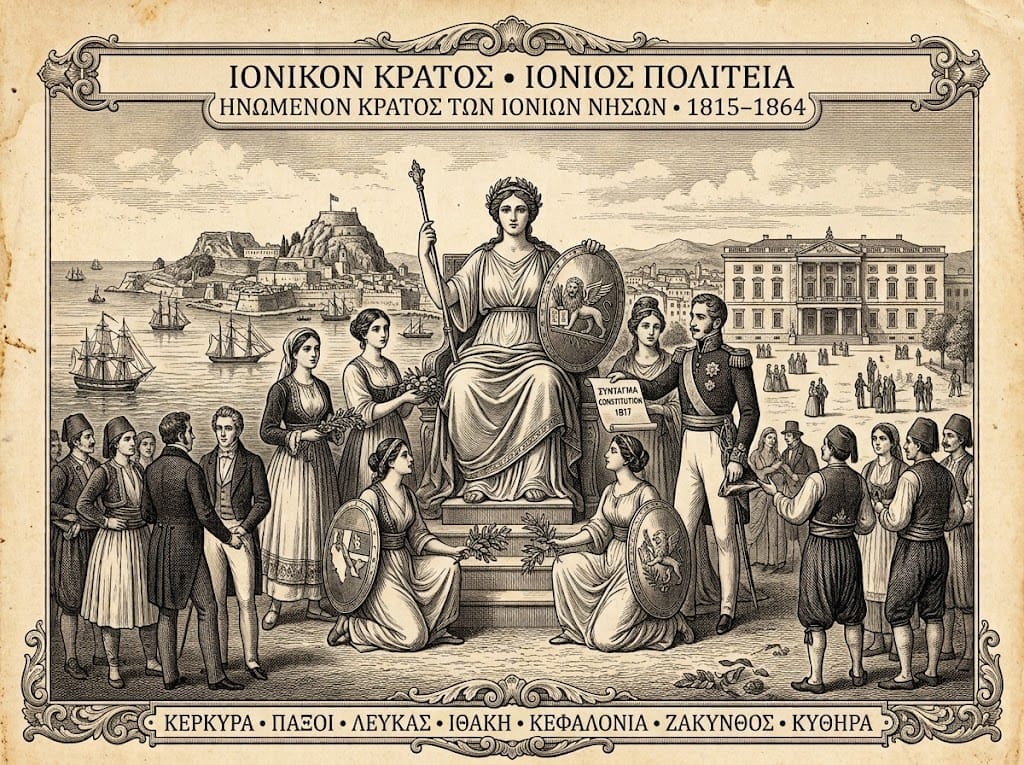
The union of the Ionian Islands with Greece on 21 May 1864 was the culmination of a political aspiration that had been present in the consciousness of the island’s Greek-speaking population since the creation of the modern Greek state in 1830 and that had roots in the broader Greek national consciousness going back considerably further. The ceremony that transferred sovereignty from the British protecting power to the Kingdom of Greece, conducted on the Spianada of Corfu Town before the assembled population and the representatives of the contracting powers, was a moment of genuine historical significance that completed the modern political map of the Greek state and fulfilled an aspiration that the Corfiot community had pursued through decades of political organisation, intellectual argument, and personal sacrifice. It was also, in retrospect, the moment that completed the island’s modern political identity while leaving intact and indeed reinforcing the cultural distinctiveness that centuries of non-Greek administration had created and that union with Greece could modify but not erase.
The Greek War of Independence and the Ionian Consciousness
The Greek War of Independence of 1821 to 1829, which resulted in the creation of the first independent Greek state recognised by the great powers of Europe, had a profound and complex impact on the political consciousness of the Ionian Islands even though the islands themselves remained under British protection throughout the conflict and did not participate directly in the revolutionary struggle. The Ionian Islands were home to significant communities of educated Greeks whose intellectual formation had been shaped by the combination of the Orthodox religious tradition, the exposure to Western European Enlightenment thought that the relatively liberal cultural atmosphere of the British protectorate facilitated, and the increasingly powerful current of Greek nationalist ideology that was circulating through Greek communities across Europe during the early decades of the nineteenth century.
Many of the most significant intellectual and practical contributors to the Greek independence movement had connections to the Ionian Islands, and the islands served as a base of operations, a source of financial support, and a reservoir of educated talent for the revolutionary cause in ways that made the Ionian contribution to Greek independence considerably greater than the islands’ political neutrality during the conflict might suggest. The most remarkable individual embodiment of this Ionian contribution was Ioannis Kapodistrias, born in Corfu in 1776 into the island’s aristocracy and educated in the intellectual culture of the Venetian and early British periods before embarking on the extraordinary diplomatic career that made him one of the most influential European statesmen of the Congress of Vienna era and eventually the first Governor of independent Greece.
Kapodistrias: Corfu’s Greatest Son
Ioannis Kapodistrias represents the most direct and the most remarkable personal connection between Corfu and the creation of the modern Greek state. His intellectual formation in the Ionian Islands, his early experience in the administration of the Septinsular Republic under the constitution he had helped draft, his subsequent career in the Russian imperial diplomatic service that took him to the highest levels of European statecraft, and his eventual return to Greece in 1827 as its first Governor all reflect the particular possibilities that the Corfiot cultural position, at the intersection of the Greek Orthodox tradition and the Western European intellectual world, offered to a person of exceptional ability and exceptional ambition in the early nineteenth century.
As Governor of Greece from 1827 until his assassination in 1831, Kapodistrias brought to the governance of the newly independent state the combination of diplomatic sophistication, institutional experience, and genuine commitment to the welfare of the Greek people that his formation in the Ionian context had provided. His approach to the governance of the new state, characterised by a commitment to institutional order and effective administration that sometimes conflicted with the more anarchic traditions of the revolutionary movement, was the approach of a man formed in the Venetian and early British administrative traditions of his home island rather than in the Ottoman or revolutionary Greek contexts that shaped most of the other figures of the independence period. The statue of Kapodistrias that stands in the square bearing his name in Corfu Town commemorates the island’s most significant contribution to the creation of the modern Greek state and the most direct personal expression of the Corfiot tradition of engagement with the broader European world in the service of Greek national aspirations.
The Enosis Campaign Under British Rule
The political campaign for enosis that developed within the Ionian Islands during the British protectorate period was one of the most sustained and most intellectually sophisticated colonial independence movements of the nineteenth century, anticipating in many of its arguments and its methods the nationalist political movements that would challenge European colonial authority across the world in the following century. The movement drew on the developing ideology of Greek nationalism, the practical example of the Greek state that Kapodistrias and his successors had constructed on the mainland, and the increasingly persuasive argument that the political separation of the Greek-speaking Ionian Islands from the Greek national state was an anomaly inconsistent with the principles of national self-determination that the nineteenth century was progressively accepting as the legitimate basis of political organisation.
The British administration responded to the enosis movement with a variety of instruments, from the repression of the most active advocates of union through the maintenance of constitutional channels for political expression that were sufficient to absorb some of the political pressure without conceding the fundamental demand. The radical wing of the movement, represented by writers and activists who challenged the legitimacy of British rule in terms that drew on both Greek nationalist ideology and the liberal political principles that Britain itself claimed to embody, proved difficult for the administration to counter effectively within its own constitutional framework, and the combination of internal political pressure and the changing diplomatic calculus of mid-Victorian Britain’s European policy eventually produced the decision to cede the islands to Greece.
The Transfer of 1864 and Its Meaning
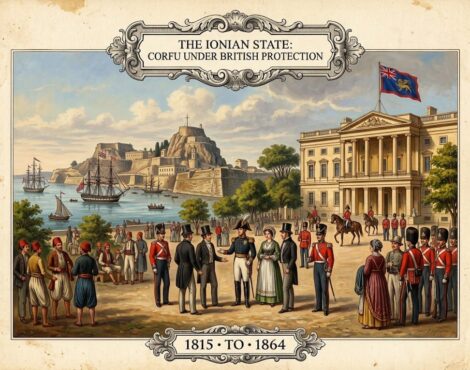
The British decision to cede the Ionian Islands to Greece, announced in 1863 and implemented in the spring of 1864, was the product of a convergence of factors that the British government found, on balance, more persuasive than the arguments for continued British control. The accession of the Danish Prince William as King George I of Greece in 1863 provided the diplomatic opportunity to make the cession as a gesture of goodwill toward the new monarch, strengthening the British position in Greek affairs without the costs of continued Ionian administration. The recognition that the enosis aspiration could not be indefinitely suppressed without escalating political costs, and the assessment that the strategic value of the Ionian positions had diminished with the development of alternative British naval facilities in the eastern Mediterranean, completed the calculation that made voluntary withdrawal the rational choice.
The transfer of sovereignty on 21 May 1864, greeted with celebrations across the Ionian Islands that reflected the genuine depth of the enosis aspiration, incorporated Corfu into the Greek national state and completed the political journey that the island’s population had been pursuing since the Greek War of Independence. The cultural identity that the journey produced, however, the result of the centuries of non-Greek administration that had shaped the island into something distinctive within the Greek world, was not erased by the political union but preserved and gradually recognised as one of the most valuable and most interesting characteristics that Corfu brings to the broader Greek national culture. The island that joined Greece in 1864 was more Western European in its architecture, its music, its food, and its social customs than any other part of the new state, and that distinctiveness, the product of the history recounted in these pages, remains the defining characteristic of the Corfiot identity in the twenty-first century.