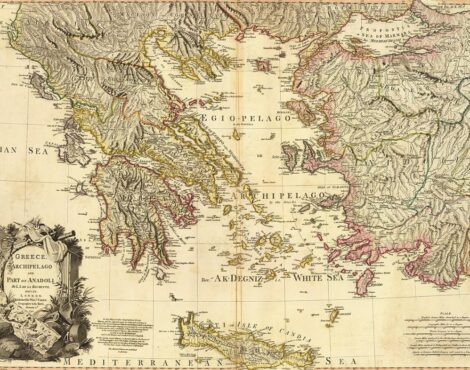
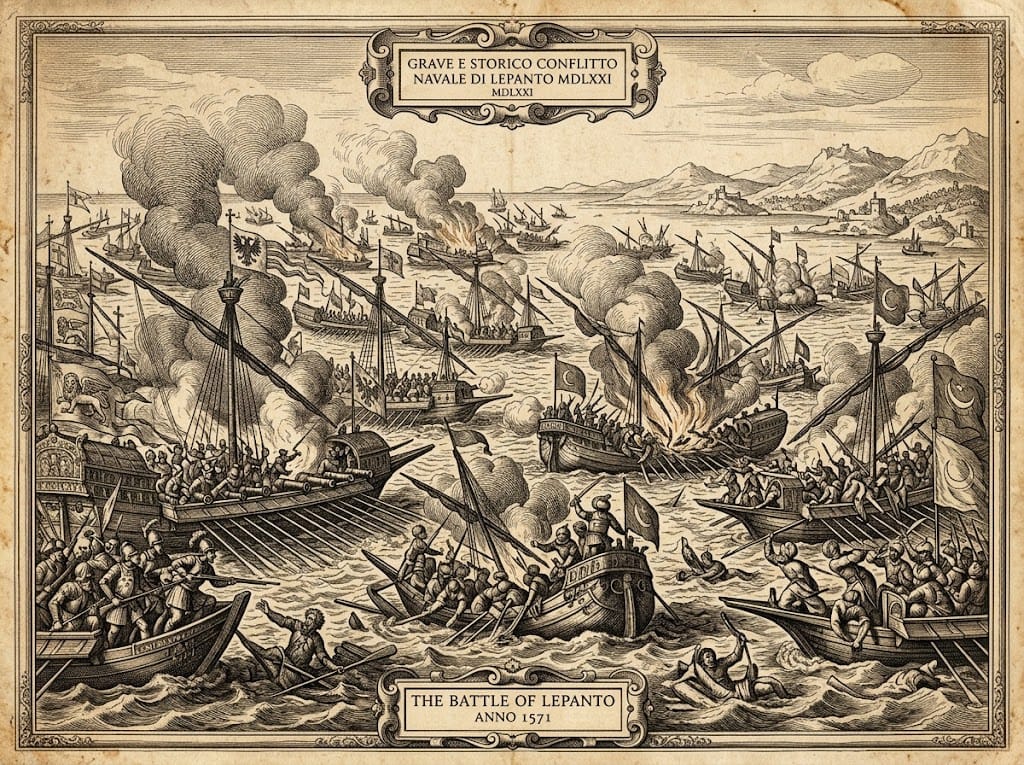
The Battle of Lepanto, fought on 7 October 1571 in the Gulf of Patras to the south and east of Corfu, was the largest naval engagement in the Mediterranean since the Battle of Actium sixteen centuries earlier and one of the most consequential military events of the sixteenth century. The engagement between the Holy League, a coalition of Christian naval powers assembled under the leadership of Don John of Austria and incorporating the fleets of Venice, Spain, and the Papal States, and the Ottoman fleet under the command of Ali Pasha, resulted in the most significant and the most psychologically devastating naval defeat that the Ottoman Empire had suffered in its history. For Corfu, the battle and the events surrounding it represent a moment of acute danger, considerable suffering, and ultimate survival that shaped the island’s understanding of its own historical significance in the broader contest between the Christian and Ottoman worlds that defined the political and military geography of the sixteenth-century Mediterranean.
The Assembly of the Holy League Fleet
In the weeks leading up to the Battle of Lepanto, the harbour of Corfu Town served as one of the principal assembly and resupply points for the Holy League fleet as it gathered from its various component ports and moved southward toward the engagement that the League’s commanders were actively seeking. The harbour, protected by the Venetian fortifications of the Old Fortress and capable of accommodating the large number of galleys and support vessels that the Christian coalition had assembled for the campaign, provided the fleet with the logistical infrastructure it required for the final stage of its journey toward the Ottoman fleet that was operating in the Gulf of Patras and the waters to the south.
The Corfiot population observed the gathering of the Holy League fleet in their harbour with a combination of hope and profound anxiety. Hope because the assembled force represented the most powerful Christian naval armament that had been gathered in the Mediterranean for a generation and the most credible challenge to the Ottoman naval dominance that had been building since the fall of Constantinople a century earlier. Anxiety because the community understood, from the experience of decades of Ottoman raiding and from the events of the weeks immediately preceding the fleet’s arrival, that the naval contest about to unfold to the south would determine the future security of their island as directly as it would determine the broader balance of power in the Mediterranean. The men who sailed from Corfu harbour toward Lepanto carried with them the hopes of a community that had lived under the shadow of Ottoman power for generations and that understood with painful clarity what it meant to be the westernmost point at which the line between the Christian and Ottoman worlds was maintained.
The Ottoman Raid on Corfu in 1571
The connection between Corfu and the Battle of Lepanto is not limited to the role the island played as a staging point for the Christian fleet. In the weeks immediately before and during the engagement at Lepanto, a separate Ottoman force under the command of Uluj Ali conducted a devastating raid on Corfu itself, exploiting the moment when the Venetian defensive forces committed to the Lepanto campaign had reduced the garrison of the island to its minimum strength. The timing of the Corfiot raid was deliberately coordinated with the broader Ottoman strategic plan for the 1571 campaign, and it reflected a sophisticated understanding of the relationship between naval superiority, garrison strength, and the opportunity for destructive raiding that the commitment of Christian forces to a major naval engagement created.
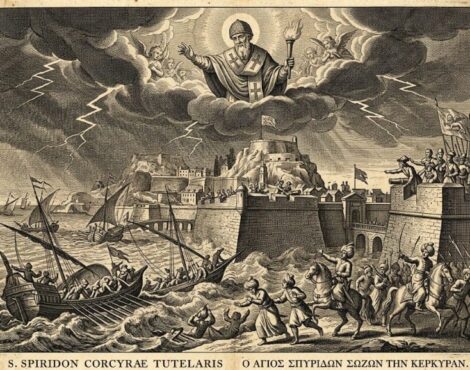
The raid was one of the most destructive that the island had experienced. The Ottoman forces, moving rapidly through the rural areas of the island that lay beyond the effective protection of the fortified town, burned villages, destroyed olive groves and other agricultural infrastructure, and captured a substantial portion of the island’s rural population into slavery. The fortified town itself held against the assault, the Old Fortress’s defences proving sufficient even with a reduced garrison, but the countryside paid a severe price for the moment of strategic vulnerability that the Lepanto campaign had created. Contemporary Venetian administrative records document the scale of the devastation and the population losses with a bureaucratic precision that makes the human cost of the raid comprehensible across five centuries of distance.
The Battle and Its Outcome
The Holy League fleet that had assembled partly at Corfu engaged the Ottoman fleet in the Gulf of Patras on 7 October 1571 in a battle that lasted for several hours and resulted in the virtual destruction of the Ottoman naval force. The engagement was the largest galley battle in the history of Mediterranean warfare, involving some five hundred vessels and perhaps 150,000 men on both sides, and its outcome was decisive in a way that few early modern naval engagements managed to be. The Ottoman fleet lost the majority of its fighting ships either sunk or captured, and Ali Pasha was killed in the fighting. The Christian losses were significant but manageable, and the psychological impact of the Ottoman defeat, achieved at the height of what had appeared to be an irresistible Ottoman naval expansion, reverberated through the political and cultural life of Europe for generations.
The immediate strategic consequences of Lepanto were more limited than the cultural response suggested. The Ottoman Empire rebuilt its naval forces with remarkable speed and efficiency, demonstrating the industrial and financial capacity of the imperial system at its mid-sixteenth-century peak, and the Christian coalition that had achieved the victory at Lepanto proved unable to maintain the unity and the sustained military commitment that would have been required to translate the naval victory into lasting territorial gains. Nevertheless, the battle marked the end of the period of apparently unstoppable Ottoman expansion in the western Mediterranean and shifted the strategic balance in ways that gradually reduced the intensity of Ottoman pressure on the Christian-held islands of the Ionian and Aegean.
Lepanto’s Legacy for Corfu
For Corfu, the events of 1571 the battle, the raid, and the survival of the fortified town left a legacy that can be read in the physical fabric of the island as clearly as in its historical records. The New Fortress, constructed in the years immediately following 1571 as a direct response to the demonstrated need for stronger defensive capacity, stands as the most substantial architectural monument to the lesson that the Venetian administration drew from the events of that year. The combined defensive system that the Old and New Fortresses together constituted after the completion of the New Fortress’s construction made Corfu Town effectively impregnable to any force the Ottoman Empire was likely to commit to an assault on the island, and the subsequent decades saw a period of relative stability and recovery that allowed the island to rebuild from the devastation of the 1571 raid and to develop the agricultural and cultural richness of the late Venetian period without the constant existential threat that the earlier part of the century had maintained. The visitor who stands today on the walls of either fortress in Corfu Town is standing on the direct physical consequence of the events of 1571, the defensive architecture that the island’s experience of Ottoman power called forth and that the Republic’s military engineering tradition provided with characteristic thoroughness and enduring quality.