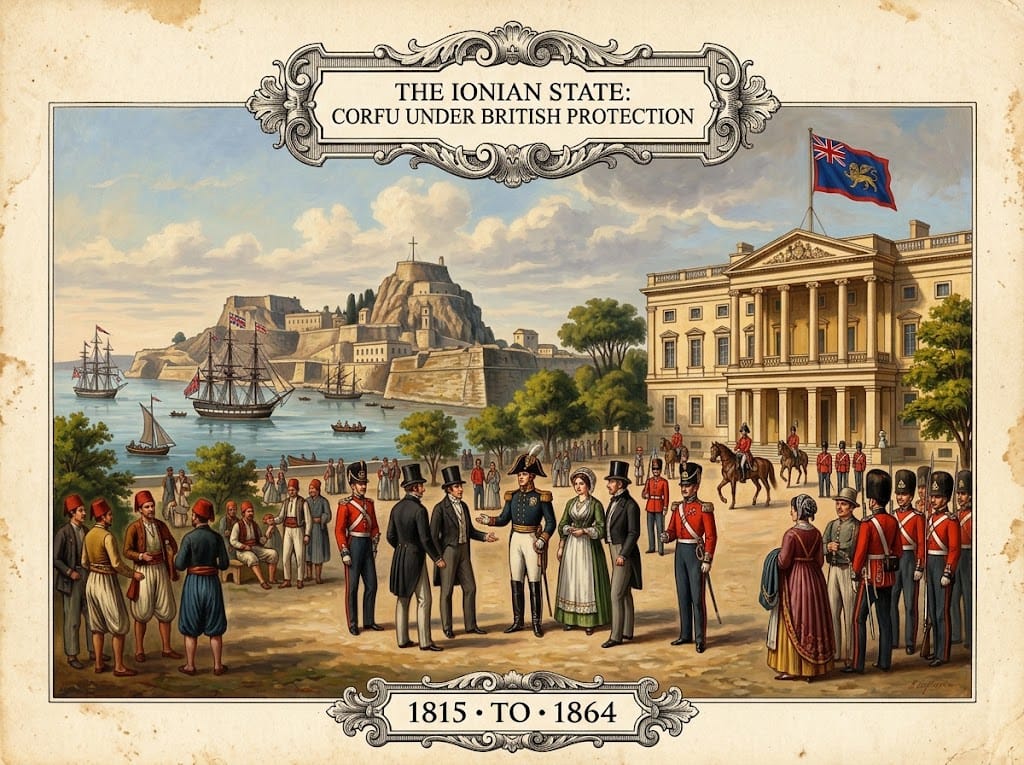
The period of British protection over the Ionian Islands, formally established by the Congress of Vienna in 1815 and lasting until the union with Greece in 1864, represents the final chapter in the long and layered history of foreign administration in Corfu and the chapter whose physical legacy is perhaps the most immediately surprising to the visitor encountering it for the first time. The neoclassical palace that faces the Spianada across the esplanade of Corfu Town, built between 1819 and 1824 in the Regency architectural style of early nineteenth-century Britain, the cricket ground spread across the northern section of the esplanade where white-clad players still compete in the summer months, and the distinctive ginger beer known locally as tsitsibira that continues to be produced and consumed on the island: these are the traces of a British administration that governed Corfu for nearly half a century with a combination of genuine institutional contribution and consistent political insensitivity to the aspirations of the island’s Greek-speaking population.
The Congress of Vienna and the Establishment of the Ionian State
The United States of the Ionian Islands, as the British protectorate was formally designated, was established by the Treaty of Paris in 1815 as part of the broader reorganisation of European territorial arrangements that the Congress of Vienna was conducting in the aftermath of the Napoleonic Wars. Britain, which had occupied the Ionian Islands militarily during the later stages of the Napoleonic conflict and had demonstrated through the quality of its naval administration of the islands that it possessed the capability and the intention to govern them effectively, was confirmed by the Congress as the protecting power over the islands, which were designated as a nominally independent state under British protection rather than as a formal British colonial possession.
The legal architecture of the Ionian State was a careful diplomatic construction designed to satisfy multiple and partially conflicting requirements: Britain’s desire for effective strategic control of the islands without the formal colonial status that might generate criticism from European powers concerned about British expansion; the Greek-speaking population’s aspiration for a form of self-governance that acknowledged their national identity; and the broader European interest in maintaining a stable settlement in a region whose strategic importance all the major powers recognised. The arrangement that emerged, the nominally independent state with a constitution, a senate, and an assembly, all operating under the effective supervision of a British Lord High Commissioner who held ultimate executive authority, was a legal fiction that served its diplomatic purpose while generating the political tensions that would eventually make British withdrawal the only viable solution.
Sir Thomas Maitland and the Foundations of British Administration
The early British administration of the Ionian Islands was shaped above all by the personality, the methods, and the considerable administrative abilities of Sir Thomas Maitland, the first Lord High Commissioner, who governed the islands from 1815 until his death in 1824. Maitland, whose previous administrative experience included the governorship of Malta and Ceylon, brought to the Ionian Islands a style of governance that combined genuine institutional competence with a personal manner and a political philosophy that made him one of the most unpopular administrators in the history of British colonial rule. His nickname of King Tom, which the island’s population applied to him with a mixture of resentment and reluctant respect, captures the essential paradox of his administration: an autocrat who built institutions, a paternalist who despised the population whose welfare he genuinely sought to promote.
Maitland oversaw the construction of the Palace of St Michael and St George, the neoclassical building that still faces the Spianada from its position at the northern end of the esplanade and that served as the official residence of the Lord High Commissioner throughout the British period. The palace, designed by the British engineer George Whitmore in a style that combines elements of Regency neoclassicism with local Maltese limestone construction, is one of the most architecturally distinguished buildings in Corfu and one of the most honest expressions of British imperial confidence in the Ionian context. It now houses the Museum of Asian Art, whose collection of Japanese, Chinese, and other Asian objects assembled by the British diplomat Gregorios Manos provides one of the more unexpected and more rewarding experiences available to the visitor in Corfu Town.
The British Contribution to Corfiot Infrastructure and Life
The British administration’s most practically significant contribution to the daily life of the Corfiot population was the construction of a road network connecting the island’s principal settlements that transformed the internal communications of an island which had previously relied on a system of ancient mule paths for much of its internal movement. The roads that the British engineers surveyed and built across the island through the 1820s and 1830s, following the topography of the terrain with a pragmatic competence that reflected the administrative experience the British had accumulated in their various island dependencies, opened the agricultural interior to commercial engagement with the market in Corfu Town in ways that had significant consequences for the development of the olive oil economy and the broader agricultural commercialisation of the island’s productive capacity.
The introduction of cricket to the island, which took place during the British period as British garrison officers and administrators played their national game on the Spianada and attracted Corfiot participation through the competitive and social attractions that the game offered, produced a sporting tradition whose survival into the present day makes Corfu the only place in Greece where cricket is regularly played. The matches that take place on the Spianada against the backdrop of the Venetian Old Fortress and the Liston promenade, between teams whose members carry Greek surnames and whose cricketing tradition is entirely Corfiot in its transmission and maintenance, are one of the most distinctive and most historically layered spectacles available in the island’s contemporary cultural life.
The Enosis Movement and the End of British Rule
Throughout the British period, the political life of the island was dominated by the movement for enosis, the union of the Ionian Islands with the Greek state that had been established in 1830 following the successful conclusion of the Greek War of Independence. The creation of an independent Greek state intensified the aspiration for union among the Ionian population, whose Greek language, Orthodox faith, and Greek cultural identity made the political separation from the Greek national state increasingly difficult to accept or justify in the terms of the nineteenth-century nationalist ideology that was reshaping the political map of Europe. The British administration responded to the enosis movement with a combination of political repression, institutional accommodation, and the consistent maintenance of a constitutional framework that provided limited channels for political expression while ensuring that the fundamental strategic control of the islands remained in British hands.
The decision to cede the Ionian Islands to Greece in 1864, taken by the British government partly as a diplomatic gesture to support the new King George I of Greece and partly as an acknowledgement that the political cost of maintaining the protectorate against the determined opposition of the island’s population had exceeded any strategic benefit that continued British control could provide, concluded the British period with an act of voluntary withdrawal that was unusual in the history of British colonial administration. The formal transfer of sovereignty on 21 May 1864 was accompanied by the symbolic demolition of a section of the island’s fortifications by British forces, a gesture designed to demonstrate that the islands were being ceded as a free gift rather than surrendered under military pressure, and by the celebrations of a Corfiot population whose aspiration for union with Greece had finally, after decades of political struggle, been realised.