
Corfu is an island that has been fought over, traded, besieged, occupied, and celebrated by almost every significant power in the Mediterranean world. The island that visitors discover today, with its Venetian campaniles and campanile bell towers rising above the rooftops of the Old Town, its French promenades opening toward the sea, its British cricket ground spread across the Spianada, and its ancient olive groves covering the hillsides in every direction, is the accumulated product of three thousand years of continuous human history. Each successive civilisation that has claimed this island has left its mark on the landscape and the culture of a place that geography made too valuable to ignore and too beautiful to leave behind. The story of Corfu is, in this sense, the story of the Mediterranean world told through the experience of a single island at its western edge.
The Ancient Foundation: Corcyra and the Greek Colonial World
The recorded history of Corfu begins in the eighth century BC with the establishment of a Corinthian colony on the island’s eastern coast. The settlers who arrived from the city of Corinth around 734 BC named their new home Corcyra, and within a century they had established one of the most prosperous and powerful colonial cities in the Greek world. The ancient Corcyraeans were above all a maritime people, their wealth built on the sea trade that the island’s strategic position at the entrance to the Adriatic made possible, and their naval power significant enough to make them participants in some of the defining military events of the archaic and classical periods.
The relationship between Corcyra and its mother city Corinth was tense from an early stage, the colonial city’s prosperity generating the kind of independence that the founding city found difficult to accept. This tension erupted into open conflict in the naval battle of 435 BC, fought between Corcyraean and Corinthian fleets over control of the colony of Epidamnus on the Albanian coast. The battle was among the largest sea engagements of the classical period, and its consequences extended far beyond the immediate dispute: the appeal of Corcyra to Athens for an alliance against Corinth drew the dominant Athenian and Spartan blocs into confrontation and was among the immediate causes of the Peloponnesian War that reshaped the entire Greek world for a generation. The ancient city of Corcyra thus played a role in Mediterranean history that went far beyond what its geographical position on the Adriatic periphery might have suggested.
Roman Rule and the Coming of Christianity
The Roman period brought Corcyra into the administrative framework of the Republic and later the Empire as the island’s importance as a maritime waystation on the route between Italy and the eastern Mediterranean became embedded in the logistical infrastructure of Roman power. Julius Caesar is reported to have used the island as a staging point during his campaigns, and the Roman period left its own archaeological traces in the landscape around the ancient city, traces that continue to emerge from the soil of the Garitsa suburb in the excavations that the Archaeological Service has conducted over recent decades.
The transition to Byzantine administration in the fourth century AD, following the Edict of Milan and the progressive Christianisation of the Roman Empire, began a period of religious and cultural transformation that gave the island much of the ecclesiastical character it retains to the present day. The pagan temples of the ancient city gave way to Christian basilicas, and the religious institutions of the new faith established themselves in the principal settlements of the island with the confidence of a tradition that expected to endure. Byzantine Corfu became a significant administrative and military position in the empire’s western frontier, its fortifications repeatedly tested by the Norman invasions of the eleventh and twelfth centuries and its population shaped by the combination of Greek language, Orthodox faith, and imperial administrative culture that defined Byzantine provincial life.
The Road to Venice: Fragmentation and Choice
The fragmentation of Byzantine authority in the thirteenth century, accelerated by the catastrophic sack of Constantinople by the forces of the Fourth Crusade in 1204, opened a period of contested control over Corfu that brought successive powers to the island in rapid succession. The Normans of Sicily, the Angevin rulers of Naples, and the Despotate of Epirus all claimed the island at various points in the turbulent decades that followed the collapse of the unified Byzantine state. Each of these powers left its own institutional and cultural traces, but none achieved the stability or the depth of engagement with the island that the Venetian acquisition of 1386 would produce.
The Corfiot population’s voluntary submission to Venetian protection in 1386 was a deliberate act of political calculation by a community that had experienced the instability of the preceding century and understood the growing Ottoman threat with the clarity of people living on the western edge of the Ottoman advance. Venice offered military capability, commercial connections, and administrative experience that no other available power could match, and the terms negotiated for the submission preserved significant elements of the existing Corfiot social and legal structure. The decision would shape the island for four centuries.
The Venetian Centuries: The Deepest Imprint
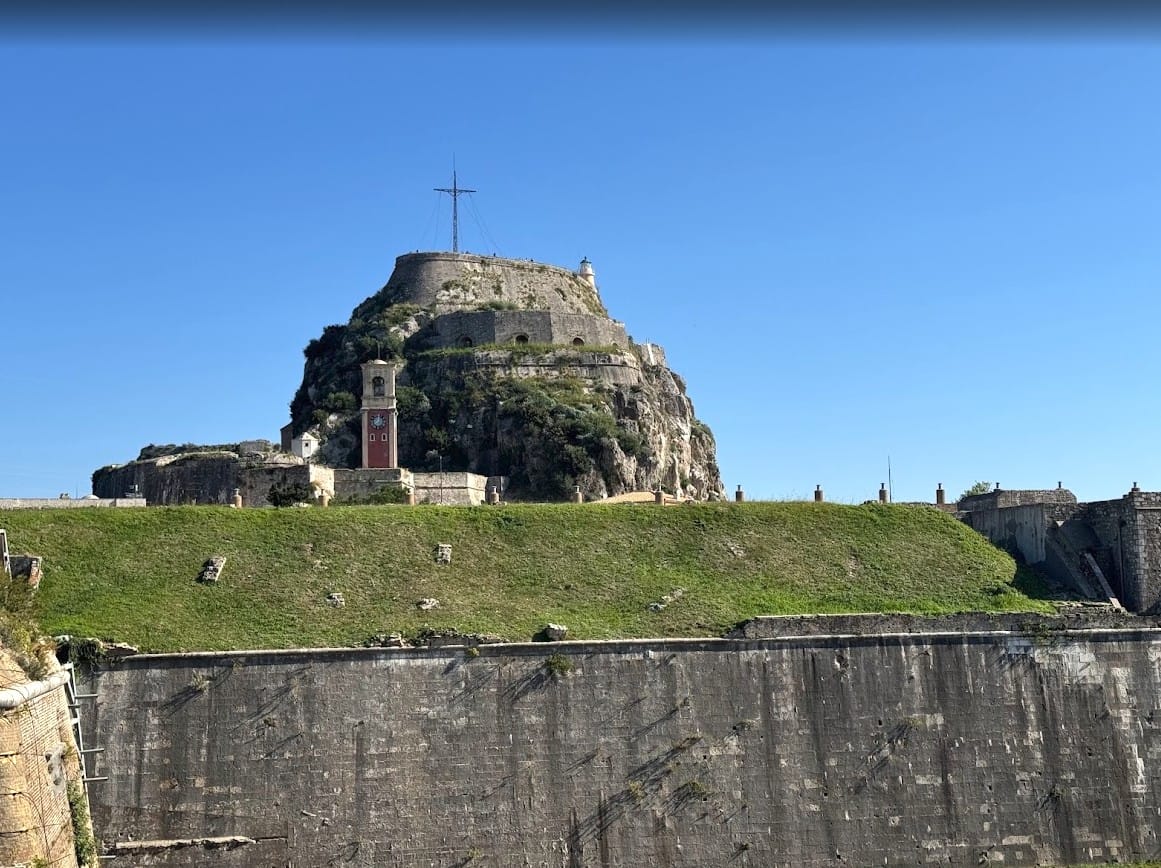
The four centuries of Venetian rule that began in 1386 and ended with the fall of the Republic in 1797 shaped Corfu more completely than any other period in its history. The Venetians built the fortifications that protected the island through multiple Ottoman sieges, most dramatically the siege of 1571 that coincided with the Battle of Lepanto, established the agricultural economy of the olive groves that still cover the island’s hillsides through a bounty system that paid farmers for every tree successfully planted, introduced the musical and artistic culture that distinguishes Corfu from every other part of Greece, and created the urban fabric of the Old Town that UNESCO recognised in 2007 as one of the finest examples of a Mediterranean fortified port in Europe. The San Giacomo Theatre, built during this period, became the first opera house in Greece, and the formal music education institutions that preceded the later philharmonic societies gave the island a Western European musical culture that persists to the present day.
Napoleon, Britain, and the Road to Greece
The fall of the Venetian Republic in 1797 transferred Corfu through a rapid succession of hands that each left their own architectural and institutional mark on the island. The French administration of Napoleon, arriving with the ideas of the Revolution and the ambitions of the Grande Armee, built the Liston promenade along the Spianada on the model of the Rue de Rivoli in Paris and attempted to reorganise the island’s social and political life on Revolutionary principles. The Septinsular Republic that followed, established under Russian and Ottoman joint protection from 1800 to 1807, provided the first experience of Greek self-governance in the modern period and planted the seeds of the national consciousness that would eventually produce the enosis movement.
The British Protectorate that governed the island from 1815 until 1864 introduced cricket, ginger beer, a neoclassical palace, and a road network that transformed internal communications, while maintaining the essential character of the Venetian city beneath its own institutional overlay. The union with Greece on 21 May 1864, the culmination of decades of political pressure from the island’s Greek-speaking population, completed the island’s modern political journey and incorporated Corfu into the Greek national state. The cultural identity that the centuries of Venetian influence had produced has never, however, been entirely absorbed into the broader Greek national character. Corfu remains, in language and architecture and music and food, an island that carries its Western European inheritance as a living and defining element of what it is, distinct from the rest of Greece in ways that three thousand years of layered history have made irreversible and irreplaceable.