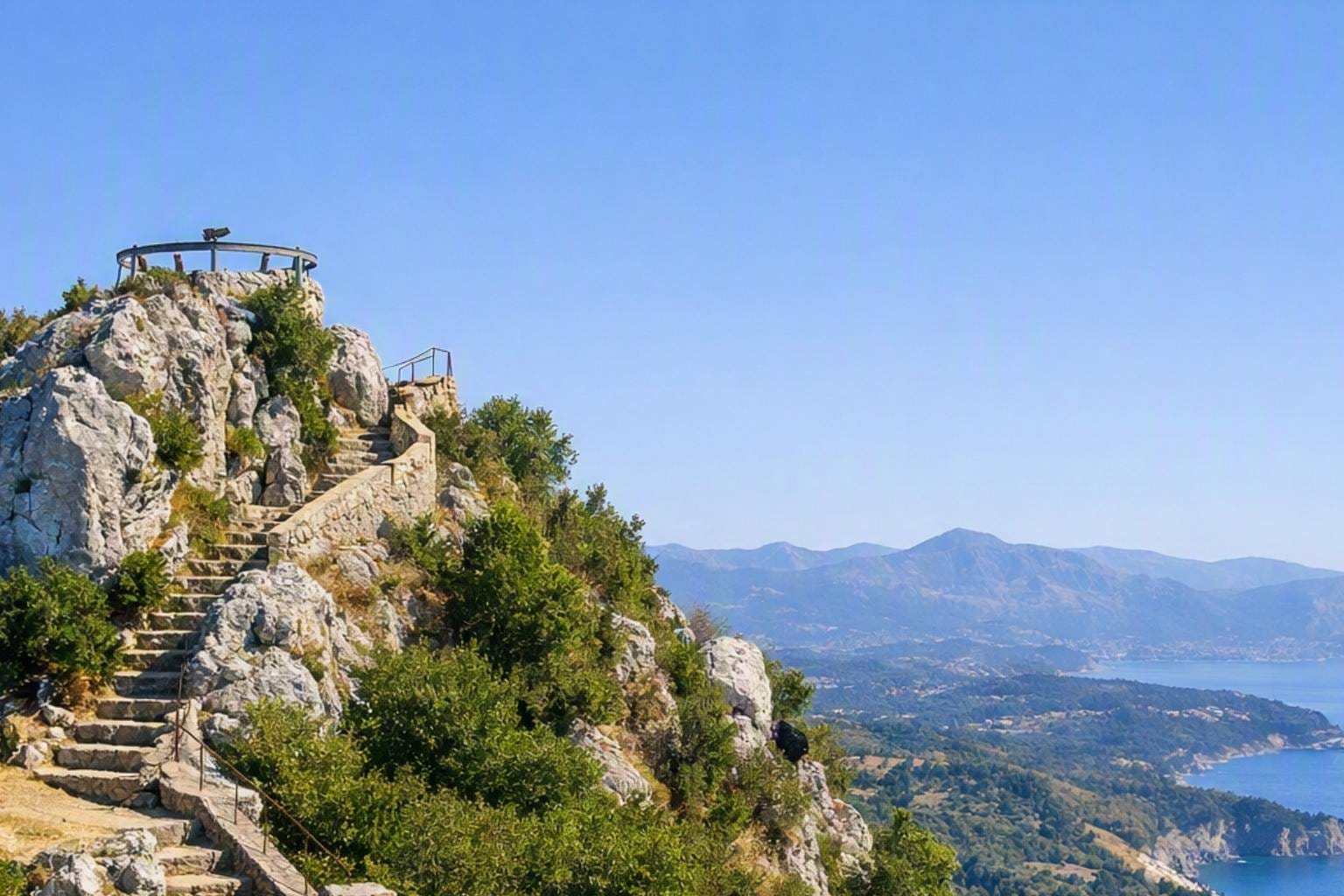
The village of Pelekas sits on the central ridge of Corfu with the particular confidence of a settlement that has occupied its elevated position for long enough to regard the view as a natural rather than a remarkable feature of daily life. The residents of Pelekas have been watching the sun set over the Ionian from this ridge for generations, and the sunset that brings visitors from across the island every evening through the summer season is, for the village, simply what happens at the end of each day: the sun moving toward the horizon over the open sea to the west, the sky performing its evening sequence, and the landscape below settling into the warm darkness of the Mediterranean night.
For the visitor, the sunset from Pelekas is a revelation. For the village, it is Tuesday.
This combination of the extraordinary natural spectacle and the completely ordinary community life that continues around it gives Pelekas its particular character, and the visitor who arrives early enough to explore the village before the sunset hour discovers that the settlement on the ridge is as rewarding for its own qualities as for the atmospheric event that has given it its most celebrated function.
The Ridge and Its History
The central ridge of Corfu, the spine of higher ground that runs roughly northwest to southeast through the island’s interior and that separates the east-facing coast from the west, has been a strategically significant feature of the Corfiot landscape since the earliest period of the island’s settlement. The elevated position that the ridge provides, with views extending to both coasts and to the surrounding sea in multiple directions, made the settlements on its higher points natural observation and communication posts in an era when the control of the surrounding landscape depended on the ability to see across it.
Pelekas, at one of the highest points of the central ridge, occupies a position that this strategic logic made significant throughout the various periods of the island’s history. The Venetian administration, which understood the defensive and communicative value of elevated positions with the practical intelligence that four centuries of island governance produced, maintained the ridge settlements as part of the system through which the island’s interior could be observed and its population mobilised in times of threat.
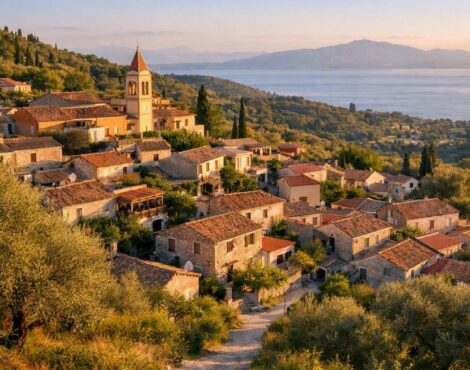
The village that has developed on and around this ridge position over the centuries reflects the layered history of its strategic location. The oldest buildings of Pelekas, the family residences of the households that have been on this ridge for the longest periods of continuous occupation, carry the architectural language of the Venetian period in the proportions of their facades and the treatment of their doorways and windows. The later buildings, from the British period and the subsequent decades of the modern Greek state, add their own layers to the accumulated built environment of the ridge settlement without entirely displacing the earlier character that the oldest parts of the village preserve.
The Kaiser’s Throne: The Viewpoint and Its Name
The viewpoint above the village known as the Kaiser’s Throne carries its name from Kaiser Wilhelm II of Germany, who visited Corfu regularly in the years between his purchase of the Achilleion Palace in 1907 and the outbreak of the First World War in 1914. The Kaiser, whose relationship with Corfu and with the island’s natural beauty was one of the more personal and less politically complicated dimensions of a reign that history has judged harshly in almost every other respect, developed a genuine appreciation for the sunset view from the Pelekas ridge and visited the viewpoint with sufficient regularity that the name he gave it, or that was given it in recognition of his appreciation, has persisted through more than a century of subsequent history.
The irony of the name, applied to a viewpoint whose natural beauty is entirely indifferent to the political significance of the person who most famously admired it, is part of what gives the Kaiser’s Throne its particular character as a destination. The view itself requires no royal endorsement and receives no particular enhancement from the name: it is simply the finest west-facing sunset viewpoint on the island, positioned at the highest accessible point of the central ridge with the open Ionian spread to the horizon and nothing between the observer and the setting sun but the sea and the air and the particular quality of the evening light that the Corfiot west coast receives most completely from this elevation.
The sunset from the Kaiser’s Throne in September and October is the finest of the year. The lower angle of the autumn sun, falling toward the western horizon at a more oblique trajectory than the summer equivalent, produces the sequence of evening colours in their most saturated and most dramatic form. The gold of the pre-sunset hour, the copper and rose of the final approach to the horizon, the deep amber afterglow that fills the western sky for thirty minutes after the sun has gone and that reflects in the Ionian below in the particular way of the calm autumn sea: these are the colours of the Pelekas sunset in September and October, and they are colours that the peak summer sunset at the same viewpoint, however beautiful, cannot quite achieve in the same richness and the same definition.
The Village Beyond the Viewpoint
The visitor who arrives at Pelekas solely for the sunset and who spends the hours before the evening light at the viewpoint cafe rather than exploring the village misses the dimension of Pelekas that the name and the celebrity of the Kaiser’s Throne specifically obscures. The village beyond the viewpoint has a genuine and unremarkable character that the tourist infrastructure of the sunset destination has not entirely displaced, and the streets and the squares of the older quarter provide the authentic Corfiot village experience that the viewpoint’s celebrity location somewhat crowds out.
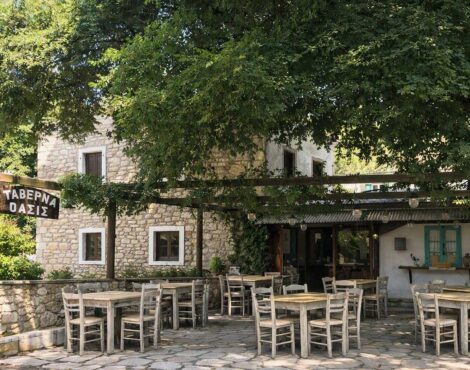
The main square of Pelekas, with its kafeneion and its small number of residents occupying the tables in the manner of a community that has been gathering in this square for generations, is the social centre of a village that continues to exist independently of the tourist trade that the sunset brings each evening. In September and October, when the tourist volume has reduced significantly from the August peak, the square returns to something closer to its natural character and the visitor who takes a coffee at the kafeneion table and watches the village’s own daily life proceed around them finds an experience of the authentic Corfiot village that the summer months, with their full complement of sunset tourists, do not consistently provide.
The lanes of the older quarter of Pelekas, climbing from the main square toward the highest point of the village settlement and the viewpoint beyond, pass through the architectural fabric of a community whose buildings span several centuries of Corfiot history. The oldest houses of the village, their facades in the Venetian domestic language of the island’s interior settlements, alternate with the later additions of the British and modern periods in the manner of a village that has grown organically through its history without the wholesale replacement of its older building stock that modernisation has produced in more economically active communities.
The West Coast Below
The relationship between Pelekas village and the beach that shares its name, visible from the ridge viewpoints as a pale arc of sand and the blue Ionian beyond it at the base of the western slope, is the relationship between the elevated and the coastal dimensions of the same geographical feature. The ridge on which the village sits is the same feature that ends, five hundred metres below, in the limestone cliffs above the beach, and the descent from the village to the water, by the road that switchbacks down the western slope, takes the visitor from the elevated, breeze-cooled character of the ridge settlement to the direct exposure to the afternoon sun and the sea that the beach below provides.
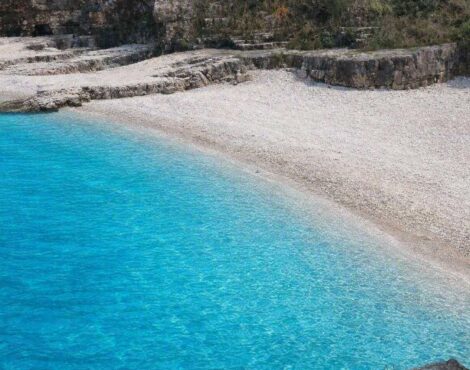
Pelekas beach itself, a long arc of fine sand facing southwest into the open Ionian, is one of the finest beaches on the west coast and one that the elevation of the village above it protects from the immediate visibility that the road-accessible beaches of the north and east coast receive. The descent to the beach and the ascent from it, while not particularly demanding, provide a degree of filtering that maintains the beach’s character as a destination reached by intention rather than by accident, and the September visitor who makes the descent finds a beach considerably quieter than the main organised destinations of the northwest coast while equally fine in the quality of its sand and its water.
Pelekas in September and October
The finest time to visit Pelekas is September or October, when the village operates at its most naturally itself and the light on the landscape is at its most dramatically golden. The September afternoon in Pelekas, with the sun moving toward the horizon over the open Ionian at the angle that produces the most richly coloured sunset of the year and the village going about its own business in the quiet of the post-peak-season month, is the Pelekas experience in its most complete and most personally rewarding form.
The October visit adds the quality of the advancing autumn light to the already fine September conditions, the lower October sun falling across the ridge and the village facades from an angle that the September sun does not quite achieve and that produces on the limestone and the older plasterwork of the village buildings the warm amber illumination of the genuine autumn afternoon. The sunset from the Kaiser’s Throne in October, with the Diapontian Islands visible on the western horizon as dark outlines against the evening sky and the sea below the ridge at the deep blue of the late season Ionian, is the sunset that the viewpoint was named for and that the advancing season makes, in September and October, the finest of the entire year.
For guests at Kapella Apartments, the Pelekas visit is the late afternoon and evening programme that the west coast sunset most naturally produces: the drive through the olive country to the ridge, the coffee at the village kafeneion, the walk to the viewpoint in the hour before the sunset, the sunset itself watched from the best available position with the full sequence of the evening colours available from first gold to final afterglow, and the dinner at one of the village tavernas in the warm September or October darkness before the return to Kapella Apartments through the quiet night roads of the Corfiot countryside.