Corfu Town in September: The Old Town Without the August Crowds
Corfu Town in August is a genuinely magnificent urban experience: the illuminated Venetian facades, the animated evening volta, the restaurants at peak season form, the Old Fortress lit against the night sky, the Campiello lanes full of the particular energy of a historic Mediterranean city at the height of its summer season. It is also, in the most practical and most directly apparent sense, very full. The lanes of the Campiello that in the early morning have the quiet character of a medieval neighbourhood going about its business are by ten o’clock crowded in a way that makes the slower, more contemplative exploration that the architecture and the history deserve considerably more difficult than the solo passage through the streets allows.
September removes the difficulty. The lanes of the Campiello in September are the lanes of a neighbourhood rather than a tourist destination, navigable at whatever pace the observation of the surrounding architecture suggests and offering at every turn the possibility of the discovery, the unexpected courtyard, the hidden church, the view through an open gate into a garden of extraordinary antiquity, that the August crowds obscure with the simple density of their presence.
The Campiello in September
The medieval heart of Corfu Town, the labyrinth of narrow lanes and small squares and unexpected passages that constitutes the Campiello quarter, reaches its finest condition for the visitor in September. The peak season months fill these lanes with a density of visitors that, while it contributes to the animated atmosphere of the Old Town, simultaneously makes the slower, more attentive exploration that the quarter rewards considerably more difficult than the architecture and the history deserve.
In September, the Campiello returns to a pace of occupation that the medieval street plan was designed for. The lanes, too narrow for vehicles and sometimes too narrow for two people to pass with full comfort, are navigated at the speed that the surroundings invite rather than the speed that the crowd behind imposes. The churches that appear in unexpected positions throughout the quarter, tucked into corners of the lane network with the unpretentious confidence of buildings that have been in these positions since the Byzantine period and expect to remain there, can be entered and explored without the queue of peak season visitors that August places before their doors.
The domestic architecture of the Campiello, the Venetian facades with their characteristic proportions and their variety of detail, the shuttered windows opening onto the morning air, the ironwork balconies that carry the occasional September geranium or the remnant of the summer’s flowering plants, the ground-floor workshops and small shops that serve the neighbourhood’s population rather than its tourists: all of these reveal themselves in September with the completeness that requires both the time to stop and look and the absence of the crowd that prevents either in the August equivalent.
The Museums in September
The Archaeological Museum of Corfu, home to the Gorgon pediment that is among the most significant pieces of archaic Greek sculpture in existence, is in September accessible without the queuing that the peak season visitor numbers impose and at the leisurely pace that a collection of this quality rewards. The Gorgon pediment, which in August must be viewed in the context of a flow of visitors moving through the gallery on the schedule that the entry management of a busy museum produces, can in September be approached and remained before for as long as the scale and the detail of the work require. The capacity to stand before a work of this significance for twenty minutes without pressure to move is not a luxury. It is the condition that the proper encounter with a great object of art requires, and September at the Archaeological Museum provides it consistently.
The Museum of Asian Art in the Palace of St Michael and St George, one of the finest collections of its kind in Greece and one that the summer visitor to Corfu frequently overlooks in favour of the more immediately accessible attractions of the Old Town, is in September a museum of exceptional quality experienced in ideal conditions. The collection, whose range from ancient Chinese bronzes to Japanese woodblock prints to the painted screens of the Edo period provides one of the most unexpectedly rewarding museum hours available in the Ionian islands, rewards the September visitor with the attentive quality of a collection seen without the distraction of peak season numbers.
The Liston in September
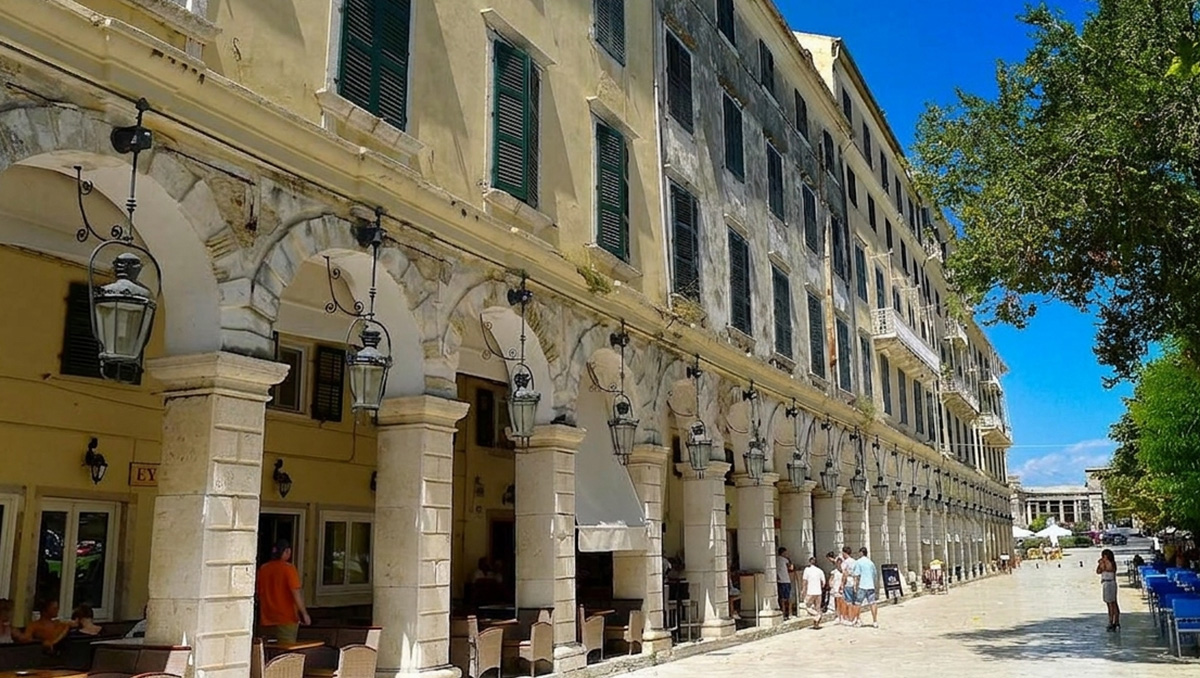
The Liston promenade, the arcaded French-era social centre of Corfu Town’s evening life, undergoes in September the same transformation that the rest of the town experiences: the essential character and the essential quality entirely present, the peak season density absent, and the result a version of the experience that the most knowledgeable and most return-inclined visitors to the island specifically seek.
The evening at the Liston in September begins with the volta, the traditional promenade of the town’s population through the Spianada and along the arcaded promenade that is one of the most genuine and least touristic of the Greek urban rituals that Corfu maintains with the consistency of a community whose social culture has not been entirely replaced by the infrastructure of tourism. In September, with the local population reasserting its relationship with the public space that the August visitor numbers temporarily occupy, the volta is at its most authentically Corfiot: the families moving slowly through the Spianada, the older residents occupying the benches in the particular way of people who have been sitting in the same public space for decades, and the children running between the adults and the pigeons with the specific energy of a Mediterranean evening in the early autumn warmth.
The Liston cafes in September have the character of establishments serving a clientele rather than managing a volume. The table is available without the competitive early occupation that August demands. The service is at the pace that a conversation over a long coffee or an evening drink naturally requires. And the view from the Liston table, across the September Spianada with the Old Fortress illuminated in the distance and the Albanian mountains visible on the northeastern horizon in the September clarity, is the Corfu Town evening view at its most complete and most quietly magnificent.
The Old Town Restaurants in September
The restaurants of Corfu Town’s old quarter are, in September, at the finest point of their seasonal operation. The kitchen teams of the best Corfiot establishments have accumulated four months of continuous service through the peak season, their skills sharpened by the volume and their confidence established by the consistent delivery of the Corfiot cuisine to audiences that have grown progressively more numerous and more demanding through the summer months. In September, this accumulated skill and confidence is applied to a clientele small enough to receive the full benefit of it, and the cooking that the September restaurant produces reflects this combination of peak skill and post-peak-season calm with a directness and a quality that the August kitchen, however accomplished, cannot consistently deliver under the pressure of its volume.
The sofrito and the pastitsada and the bourdeto, the three dishes that most directly express the distinctive character of the Corfiot kitchen, reach their September expression in the hands of the chefs who have been cooking them throughout the season and who bring, in September, the confidence of the fully established seasonal form to the preparation of the dishes that their restaurants are most celebrated for. The October guest in the most celebrated of these restaurants, arriving for a dinner that in August would have required booking days in advance and that in September requires only the decision to go, encounters the Corfiot kitchen at the most complete and most personally rewarding point of the culinary year.
The Old Fortress and the New Fortress in September
The fortresses that define the visual geography of Corfu Town from both the east and the west, the Old Fortress on its rocky promontory and the New Fortress on the San Marco hill, are in September accessible and explorable in the conditions of space and quiet that the archaeological and architectural significance of both structures rewards. The Old Fortress, whose upper levels provide some of the finest panoramic views available in the Ionian islands, can be climbed and explored in September at the pace that the view from each successive level suggests, without the management of the peak season crowd that August imposes.
The view from the upper levels of the Old Fortress in September, with the September clarity extending the visible range to its annual maximum and the September light on the sea below adding the golden quality of the early autumn to the panorama, is the Old Fortress view at its finest. The Albanian mountains to the northeast, the Diapontian Islands to the northwest, the full length of the island’s east coast curving southward below, and the rooftops and campaniles of the Old Town in the foreground: this is the Corfu Town panorama at its most completely revealed, and September provides both the visibility and the calm that the full appreciation of it requires.
The September Day in Corfu Town from Kapella Apartments
For guests at Kapella Apartments, the September day in Corfu Town is the most completely satisfying version of the town visit that the season provides. The morning for the Archaeological Museum and the Campiello walking tour, conducted at the pace that the architecture and the history invite without the August pressure to keep moving. The midday for the covered market and the cheese and fish and vegetable stalls that reflect the September harvest in their September best. The afternoon for the Old Fortress climb and the view from the upper levels in the September clarity. And the evening for the Liston and the volta and the dinner at one of the old quarter’s finest restaurants, served with the September attentiveness of a kitchen that has found in the early autumn month the conditions that produce its finest work.
This is the Corfu Town day that the September guest at Kapella Apartments makes, and it is the day that the August guest, however richly rewarded by the energy and the vitality of the peak season town, misses in the form that September alone provides: the Old Town without the crowds, at the pace the Old Town was built for, in the light that the September Ionian delivers to those who choose the month that best knows how to use it.