There is a version of Corfu that exists above the olive line, above the coastal resorts and the tourist beaches and the Venetian architecture of the town, in the higher terrain of the Pantokrator massif where the island’s character is shaped by altitude and exposure and the particular quality of a mountain community that has existed at this elevation for centuries without the sea trade and the tourist economy that have defined the lower island’s development. This is the Corfu of the mountain villages, and of all the settlements on the slopes of Pantokrator, it is Strinilas that most completely and most directly expresses what this higher version of the island is and has always been.
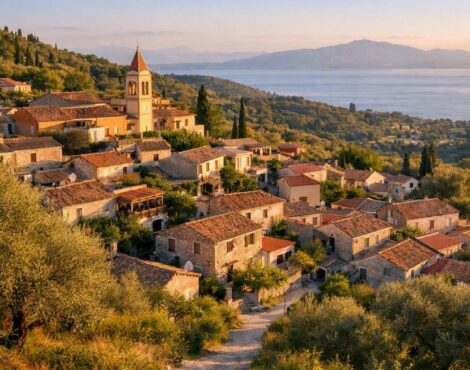
Strinilas is not a picturesque village in the way that the word picturesque is usually applied to the settlements that tourism has identified and commodified and adjusted to its requirements. It is a village that the mountain has shaped and that the mountain continues to shape, whose character derives from the altitude and the exposure and the pastoral economy of the surrounding terrain rather than from any external appreciation of its qualities. The appreciation exists, and the visitors who find their way to Strinilas on the mountain road from Spartilas and Sokraki consistently find more than they anticipated. But the village was not made for them, and this fact is visible in everything about it.
The Mountain and Its Villages
Mount Pantokrator, at 906 metres the highest point on Corfu, dominates the northeastern quadrant of the island with the authority of a feature whose scale makes it visible from every elevated point on the island and from the sea in every direction around the northeastern coast. The mountain is not a single dramatic peak but a massif, a substantial area of high ground whose various slopes descend toward the coast in different directions and at different gradients, creating a variety of terrain and microclimate that has supported human settlement at different altitudes through the full range of the mountain’s elevation.
The villages on the Pantokrator slopes form a sequence from the lower, more sheltered settlements close to the coastal plain to the higher communities that occupy the middle and upper slopes in positions of increasing exposure and increasing altitude. Spartilas, at the foot of the main ascent road, has the character of a transitional settlement between the coastal plain and the mountain proper. Sokraki, higher on the slope, begins to have the character of the genuine mountain village. And Strinilas, at 600 metres on the open southwestern face of the massif, is the mountain village in its most complete form: the altitude sufficient to produce the temperature difference that separates it from the coastal communities below, the views extensive enough to reveal the full geographical scope of the island and its surrounding seas, and the community character shaped by the pastoral economy and the mountain isolation that five or six centuries of continuous settlement at this altitude have produced.
The History of the Village
The precise origins of Strinilas as a settled community are, as with most of the Corfiot interior villages, difficult to date with the certainty that documentary evidence would provide. The mountain villages of the Pantokrator area were established at various points in the medieval and early Venetian periods, their positions on the higher ground reflecting a combination of defensive logic, the need to be above the malaria-prone coastal lowlands that made lower settlement hazardous in certain seasons, and the pastoral economy of the mountain terrain that provided the grazing for the sheep and goat herds whose products, the milk and the cheese and the meat, constituted the primary agricultural output of the higher villages.
The Venetian period shaped Strinilas as it shaped all the villages of the Corfiot interior, not through the direct investment in architectural infrastructure that the town and the fortifications received, but through the administrative and social framework that the Republic imposed on the island’s population and that gave the mountain communities their particular relationship with the governing authority and with the agricultural economy that the olive bounty system was transforming in the lower terrain. Strinilas, at an altitude where the olive does not thrive with the same productivity as on the lower slopes, remained more fully committed to the pastoral economy through the Venetian period than the villages of the olive country below, and this pastoral character is still visible in the village’s relationship with the mountain terrain that surrounds it.
The View: The Finest on the Island
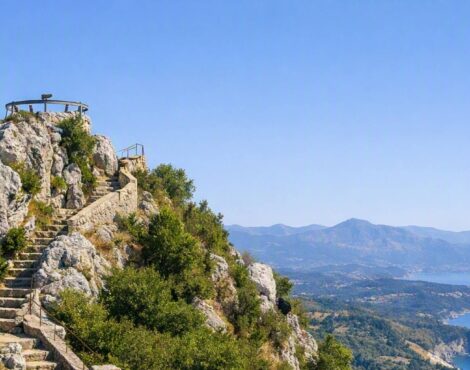
The view from Strinilas is the view that the mountain provides to those willing to make the ascent, and it is a view of the northeastern Ionian and the surrounding geography that no coastal viewpoint and no lower elevation on the island can replicate with the same completeness and the same scope. At 600 metres, the village looks out across a panorama that encompasses the full northeastern coast of Corfu from Kassiopi in the north to Corfu Town in the south, the Albanian mountains rising directly across the channel to the northeast, the open sea of the Ionian stretching northwest toward the Diapontian Islands and beyond them to the Italian coast on the far horizon, and the mountains of the Greek mainland visible on clear days to the east across the narrowing waters of the northern Ionian.
The September and October view from Strinilas is the finest of the year, the clarity of the early autumn atmosphere extending the visible range to its annual maximum and revealing the full extent of the geographical panorama with a definition that the summer haze reduces and that the early autumn clarity restores. The Albanian mountains in September and October clarity, their ridges and their peaks individually distinguishable rather than merged into the atmospheric blur of the August equivalent, provide the most dramatic element of the northeastern view and the element that most powerfully communicates the geographical reality of Corfu’s position: an island sitting at the edge of the European world, the Albanian mountains a visible presence across a channel of two kilometres at its narrowest point.
The Taverna: The Reason People Come Back
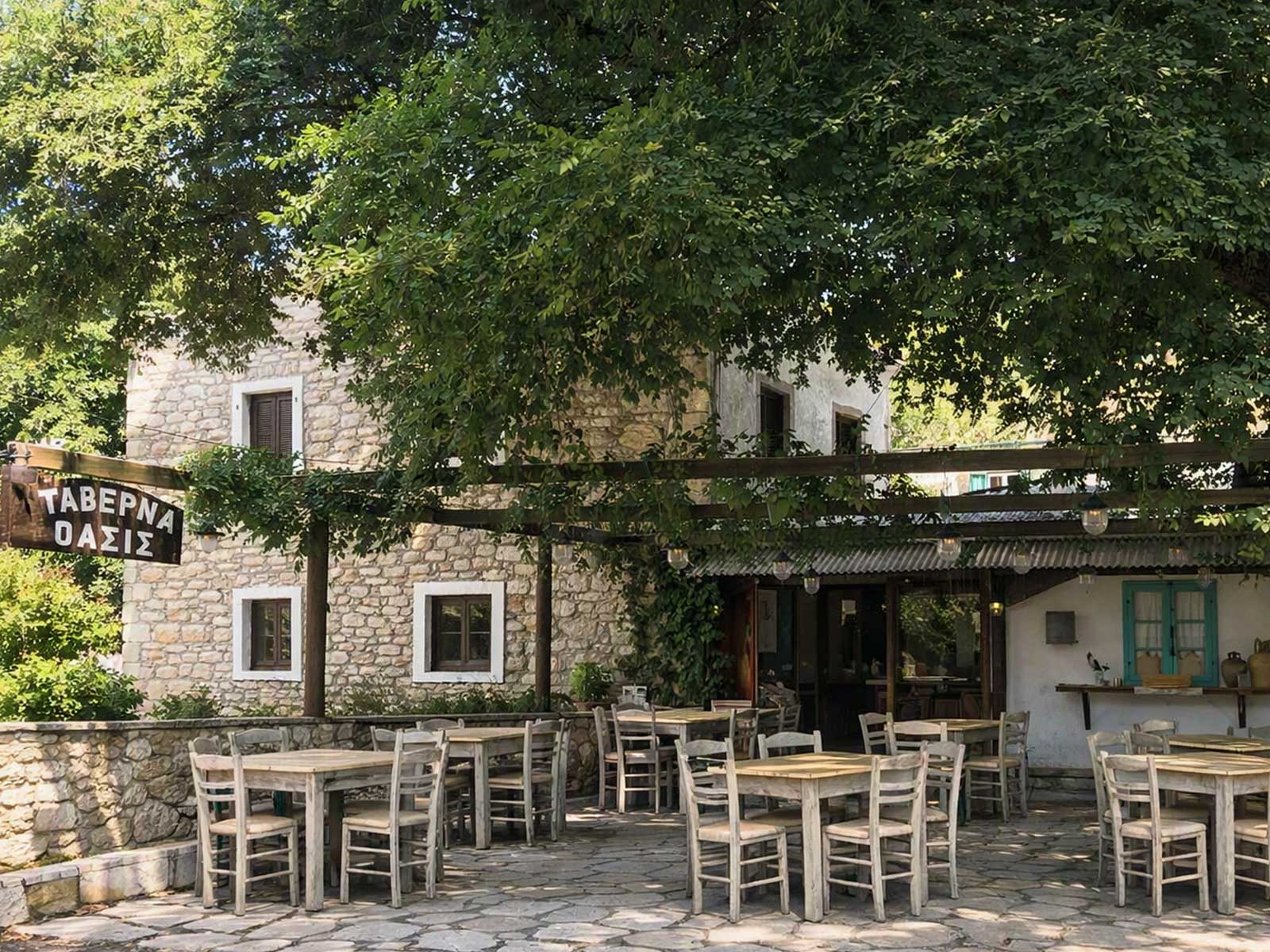
If the view is the reason people first come to Strinilas, the taverna is the reason they come back. The village eating establishment, whose precise name matters less than its consistent and entirely deserved reputation among the people who know the Corfiot interior most thoroughly, is one of those rare places that achieves the quality of the finest food in the most natural and least self-conscious manner: by having access to exceptional ingredients, by applying to them the techniques of a kitchen that has been cooking the same dishes for generations, and by serving the result in a setting whose natural beauty does the work that no amount of interior design or atmospheric engineering could replicate.
The food at the Strinilas taverna is the food of the Corfiot mountain tradition. The lamb and the kid that the mountain pastures of the Pantokrator area produce have the particular flavour of animals raised on the aromatic grasses and herbs of the higher terrain, a flavour that the meat of the coastal lowland does not achieve and that the cooking methods of the mountain kitchen, the slow roasting and the oven braising that the colder temperatures and the longer cooking times of the altitude make natural, develop to their fullest expression. The salads are dressed with the oil of the olive groves visible from the taverna terrace, grown on the lower slopes below the village where the altitude and the exposure allow the olive to prosper. The wine is the wine of the local producer, served without ceremony in the manner of a taverna that treats wine as a natural companion to the food rather than as a commercial offering requiring presentation.
The taverna terrace, positioned to face northeast across the channel and the Albanian mountains with the full extent of the panorama available from the tables, is the setting for a meal that the combination of the food and the view makes one of the most specifically and most directly rewarding eating experiences available anywhere in the Corfiot calendar. In September and October, with the post-peak-season quiet reducing the taverna to a clientele of the specifically interested rather than the generally passing, the quality of attention that each table receives is the quality of a restaurant that has recovered from the summer pressure and is giving its post-season best with the particular pleasure of a kitchen that has time and inclination to do so.
The Mountain Road and the Descent
The approach to Strinilas by the road that climbs from the northeast coast through Spartilas and Sokraki is itself a significant dimension of the village experience, the road delivering at each successive turn a view that improves on the previous one and a landscape that becomes progressively more dramatic and more specifically mountain in character as the altitude increases. The olive groves of the lower slopes, familiar from the coastal plain and the interior valleys, give way on the middle slopes to the more open terrain of the higher mountain: the scrub vegetation of the garrigue, the rocky outcrops of the limestone that appears through the thinner soil of the higher ground, and the occasional clear view through the mountain vegetation to the coast and the sea below.
The descent from Strinilas, whether by the same road or by the alternative route through the villages of the northern slopes toward the northwestern coast, delivers a different perspective on the mountain and the island from the ascent, the afternoon or evening light on the terrain below providing the visual rewards that the morning approach, with the sun behind the mountain, does not produce in the same form. The October descent in the late afternoon, with the low sun falling across the olive groves of the lower slopes and the coastal plain below in the amber gold of the advancing season, is one of the most beautiful drives available anywhere on the island at any point in the year.
Strinilas from Kapella Apartments
For guests at Kapella Apartments, Strinilas is the mountain day that most completely rewards the drive and most directly connects the coastal and outdoor character of the Kapella Apartments stay to the higher, more austere and more anciently inhabited dimension of the Corfiot landscape. The drive from the property to the village, through the olive country of the central island and up the mountain road through Spartilas and Sokraki, takes less than an hour and delivers the guest to an experience of the island that the beach days and the coastal excursions, however excellent, do not provide in the same form.
A September or October day at Strinilas, beginning with the morning drive through the mountain villages and the arrival at the taverna for a late morning coffee on the terrace with the panorama below, proceeding through a long and unhurried lunch of the mountain kitchen’s finest offerings, and concluding with the afternoon descent in the golden light of the autumn sun on the olive country below: this is the Kapella Apartments mountain day in its most complete and most personally rewarding form, and it is the day that the guests who experience it most consistently identify as the one they would most willingly repeat.