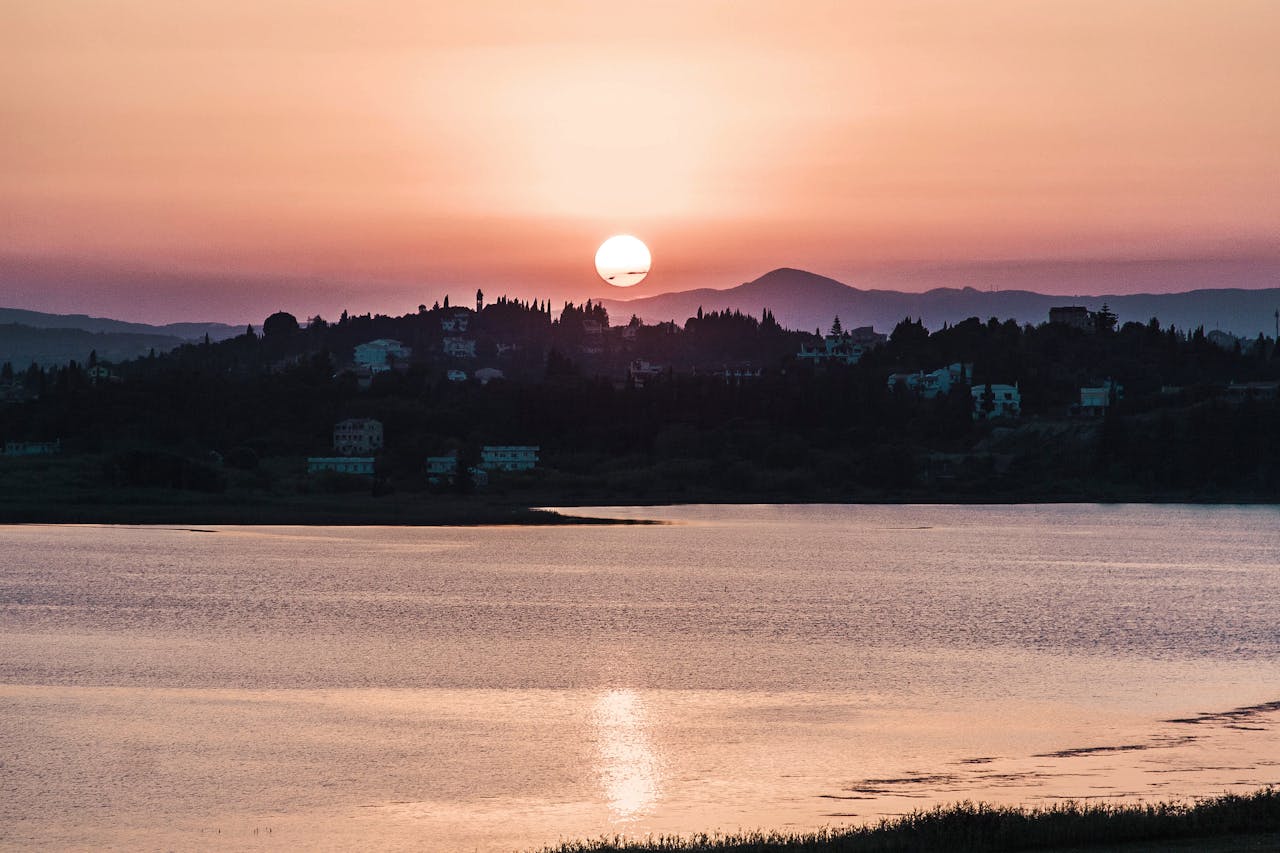
Every day on Corfu ends with a performance. The island’s position in the northeastern Ionian, facing west across open water toward the Italian coast and south toward the Ionian islands and the open Mediterranean beyond, means that the setting sun has nothing to obstruct it from the moment it touches the horizon until the last light fades from the western sky. The result, on a clear June evening, is a sequence of colour and light that the west-facing viewpoints of the island deliver with the reliability of a natural phenomenon that has been occurring every evening for as long as the island has existed and that has been watched, with varying degrees of conscious appreciation, by every civilisation that has lived here.
Watching the sunset in Corfu is not a tourist activity in the sense that it requires organisation or expense or the consultation of a guidebook. It is simply what the island offers at the end of every day to anyone positioned to receive it. But some positions are better than others, and the effort of reaching the finest viewpoints rewards itself with a quality of visual experience that the more casually observed sunsets of the beach and the taverna terrace do not quite achieve.
The Kaiser’s Throne: The Celebrated Viewpoint
The viewpoint above the village of Pelekas, known as the Kaiser’s Throne after Kaiser Wilhelm II who visited it during his summers at the Achilleion and whose appreciation of the view gave it a royal endorsement that its own qualities did not require, is the most celebrated sunset spot on the island and one of the most famous in the Greek islands generally. The name has stuck despite the complicated associations of its origin, and the viewpoint itself has earned its reputation through the simple means of delivering, on clear evenings throughout the season, one of the finest sunset panoramas available from any fixed point in the Mediterranean.
The position on the central ridge of the island, at a height that places it above the coastal terrain on both sides, provides an unobstructed view westward across the Ionian Sea to the horizon. The island’s own landscape fills the foreground: the olive groves and villages of the west coast, the beaches of Pelekas and Glyfada visible as pale strips of sand below the cliffs, and the open water beyond extending to the point where the sun will eventually meet it.
The quality of the Kaiser’s Throne sunset in June is a function of several converging factors. The late hour of the June sunset, after nine o’clock, means that the full arc of the evening light is available to the observer from the warm gold of the pre-sunset hour through the deepening rose and orange of the final descent to the long, slow fade of the afterglow that follows the sun below the horizon and continues, in June’s long evenings, for thirty minutes or more. The atmosphere in June, relatively free of the haze that the heat of high summer produces, gives the light a clarity and a definition that intensifies the colours and sharpens the horizon in ways that make the June sunset at the Kaiser’s Throne as fine as at any point in the season.
Lakones: The Village Above the Bays
The village of Lakones, perched on the ridge above Paleokastritsa with views that look directly west and southwest across the northwest bays and the open sea beyond, is among the finest sunset viewpoints on the island and one that receives considerably fewer visitors than the Kaiser’s Throne. The combination of the village character, with its kafeneion and its handful of tavernas occupying positions specifically designed to take advantage of the view, and the quality of the panorama below makes Lakones one of the most rewarding places on the island to spend a June evening.
From the taverna terraces of Lakones, the full extent of the Paleokastritsa bay system is visible below, the multiple coves and headlands that from water level seem separate and enclosed appearing from this height as parts of a single coherent coastal landscape. The monastery of Theotokos on its promontory, visible from almost every angle in the surrounding landscape, sits directly below the Lakones viewpoint in a relationship that clarifies the geography of the northwest coast as no lower vantage point can.
The sunset from Lakones in June reaches its finest moment when the sun is low enough to light the monastery and the bays from the west, the water turning from the turquoise of the afternoon to the gold and rose and deep copper of the evening light, and the monastery walls catching the last direct sunlight of the day in a way that makes them appear to generate their own illumination. Eating dinner at a Lakones taverna with this view available throughout the meal is one of the most completely satisfying dining experiences that Corfu offers.
Afionas: The Headland Village
At the northwestern tip of Corfu, the village of Afionas sits on a headland that projects into the sea between two bays, its position offering a 270-degree panorama that encompasses the open Ionian to the west, the bay of Arillas to the south, and the bay of Agios Stefanos to the north. The headland below the village, reached by a short walk from the village square, is one of the finest sunset viewpoints on the island for those seeking a position that is genuinely remote and genuinely undisturbed.
The walk to the headland from Afionas takes fifteen minutes through low coastal scrub and wildflowers, the path descending gradually toward the tip of the promontory where the sea is visible in multiple directions simultaneously. In June, the wildflowers of the coastal scrub are still present in the lower and more sheltered sections of the path, and the walk to the viewpoint is as rewarding in botanical terms as it is in scenic ones.
From the headland tip, the sunset is visible without obstruction in every westward direction. The Diapontian Islands, the remote northwestern outposts of Othonoi, Erikoussa, and Mathraki, are visible on the horizon as dark shapes against the evening sky, and the knowledge that the sea between the headland and those islands is open Ionian, with nothing between Corfu and Italy in the distance, gives the sunset from this point a quality of oceanic scale that the more enclosed viewpoints of the central island cannot produce.
The New Fortress: The Urban Sunset
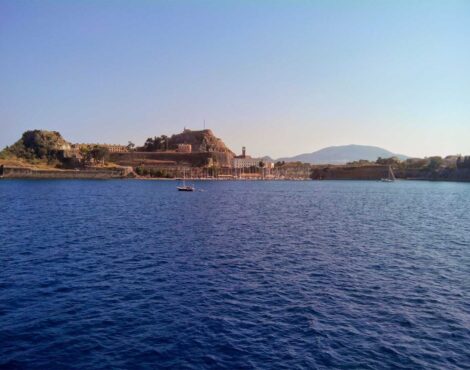
For guests spending an evening in Corfu Town, the upper bastions of the New Fortress provide a sunset viewpoint of an entirely different character from the rural and coastal alternatives. The urban panorama from the fortress, with the rooftops and campaniles of the Old Town in the foreground and the harbour and the open sea beyond, turns gold in the evening light in a way that the architectural landscape of a historic Mediterranean city makes particularly beautiful.
The light on the Venetian stonework of the Old Town at sunset is one of the most photographed phenomena in Corfu Town, and the reason for its photographic appeal is the reason for its appeal to the unmediated eye: the warm limestone of the buildings responds to the evening light by deepening in colour toward a rich amber gold that the same stone in the midday sun does not approach. From the New Fortress bastions, this transformation of the townscape is visible in its full extent, and the combination of the architectural panorama below and the sea view to the west creates a sunset experience that is simultaneously urban and oceanic in its scope.
The Boat Sunset: The Finest View
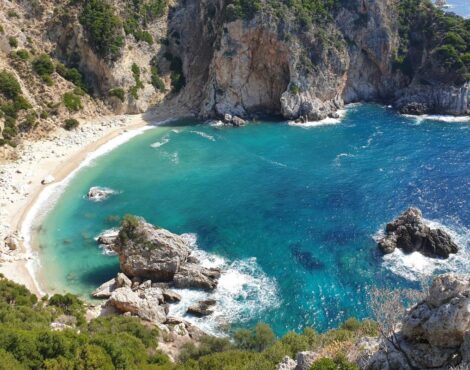
Of all the ways to watch the sunset in Corfu, the finest is from the water. A small boat positioned off the west coast in the late afternoon, moving slowly southward along the cliff line as the sun descends, provides a perspective on the evening light that no land-based viewpoint can replicate. The cliffs lit from the west, the sea turning through its sequence of colours as the light changes, and the absence of any man-made structure between the observer and the horizon create conditions for sunset watching that are, in the most literal sense, incomparable.
For guests at Villa Kapella with access to a hired boat for the day, timing the return journey along the west coast for the late afternoon hours, arriving back at the base as the sun is completing its descent, is one of the most natural and most rewarding ways to conclude a day on the water. The sunset from a boat off the Corfiot west coast in June is the kind of experience that the island offers freely to those who position themselves to receive it, and its quality, on a clear evening with the Ionian calm and the light performing its unhurried transition from gold to rose to the deep violet of the Mediterranean dusk, is entirely sufficient justification for everything that the day required to produce it.
Sunset and the Villa Evening
For guests returning to Villa Kapella after a sunset excursion, whether from the Kaiser’s Throne or the Afionas headland or a boat on the western sea, the transition from the spectacle of the sunset to the quietness of the villa garden carries its own particular pleasure. The evening garden, warm with the stored heat of the June day and fragrant with the herbs and flowers of the surrounding landscape, receives the returning guests with the unhurried ease that the best private spaces provide.
The dinner that follows, prepared in the villa kitchen or brought back from a taverna encountered along the route, is the natural conclusion of a day that the Corfiot summer has filled from the first morning light to the last colour in the western sky. June in Corfu delivers this sequence with a generosity and a reliability that is, for those fortunate enough to experience it from Villa Kapella, the defining quality of an island that does everything, including its endings, extraordinarily well.