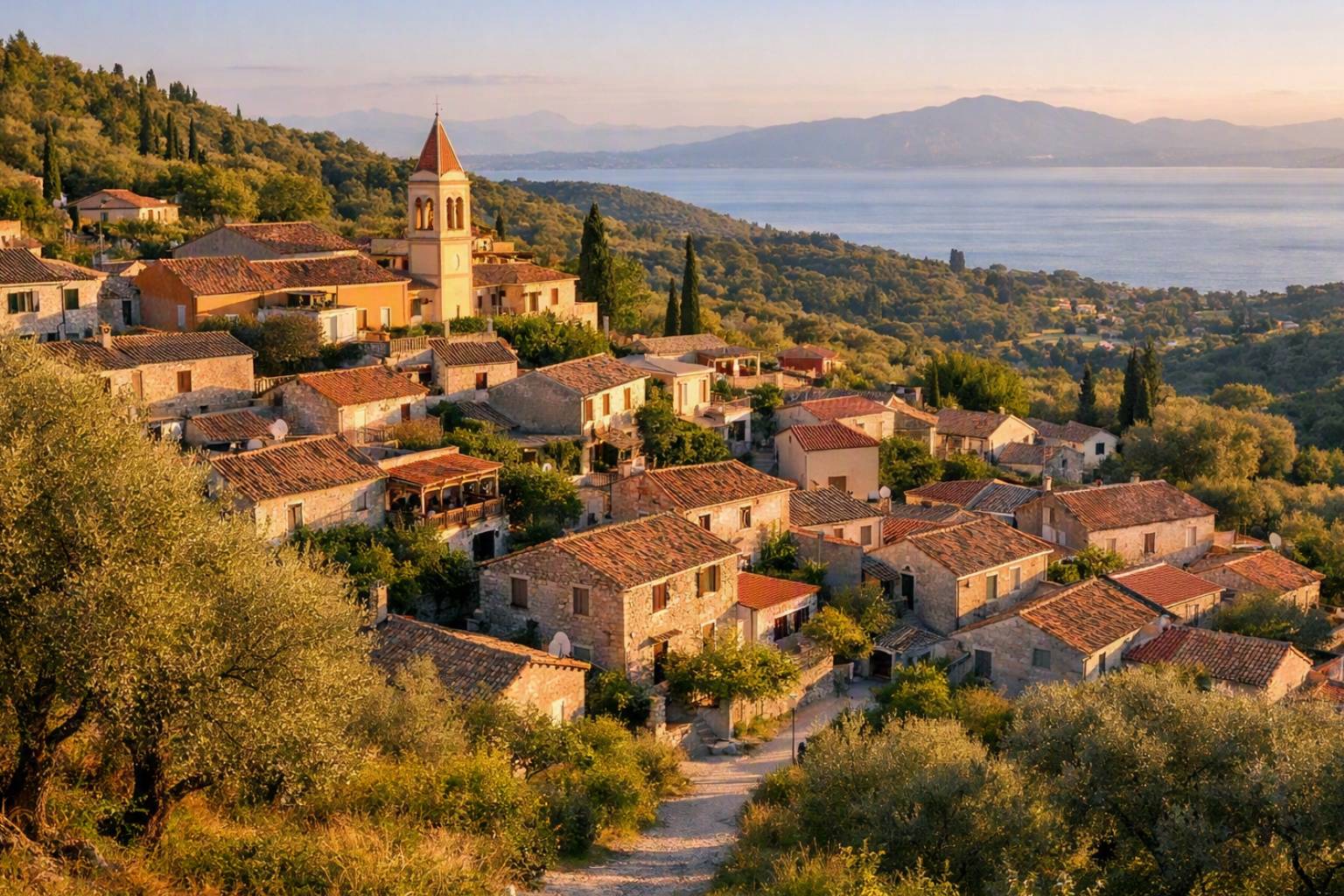
There are villages in Corfu that have accommodated the tourist century with more or less grace, adjusting their character to the requirements of the visitors who pass through them while retaining enough of their original substance to remain worth visiting. And then there is Ano Korakiana, which has not particularly accommodated the tourist century at all, which has remained on its hillside above the east coast in the manner of a village that has other things to be than a destination, and which offers to the visitor who finds their way there something that the more tourist-oriented settlements of the island cannot provide: the experience of a genuinely living community that happens also to be one of the most architecturally distinguished and historically significant villages in the Ionian islands.
The Setting
Ano Korakiana sits on the slope of a hill above the coastal plain of the northeast Corfu, its position elevated enough to provide views across the olive groves of the surrounding countryside and down to the sea without being so high as to give it the mountain character of the Pantokrator villages. The hill it occupies faces east and southeast, catching the morning sun with a directness that fills the upper village streets with light from the earliest hours of the day and that gives the eastern facades of the Venetian buildings their particular quality of early morning illumination.
The approach to the village from the main coastal road, climbing through the olive groves that cover the hillside between the lower ground and the village edge, is an approach through landscape that has changed very little in the past three or four centuries. The olive trees that line the road to Ano Korakiana are among the older specimens of the island’s groves, their massive trunks and their extraordinary canopy spreads bearing witness to centuries of continuous productive life, and the visual transition from the coastal road’s more developed character to the ancient agricultural landscape of the hillside approach is the first signal that Ano Korakiana operates in a different temporal register from the tourist infrastructure of the east coast below.
The Venetian Inheritance
The architecture of Ano Korakiana is the most immediately apparent expression of the village’s Venetian inheritance, and it is an expression of considerable quality and completeness. The Venetian Republic that governed Corfu from 1386 to 1797 left its architectural mark across the island in the form of fortifications, public buildings, and the urban fabric of Corfu Town, but it also shaped the domestic architecture of the island’s villages through the presence of the Corfiot aristocracy and the professional classes whose lives were embedded in the Venetian administrative system and whose houses reflected, in their proportions and their decorative detail, the architectural culture of the Republic.
Ano Korakiana was a significant settlement in the Venetian period, its population including members of the Corfiot aristocracy whose names appeared in the libro d’oro, the register of noble families that the Venetian administration maintained as the basis of the island’s social hierarchy. These families built their houses in Ano Korakiana in the manner of the Venetian colonial architecture: the facades articulated with the pilasters and the window treatments that the Republic’s architectural influence spread throughout its island territories, the proportions of the buildings reflecting the Venetian understanding of domestic scale and decorum, and the occasional coat of arms above a doorway marking the house of a family whose claim to aristocratic status was recorded in the book that the Venetian administration kept for this purpose.
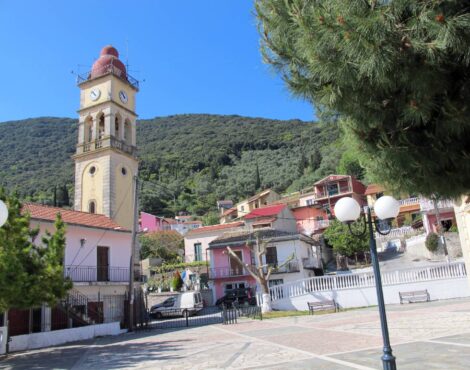
The cumulative effect of these buildings, arranged along the narrow streets of the village in the manner of a settlement that developed organically within the constraints of the hillside topography rather than being planned from above, is a streetscape of genuine architectural quality that rewards the slow walk and the attentive observation. The variety of detail within the consistency of the overall character, the way in which each building contributes its own specific interpretation of the Venetian domestic language while remaining recognisably part of the same architectural family, is the quality that distinguishes the finest historic villages from the merely picturesque, and Ano Korakiana achieves it with a completeness that few Corfiot villages can match.
The Churches: A Village of Devotion
The number of churches in Ano Korakiana is the most immediately striking fact about the village for the visitor who begins to count them as they move through the streets and discovers that the count extends well beyond the number that a settlement of this size might reasonably be expected to support. More than thirty churches and chapels within the village boundaries, ranging from the substantial parish church to the tiny family chapel tucked into a corner of a private courtyard, attest to the depth of the community’s Orthodox devotion and to the prosperity of the Venetian period that funded so much of the religious building.
The principal parish church of Ano Korakiana, dedicated to the Assumption of the Virgin and occupying the most prominent position in the village, is the largest and the most architecturally significant of the settlement’s religious buildings. Its interior, maintained with the care that the community has devoted to it through the centuries of its existence, contains icons of considerable age and quality alongside the liturgical objects and the devotional paintings that the Orthodox tradition accumulates in its parish churches through generations of donation and dedication.
The smaller churches and chapels scattered through the village streets are the most historically interesting of Ano Korakiana’s religious buildings for the visitor whose interest extends beyond the formally significant to the genuinely intimate. Many of these small churches retain their original dedication plaques and their family associations, the connection between a specific building and the aristocratic family that commissioned it sometimes traceable through four or five centuries of continuous association between the church and the descendants of its original patrons. These buildings are not museums. They are active places of worship that the village continues to use for the feast days and the family occasions that the Orthodox calendar and the life of a community provide throughout the year.
The Musical Tradition
Ano Korakiana’s musical tradition is one of the distinctive cultural features of the village that connects it to the broader Corfiot musical heritage while expressing something specific to the community itself. The village has maintained a philharmonic band that participates in the Easter processions and the village feast days with the formal musical tradition that the Venetian period introduced to the island and that the Corfiot communities have maintained with remarkable consistency through the subsequent centuries.
The musical culture of Ano Korakiana, like that of the broader Corfiot tradition, reflects the Western European inheritance of the Venetian period: formally notated, harmonically organised, performed by trained musicians reading from scores in the manner of the bands that the Republic introduced to the island as part of the cultural infrastructure of its administration. The sound of the Ano Korakiana band in the village streets during the Easter processions or the feast day celebrations is the sound of this tradition in its most local and most directly communal expression, the music performed for the village rather than for a tourist audience and carrying the authenticity of a cultural practice that the community has maintained because it genuinely values it rather than because it has any external reason to do so.
Walking Through Ano Korakiana
The finest way to experience Ano Korakiana is on foot, the car left at the village edge and the exploration conducted at the pace that the streets and the buildings and the occasional view through an open gate into a private courtyard invite. The streets of the village are too narrow for vehicles and sometimes too narrow for two people to pass comfortably, and the scale of the lane network, calibrated to the pedestrian and the mule rather than the motor vehicle, is preserved in September and October in conditions of relative quiet that allow the walking to proceed at the speed that observation requires.
The upper streets of the village, climbing toward the highest point of the settlement with the views across the olive country and down to the sea expanding with each successive level, are the most architecturally rewarding section of Ano Korakiana and the section that most directly reveals the quality of the Venetian domestic architecture in its finest local expression. The facades of the upper village buildings, many of them in a state of preservation that reflects the care of families who have maintained these properties through generations of continuous occupation, present the full vocabulary of the Corfiot Venetian house: the proportion of the openings, the treatment of the surrounds, the occasional carved detail above a doorway that marks the house of a family of particular social distinction.
The September or October afternoon in Ano Korakiana, with the low angle of the early autumn sun falling across the Venetian facades from the southwest and warming the stone to the amber gold that this light specifically produces, is one of the most complete and most visually extraordinary experiences available in the island’s interior at any point in the season. The village, lit by the finest light of the year in conditions of genuine quiet, is the Corfiot architectural heritage in its most intimate and most personally available form.
Ano Korakiana and Kapella Apartments
For guests at Kapella Apartments, Ano Korakiana is the interior village destination that most completely rewards the drive through the olive country and the short walk through the streets that the visit requires. The combination of the architectural quality of the village, the authenticity of its community character, and the extraordinary light that September and October produce on its Venetian facades makes Ano Korakiana the village that guests most consistently return from with the specific intention to come again and to spend longer than the afternoon visit allowed.
A morning at the Ano Korakiana kafeneion, drinking coffee in the village square in the company of the village’s own population rather than a tourist crowd, followed by a slow walk through the upper streets in the September or October light and a lunch at the village taverna that serves the food of the Corfiot interior with the directness and the quality of a kitchen cooking for its community: this is the Ano Korakiana visit at its most complete, and it is one of the finest half-day programmes available to the Kapella Apartments guest in the hidden season months that deliver the interior villages of Corfu at their most naturally and most completely themselves.