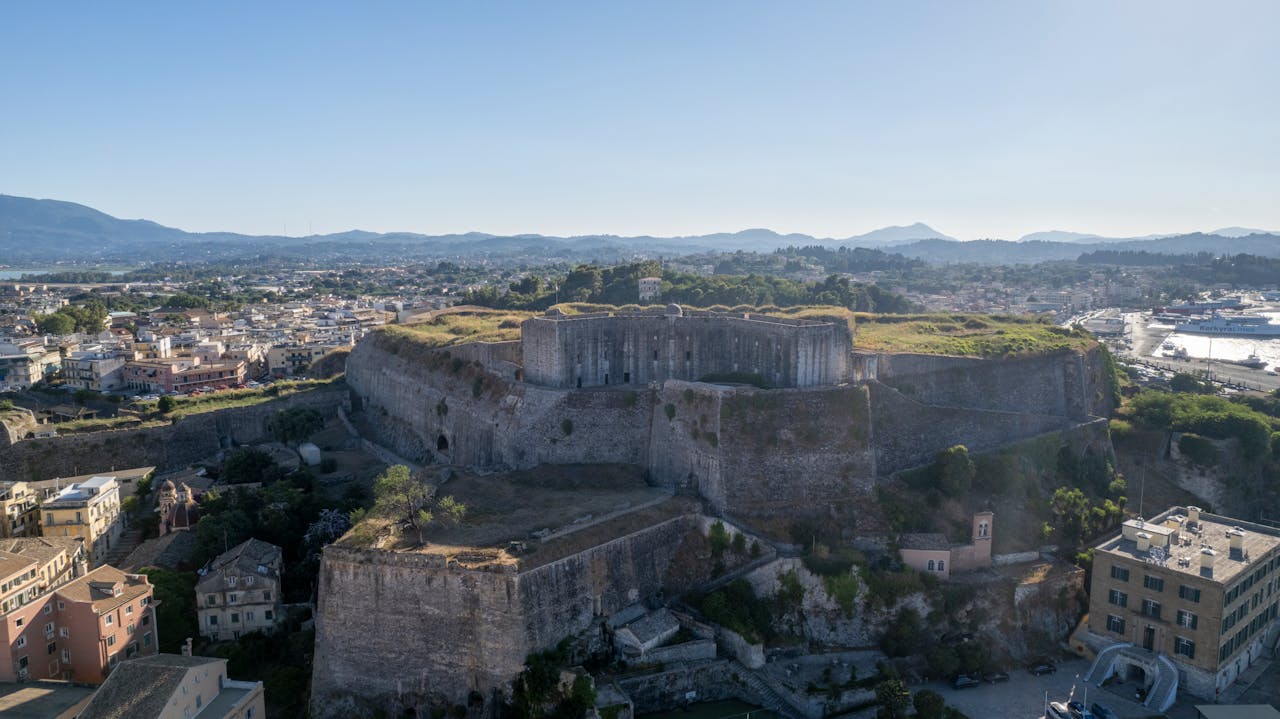
Corfu Town has two fortresses, and most visitors spend most of their time at the wrong one. The Old Fortress, dramatic on its rocky promontory above the Spianada, is the more immediately photogenic and the more obviously positioned for the tourist gaze. The New Fortress, rising on the San Marco hill above the western edge of the old town, is the more architecturally sophisticated, the more historically complex, and the more rewarding for the visitor willing to climb its bastions and engage with what the Venetian engineers achieved here in the second half of the sixteenth century.
The New Fortress is not new in any sense that the word normally implies. It has been standing on its hill above Corfu Town for nearly four and a half centuries, its limestone walls and bastions as much a part of the town’s permanent fabric as the Liston or the campanile of St Spyridon. The name distinguishes it from the Old Fortress that preceded it, and the distinction is architectural as much as temporal: the New Fortress represents a generation of military engineering that had absorbed the lessons of gunpowder warfare in a way that the older fortification, however many times modified, could not entirely reflect.
The Context of Construction
The New Fortress was built between 1576 and 1645, in response to a strategic situation that had become increasingly threatening to Venetian possessions in the eastern Mediterranean. The Ottoman Empire, at the height of its military power during this period, had demonstrated both the will and the capacity to attack Venetian island territories, and the defences of Corfu, which the Republic regarded as among its most strategically critical possessions, were in need of comprehensive modernisation.
The existing fortifications, concentrated in the Old Fortress on its eastern promontory, provided excellent defence against seaborne attack from the east and south but left the western and northern approaches to the town inadequately covered. The high ground of San Marco hill, overlooking the harbour and the western approaches to the town, was the obvious position for a complementary fortification, and the Venetian Senate authorised its construction with the urgency that the strategic situation demanded.
The engineers who designed the New Fortress were working within the tradition of the trace italienne, the system of angular bastions and low walls that had emerged in response to the development of artillery warfare and that had replaced the high vertical walls of medieval fortification across Europe during the course of the sixteenth century. The New Fortress is one of the finest examples of this system of fortification in the Greek world, its geometry of bastions and ravelins and curtain walls reflecting the state of military architectural knowledge at the time of its construction.
The Architecture of Defence
Approaching the New Fortress from the town below, the first impression is of mass: the walls rising from the rock of the hill with a solidity and a scale that conveys the seriousness of the military purpose they served. The stone is the same warm golden limestone that characterises the rest of Corfu Town’s architecture, quarried from the island and shaped by Venetian-employed craftsmen into the complex geometry that the fortification system required.
The main gate, facing the town on the eastern side of the fortress, is the most architecturally refined element of the exterior. The gateway passage, designed to funnel any attacking force into a controlled space where it could be engaged from multiple positions simultaneously, carries the carved inscription that records the date of construction and the authority under which it was built, the standard Venetian practice of marking their major works with both the date and the name of the responsible official.
The interior of the fortress, entered through the main gate, reveals the complexity of the structure that the exterior walls conceal. The space within the bastions is divided into a series of levels connected by ramps and staircases, each level serving a different defensive function. The lower levels contain the cisterns and storerooms that would have sustained a garrison through an extended siege, their vaulted ceilings and carefully engineered drainage systems reflecting the practical intelligence that Venetian military engineering brought to the problem of maintaining a fortified position under conditions of blockade.
The Underground Passages
Among the most remarkable features of the New Fortress are the underground passages that extend through the hill beneath the surface works. These passages, cut through the living rock and lined with the same limestone masonry that appears above ground, connected the various elements of the defensive system and allowed the movement of men and supplies within the fortress without exposure to enemy fire.
Exploring the underground passages of the New Fortress is one of the most atmospheric experiences available at any fortification site in Greece. The passages are cool even in the warmest June weather, their stone walls carrying the particular dampness of underground spaces that have been sealed from the outside world for extended periods, and the darkness beyond the reach of the available light gives them a quality of spatial mystery that the open bastions above do not produce.
The cisterns that are connected to the passage system are among the finest surviving examples of Venetian water engineering in the Ionian islands. The largest of them, capable of storing sufficient water for a garrison of several hundred men over an extended period, demonstrates the care with which the fortress designers addressed the logistical realities of a fortified position that might need to function independently of the surrounding town for months at a time.
The Bastions and the Views
The upper bastions of the New Fortress provide the reward for the climb through the interior levels. The position on the San Marco hill places the upper works above the surrounding town at an elevation sufficient to provide views that extend in every direction with a completeness that the Old Fortress, lower and more enclosed by the surrounding topography, cannot match.
To the west, the view extends across the harbour and the Ionian Sea to the horizon. On a clear June day, the outline of the Italian coast is occasionally visible in the far distance, a reminder that the Adriatic is narrow at its southern end and that the water between Corfu and Italy was, for the Venetians who built this fortress, a highway rather than a barrier. To the north, the Albanian coast and the mountains behind it provide the dramatic backdrop that the northeast corner of the view delivers.
Downward and to the east, the view across the rooftops of the Old Town is one of the finest urban panoramas in Corfu. The campanile of St Spyridon, the dome of the Catholic cathedral, the roofscape of the Campiello quarter, and the Spianada with the Old Fortress beyond it are all visible simultaneously from the upper bastions, and the relationship between the different elements of the town’s historical geography becomes clear from this elevated perspective in a way that ground-level exploration only partially achieves.
The Lion of St Mark
Several carved reliefs of the winged lion of St Mark, the symbol of the Venetian Republic that marked every significant work of the administration throughout its maritime empire, survive on the walls and gate structures of the New Fortress. These reliefs, some damaged and some relatively well preserved, are among the most direct physical expressions of Venetian authority remaining in Corfu Town and carry a historical weight that their modest size does not diminish.
The lion of St Mark on the main gate of the New Fortress is the most prominent of these reliefs, positioned to be visible to anyone approaching the fortress entrance and intended to communicate, with the directness of a symbol understood throughout the Mediterranean world, that this fortification was built by and belonged to the power of Venice. The wear that centuries of weather have inflicted on the relief adds rather than detracts from its significance: the erosion is itself a form of history, the accumulated evidence of the time that has passed since the Republic placed its mark on this hill above Corfu Town.
Visiting in June
The New Fortress is open to visitors throughout the season and in June offers the combination of full accessibility and comfortable visiting conditions that the peak summer months make more complicated. The climb through the interior levels and to the upper bastions is manageable in June’s warm but not yet intense heat, and the views from the top, in the clear visibility that the pre-summer atmosphere provides, are at their most extensive.
The combination of the New Fortress with the Old Fortress in a single day of Corfu Town exploration provides the most complete understanding available of the Venetian defensive system that protected the island’s capital for four centuries. For guests at Villa Kapella spending a day in Corfu Town, the New Fortress is the destination that most consistently rewards the visitor who goes beyond the obvious and discovers that the less celebrated half of the town’s Venetian military heritage is, in architectural and historical terms, the more sophisticated and the more rewarding of the two.